The amnesia of a nation: How Kenya forgets its dead and crowns its tormentors
 The Mt Kenya Times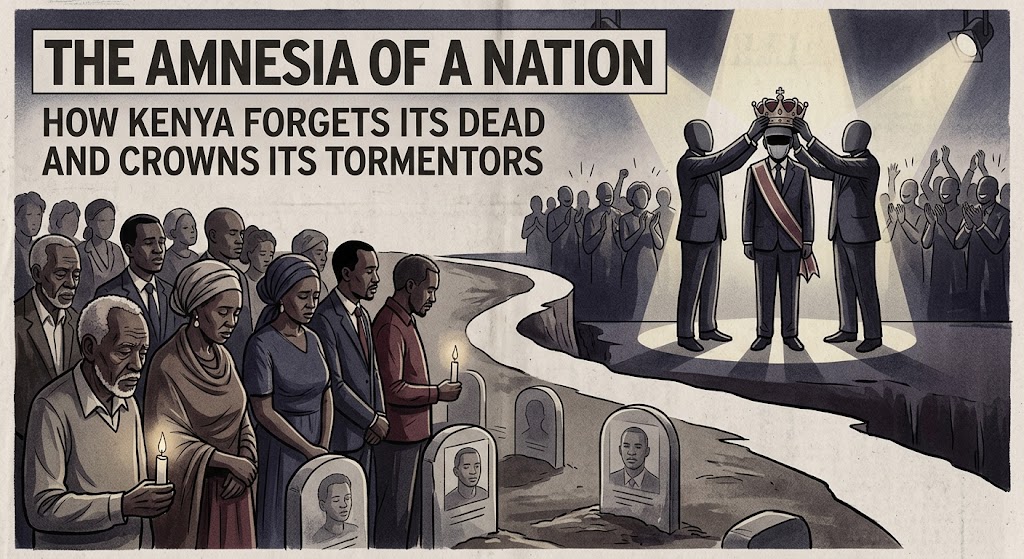
By Jerameel Kevins Owuor Odhiambo
In the summer of 2024, more than fifty young Kenyans students, hustlers, dreamers were shot dead or beaten into eternity by security forces while protesting a tax bill that sought to squeeze the last drop of blood from an already anaemic public. Human rights monitors documented dozens more abductions, some of the victims still missing, others returned broken or never returned at all. These are not rumours whispered in the dark. They are the cold arithmetic of state violence under William Ruto’s administration: live bullets against unarmed citizens, unmarked vans, and a presidential shrug that treated the body count as collateral noise.
That arithmetic has not changed. What has changed is the national capacity to remember it.
Kenya suffers from a peculiar, almost theatrical form of amnesia. It is not the gentle forgetting of age. It is a selective, self-inflicted erasure that allows the same man once branded the devil incarnate by large sections of the Luo nation and the urban youth to be rebranded, within months, as a legitimate partner in a “broad-based” government. The same Ruto who forced the Housing Levy down the throats of salaried workers 1.5 per cent deducted from every payslip, matched by employers, pouring over 200 billion shillings into a fund whose houses remain largely theoretical now sits at tables with former adversaries who once called him a predator. The same administration that hiked NSSF contributions, further shrinking disposable incomes already ravaged by food and fuel inflation, now enjoys the political cover of opposition figures who once vowed to resist such predation. The same government accused of reckless public spending and opaque procurement still lectures the nation on fiscal discipline.
This is not pragmatism. It is political alchemy performed on a population that refuses to hold a consistent memory.
History in Kenya is a carousel of elite handshakes. After the 2007–2008 post-election violence, Kibaki and Raila discovered the virtues of power-sharing. After 2017, Uhuru and Raila discovered the same virtues. Each time the people paid in blood or in lost years of accountability; each time the elite emerged richer and more secure. Ruto’s 2024 manoeuvre is the latest turn of that carousel. Facing the first genuine generational revolt in decades the Gen Z protests that nearly toppled the legitimacy of his government he reached for the oldest trick in the Kenyan political playbook: absorb the opposition, dilute the anger, declare unity, and continue. The “broad-based” government is not a concession to the people. It is a bread-based government: an arrangement in which the loaves of power are shared among the same political class while the public is left to fight over crumbs.
The intellectual insult is almost as severe as the material one. Ruto once thundered against the judiciary when rulings inconvenienced him, questioning the legitimacy of courts without offering evidence beyond political irritation. He has governed as though the Constitution were a set of suggestions rather than the supreme law. Yet the same man is now presented, by some of his former fiercest critics, as a stabilizing force. What alchemy turns a man who failed to live by the edifice of the Constitution into a saint? Only the short memory of a people who prefer the comfort of ethnic arithmetic and the theatre of elite reconciliation over the harder discipline of principle.
Consider the Luo support that once treated Ruto as the embodiment of everything to be resisted. In the run-up to 2022, the language was apocalyptic. He was the devil, the hustler who would devour the nation. Two years and a few cabinet positions later, sections of that same constituency appear ready to swallow the narrative of partnership. This is not evolution. It is the triumph of transactional politics over historical conscience. The dead of June and July 2024 do not get to renegotiate their fate. The families of the disappeared do not receive political appointments. The workers whose payslips are lighter because of the Housing Levy and swollen NSSF deductions do not sit in the new cabinet. Only the living elite do.
There is a deeper, more corrosive insight here. Kenyan public life has trained itself to treat outrage as a temporary emotion rather than a sustained ethical posture. We rise when the pain is immediate when the bullet is still warm, when the tax is newly announced then settle into the familiar grooves of tribal calculation and elite accommodation. The result is a democracy that can generate spectacular moments of resistance and then systematically disarm itself. The protests of 2024 proved that a generation could organise without the old ethnic brokers. The aftermath proved that the old ethnic brokers still know how to close the deal once the cameras leave.
Data does not lie even when memory does. Official inflation figures may have moderated from the peaks of 2022, yet the lived cost of living fuel, food, transport, housing remains a daily assault on household budgets. Real wages have barely recovered the ground lost in previous years. Meanwhile, the machinery of extraction continues: statutory deductions that function as stealth taxes, procurement processes that invite suspicion, and a security apparatus that has shown itself willing to disappear citizens when dissent grows inconvenient. Human Rights Watch and the Kenya National Commission on Human Rights documented the pattern. The state responded with denial, deflection, and, eventually, the political absorption of its critics.
What makes this amnesia particularly dangerous is that it is not passive. It is actively cultivated. Every handshake, every broad-based announcement, every claim that “we must move forward” is an invitation to forget. Forgetting is not healing. It is the precondition for repetition. The same methods that produced the body count of 2024 will be available again when the next fiscal squeeze arrives or the next generation of protesters refuses to be managed. The same elite compact that now claims legitimacy will once more demand silence in the name of stability.
The question, then, is not merely why Ruto has been allowed to rehabilitate himself. The deeper question is why a people with such a vivid recent history of state violence choose, again and again, the soft comfort of forgetting. Being Kenyan has become a comedy sport only because the audience keeps laughing at the same jokes and clapping for the same performers. The script never changes; only the costumes do.
This cannot continue without consequence. Citizens must refuse the sedative of elite reconciliation. Civil society must keep the names of the dead and the disappeared in public view, not as seasonal activism but as permanent moral inventory. The judiciary must resist the political pressure that has historically bent it toward convenience. Opposition figures who enter government must be judged not by the titles they receive but by whether they use those titles to constrain the very excesses they once denounced. And the youth who faced live fire in 2024 must refuse the soft amnesia that turns their sacrifice into a footnote.
Nations are not destroyed only by tyrants. They are destroyed by the gradual acceptance that memory is optional. Kenya has paid enough blood and enough dignity for that particular luxury. The dead of 2024 are not symbols. They are citizens who expected their government to protect rather than hunt them. Their silence is not consent. It is an indictment. And the longer the living choose not to hear it, the more certain it becomes that the next generation will be asked to pay the same price, again, for the same failure of memory.
The writer is a social commentator
Similar Posts by The Mt Kenya Times:
- Mt Kenya Times ePAPER October 7, 2026
- Ruto signs KSh389B electric vehicle deal at State House
- Kenya mobilises KSh70B to fight Ebola as US and World Bank step in
- High Court freezes law school admissions over disputed entry rules
- Grade 11 textbooks head to schools as CBC transition gathers pace
About the Author