
Muzamal Afzal
| Name: | Muzamal Afzal |
| Course: | Modern Novel |
| Submitted To: | Muzamal Afzal |
Review of the novel Twilight in Delhi by Ahmed Ali.
Twilight in Delhi by Ahmed Ali was published in 1940, is one of the most important works in Indian literature in English by Ahmed Ali. It is a crystal clear example of challenging the patriarchal system. It is not only a tale of a family; it is a touching ‘elegy’ for a vanishing culture. The novel takes place in early 20th century Delhi, which slowly and painfully moves from being the capital of the majestic Mughal Empire to a colonised part of the British Raj.
The word “Twilight” is very symbolic. It stood at the threshold of day and night, the days when the Sun of the Mughal-Muslim empire was fading and the darkness of colonial dispossession was slowly coming in. It is set around 1911 the year of the Delhi Durbar, when King George V was proclaimed Emperor of India. For the people of Delhi, this historical moment is a reminder of the pain in their city that their city is not theirs anymore, it’s physically and culturally re-configured to serve the British Crown.
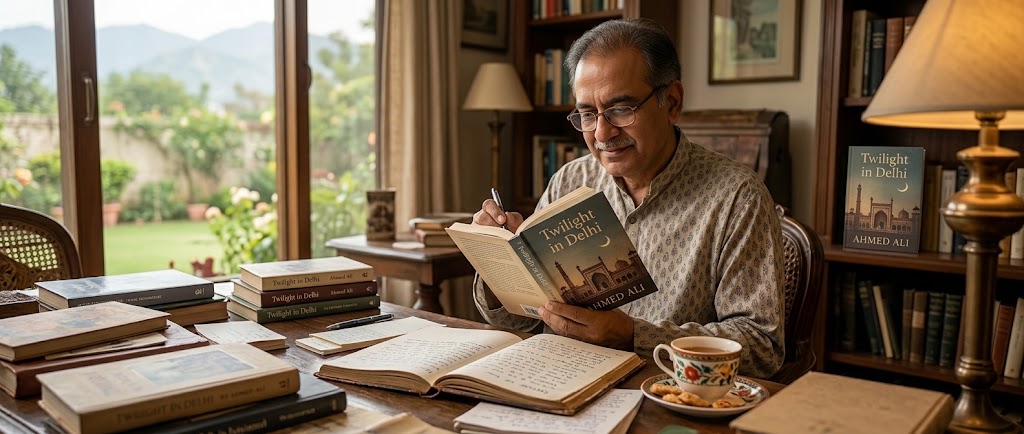 Surely, One of Ahmed Ali’s greatest achievements is his portrayal of Delhi. It’s not a setting, it’s a living, dying place. Ali’s description of the narrow streets, the heat of the summer, the scent of jasmine and the muezzin’s call is so much more sensory that the reader can feel the pulse of the city.
Perhaps, the physical decay of the city is seen through Mir Nihal’s eyes. The British razed historic neighbourhoods to create broad unappealing streets and colonial structures. It is cultural violence that is shown as this “urban renewal”. The old buildings are crumbling and so are the people’s spirits. Its ruins mirror the ruins of the inhabitants of the city.
However, the main character of the novel is Decay. A decay is seen at three levels:
Physical: Literal destruction of homes, ageing of Mir Nihal’s body.
Social: Disintegration of communal life, decline of the mushara (poems) and the disappearance of pastimes such as pigeon flying.
Political – British rule and the loss of Mughal sovereignty.
In addition to it, every page is also suffused with nostalgia. In a world of great promise that has been lost forever, the characters live their lives. Mir Nihal’s obsession with his pigeons is an attempt to keep his freedom and his sense of control in some other sphere, namely in politics. He kills his pigeons, and it is a sign of predation of time and the colonial force that eats the fragile remains of his world.
Ahmed Ali’s use of strong imagery to create the emotional impact:
By coming forward, Pigeons are the symbol of the old world’s soul, free, graceful, yet extremely helpless.
The Heat and Dust: Oppressive summer heat symbolizes the stifling pressure of colonialism and the lack of progress for a people caught in a culture that has been unable to progress.
Toward the end of the novel, Mir Nihal ends up with a stroke, and is paralyzed. A great metaphor for the old order, it is alive, but cannot move, or affect the world around it. It can only stand idly by and witness the new world.
Eventually, though written in English, the novel’s “soul” is Urdu. The English literature has been deliberately adorned with the rhythms, metaphors and idioms of Urdu and Persian poetry by Ahmed Ali. He often borrows the words of the masters such as Ghalib and Mir Taqi Mir and translates them to capture the characters’ deep sadness. The result is a special language quality or “Dastangoi” (storytelling) which celebrates the same culture that the novel is supposedly preserving.
Furthermore, the novel focuses on the Zenana (women’s quarters), while the public aspect is covered by Mir Nihal. Ali through Begum Nihal and Bilqeece deals with the voicelessness and hidden silent suffering of women. They live only within the four walls of the house, get involved in the domestic problems and see the emotional consequences of decisions made by the men. Their “twilight” is perhaps even darker, as they are doubly marginalized, colonized and patriarchal.
To sum up the debate, the book concludes in a hopeless manner. In his bed, Mir Nihal watches himself grow old. The British have remodeled Delhi, with the young generation moving on and unaware of the treasures that have preceded them.
It is a must read book on twilight in Delhi as it helps to preserve the memory of a culture that was systematically erased. It’s a lesson that when a civilization collapses, it’s not just their power that goes.“ It’s teaching us that when a civilization collapses, it’s losing its language, its poetry, its identity.” In Ahmed Ali’s haunting, beautiful and moving picture of a once vibrant world, it is now but a ghost in the alleys of history.
Summary
Twilight in Delhi by Ahmed Ali is a depiction of the gradual process of the decline of the traditional Muslim aristocracy in Delhi during the early 20th century under the British colonial rule. The story is about the relics of the Mughals dynasty, their father Mir Nihal, who finds comfort in hobbies such as pigeon flying, as the British are physically and culturally changing his city. When his son, Asghar, insists on marrying for love and his Westernized traits, a generational divide becomes apparent. Eventually, a series of misfortunes unfold: the death of Mir Nihal’s mistress, the slaughter of his beloved pigeons, etc., mirroring the more than millennial decline of a civilization. The sadistic nature of marriage between Asghar and Bilqeece is further emphasized with the eventual souring of their relationship and Bilqeece’s early demise. In the end, Mir Nihal has a stroke, which is a metaphor for the political and social helplessness of the old order. The book ends with his “twilight” when he is helplessly waiting to see the last of his legacy vanish into an obscure and shadowy future. This moving account is a snapshot of an old world that is not only altering, but also quietly vanishing.
Similar Posts by The Mt Kenya Times:
- Mt Kenya Times ePAPER September 14, 2026
- Diaspora Times Global Sep 12 – Sep 18, 2026
- When political words become weapons: Kenya must lower the temperature before it is too late
- Kenya’s youth are not asking for handouts — they are asking for opportunities
- Samchi Group CEO Muchemi named Africa’s most influential leader
About the Author