From Moscow with ambition: Ruto bets on Russia to rewrite Kenya’s economic story before 2027
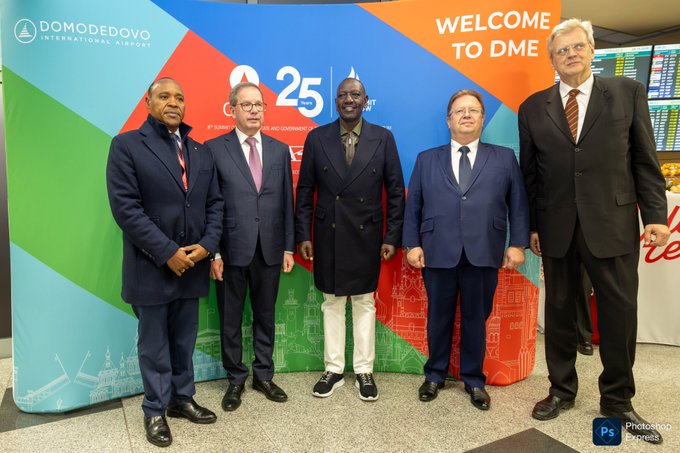
President William Ruto (centre) received by Russian officials when he arrived for the Third Russia–Africa Economic and Humanitarian Forum on October 28, 2026. Photo: PCS
With an election looming and an economy under pressure, the president’s pitch to Russian investors carries as much domestic calculation as diplomatic vision
By David Kimani
President William Ruto stood before Russian investors in Moscow yesterday and made a case that was as much about Kenya’s future as it was about his own — pitching a new economic partnership with Russia while an election at home, now less than a year away, waits with unforgiving patience.
The setting was the Russia-Kenya Business Roundtable in the Russian capital, and the message Ruto carried was deliberate and pointed. Kenya, he told the assembled investors, was no longer interested in the extractive logic that has defined Africa’s engagement with the global economy for generations — the endless cycle of exporting raw materials cheaply and importing finished goods expensively, with the wealth, the factories and the jobs created somewhere else entirely. That era, he said, was over. What Kenya wanted now was different: genuine partnership, shared prosperity and mutual respect between sovereign equals.
“We seek partnerships founded on sovereign equality, mutual respect, and shared prosperity,” Ruto said. “Not relationships of dependency, but partnerships of mutual benefit.”
It is a compelling line, and not an accidental one. The language of sovereign equality and mutual benefit has particular resonance across Africa right now, where a growing number of governments are reassessing long-standing relationships with Western powers and quietly opening doors to alternative partners. Russia, China and the Gulf states have been swift to walk through those doors. Ruto’s Moscow visit — his pitch framed not as supplication but as opportunity — fits neatly into that evolving continental mood.
The economic case he presented was built on candid numbers. Bilateral trade between Kenya and Russia stood at $380 million in 2025, a figure that sounds substantial until the detail is examined. Kenya exported $52 million worth of goods — tea, coffee, flowers, fruits and vegetables — while importing $330 million in wheat, fertilisers, iron and steel. Russian investment in Kenya, meanwhile, was estimated at just $22 million. The trade balance is lopsided, the investment footprint is modest, and Ruto did not shy away from saying so. “These figures challenge us to rethink the nature of our partnership,” he told the gathering.
His ask was specific. He called on Russian enterprises to invest in local manufacturing, agricultural processing and mineral beneficiation — to build production facilities in Kenya, partner with Kenyan firms and use the country as a base for regional and continental expansion. “Invest in Kenya, manufacture in Kenya, and serve Africa and the world from Kenya,” he said. Russia’s expertise in energy, mining, fertiliser production, engineering, transport and manufacturing, he argued, aligned precisely with Kenya’s industrialisation priorities.
“This is the partnership we invite Russian investors to build,” Ruto said. “One that combines Russian capital, technology and industrial expertise with Kenya’s resources, talent, and access to African markets. A partnership in which both countries contribute, both benefit and both prosper.”
The vision is sound. The harder question — one that Moscow’s boardrooms will ask even if Nairobi’s political audience does not — is whether Kenya can deliver the conditions that serious industrial investment requires: reliable infrastructure, legal certainty, a stable regulatory environment and protection from the kind of policy reversals that have unsettled investors in the past. A country preparing for a contested general election is not always the most reassuring environment for long-term capital commitments.
And the election is the context that shapes everything. Kenya votes in August 2027, and the political temperature at home is already rising sharply. Ruto faces a fractured political landscape, a restless population and an opposition that, despite its own internal tensions, is consolidating with purposeful energy. Jubilee’s Fred Matiang’i is building an inter-party coalition committee under the Ukombozi Alliance banner. Azimio la Umoja remains a reference point for opposition cooperation. The emerging contest will be fought on the cost of living, unemployment, public debt and the basic question of whether ordinary Kenyans feel better or worse off than they did five years ago.
Against that backdrop, the Moscow visit is not merely diplomatic housekeeping. It is economic storytelling — a president demonstrating to his electorate that he is pursuing growth from every available direction, that he will not be constrained by old allegiances or conventional frameworks, and that Kenya’s place in the world is being actively renegotiated on terms favourable to Kenyans. Whether Russian investors materialise in meaningful numbers before August 2027 is almost secondary to the narrative being constructed right now.
Ruto was careful to set the terms by which success should be judged. Agreements on paper, he said, are not the measure. “The success of this partnership should be measured by projects completed, industries established and jobs created,” he told the roundtable. It is the right benchmark — and one that his opponents will hold him to with considerable enthusiasm when campaigning begins in earnest.
The broader picture Ruto painted in Moscow is one that resonates beyond Kenya’s borders. Africa’s determination to move up the value chain — to stop being the world’s quarry and start being one of its workshops — is one of the most significant economic and political shifts of this decade. Kenya, with its relative stability, its educated workforce, its regional connectivity and its ambitions as an East African hub, has genuine credentials to make that case. The question is execution.
For Ruto, the political calculus is acute. Voters facing high food prices, expensive fuel and scarce formal employment will not be moved by speeches in Moscow, however polished. They will want factories, jobs and lower cost of living. If the partnerships announced in the Russian capital translate into visible economic activity before next August, they strengthen his re-election argument considerably. If they remain at the level of MoUs and roundtable rhetoric, his opponents will use them as evidence of a presidency long on promises and short on delivery.
The road from Moscow to State House runs through the lives of ordinary Kenyans. That is the only partnership that will matter when August arrives.
Similar Posts by The Mt Kenya Times:
- Mt Kenya Times ePAPER October 29, 2026
- Ruto courts Moscow as Africa’s big powers rewrite the rules of engagement
- The running-mate puzzle: Who blinks first?
- Jubilee’s coalition gambit: The opposition clock is ticking towards 2027
- Kenya’s 2027 election: Will political alliances and the fight over transparency decide who wins State House?
About the Author