The Mt Kenya Times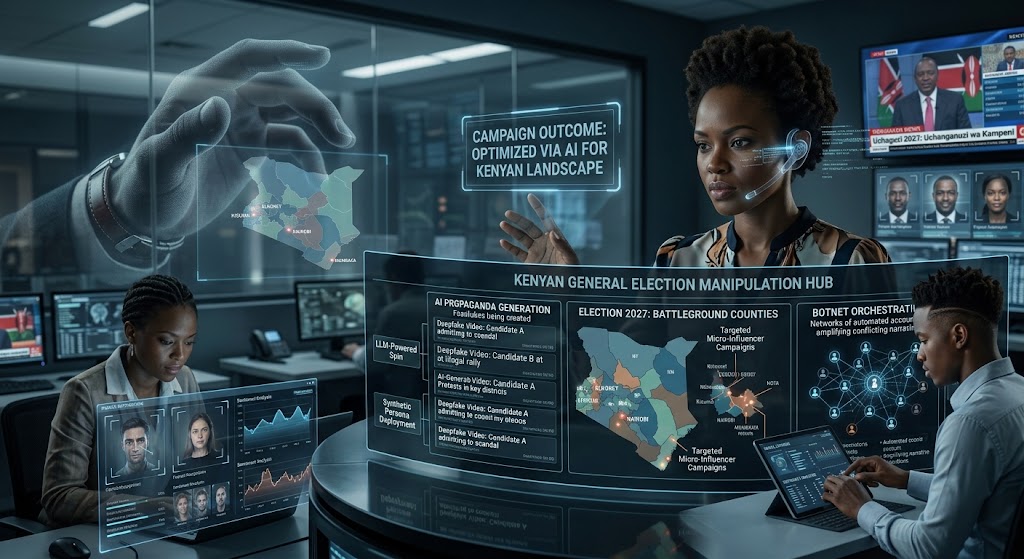
How artificial intelligence is reshaping political manipulation ahead of the next general election
By Dennis Wendo
Kenya’s next major political battle may not begin at a rally, in Parliament or even at the ballot box. It may begin on a mobile phone.
A fabricated video. An artificial voice appearing to belong to a political leader. A photograph showing an event that never happened. A false statement attributed to a public figure. Or hundreds of apparently ordinary social media accounts repeating the same political message without disclosing that the content was generated and coordinated using artificial intelligence.
This is no longer a distant possibility.
Anthropic’s recent disclosure that it disrupted a Kenyan political influence operation — in which AI was reportedly used to generate large volumes of political content — should serve as a wake-up call. The operation reportedly promoted government narratives while attacking opposition figures, demonstrating how AI can now be deployed not only to create false content but to manufacture the appearance of spontaneous public opinion.
That development should force Kenya to rethink what it means by misinformation, disinformation and information warfare.
The danger is no longer simply that false information travels quickly. Technology can now help manufacture, personalise and distribute political narratives at a scale that would previously have required a large human operation.
Perhaps even more troubling is the ability to manufacture the appearance of public consensus. If hundreds or thousands of apparently independent accounts repeat similar political messages, an ordinary citizen may conclude that a particular view is genuinely widespread. Yet behind those voices could be a coordinated operation designed to create the illusion of grassroots support.
The weapon, therefore, is not simply false information. It is the manipulation of perception itself.
This comes at a particularly consequential moment for Kenya as the country moves towards the 2027 General Election.
Government Spokesperson Charles Owino warned yesterday that the spread of misinformation, disinformation and false information is becoming a serious threat, describing it as a time bomb and cautioning that Kenyans risk making important decisions on the basis of information that is neither factual nor properly verified.
That warning deserves serious attention.
But it also raises a larger question. If disinformation is becoming a threat to Kenya’s democracy, peace and security, who should be trusted to lead the response?
The answer cannot be government alone. Nor can it be left entirely to technology companies, political actors or the media.
Civil society must become a central pillar of Kenya’s information resilience architecture.
Civil society organisations are often closest to the communities where rumours first emerge. They understand local languages, social networks, grievances and community dynamics. They can identify early warning signals, verify information, educate citizens and help prevent harmful narratives from escalating into community tensions. Their greatest advantage is proximity and trust.
But there is an uncomfortable dimension to this discussion that must also be acknowledged.
Civil society is not automatically neutral.
Organisations can themselves become vulnerable to political interests, ideological agendas, ethnic mobilisation, donor influence or externally sponsored narratives. Competition for funding, visibility and political access can create incentives to communicate before information has been properly verified.
This raises an important question: who verifies the verifiers?
The answer should not be to silence civil society. Instead, civil society must hold itself to the same standards of transparency, independence and accountability that it demands from government, political actors and media organisations.
Every organisation involved in information integrity should be prepared to answer straightforward questions: Who funds us? Who influences us? What evidence supports what we are saying? Who scrutinises our work? And what happens when we are wrong?
These questions do not weaken civil society. They protect its credibility.
Kenya therefore needs to move from reactive fact-checking to a broader culture of information resilience.
That process should begin at community level. Civil society organisations, journalists, researchers and relevant public institutions should be connected through effective early warning mechanisms capable of identifying dangerous narratives before they harden into social tensions.
Independent verification capacity must also be strengthened — including fact-checking and public education in Kiswahili and other widely spoken local languages. Information resilience cannot depend exclusively on English-speaking audiences.
Digital and media literacy should become a permanent civic programme rather than something that surfaces only during election cycles. Citizens should be equipped to recognise manipulated photographs, fabricated accounts, misleading statistics, deepfakes, artificial voices and emotionally engineered narratives.
Technology companies must also accept greater responsibility for the information environments their platforms create. Greater transparency is needed around coordinated campaigns, AI-generated content and the systems that amplify political messages to millions of users.
But technology alone will not solve the problem.
Trust remains at the centre of the challenge.
A citizen who does not trust government may reject an official correction. A citizen who does not trust the media may dismiss a fact-check. A community that feels politically or economically excluded may be more receptive to narratives that confirm its grievances, even when those narratives are false.
This is why information warfare cannot be separated from the wider questions of governance, inequality, political inclusion and social cohesion.
The Horn of Africa offers important lessons. Across the region, contested narratives have interacted with political grievances, ethnic tensions, conflict and insecurity. Kenya cannot assume that its relatively stronger democratic institutions make it immune.
The country is also a major political, economic, diplomatic and humanitarian hub in the region. What happens within Kenya’s information environment can therefore have consequences well beyond its borders.
Disinformation does not stop at national boundaries, and neither should efforts to build resilience.
Kenya should work with regional partners to strengthen information integrity — particularly around emerging technologies, cross-border narratives, conflict-related misinformation and election-related manipulation.
There is, however, an equally important caution.
The fight against disinformation must never become a convenient cover for suppressing legitimate criticism, investigative journalism or political dissent.
Government should not label uncomfortable information as disinformation simply because it is critical. Opposition parties should not dismiss legitimate scrutiny as political persecution. Civil society should not present advocacy as independent verification. Media organisations should not sacrifice accuracy in pursuit of clicks and influence.
The same standards must apply to everyone.
If government is asking citizens and journalists to verify information, government itself must be prepared to meet the same standard. Political actors, civil society organisations, media houses and technology platforms must all be subject to scrutiny.
The objective is not to create a society where everyone believes the same thing. It is to create a society capable of distinguishing evidence from manipulation, disagreement from incitement and genuine public opinion from manufactured consensus.
This is where Kenya’s preparations for the 2027 General Election must expand beyond voter registration, polling stations and physical security.
The information environment in which citizens make their political choices must also be protected.
An election cannot be considered fully secure simply because votes are counted correctly. The quality of democracy is also shaped by whether citizens have access to credible information before they reach the ballot box.
Kenya needs to begin building that information resilience now.
Civil society can play a critical role through a simple but coordinated approach: monitor emerging narratives, verify information, respond rapidly to harmful falsehoods, build public resilience, connect communities and institutions, and demand accountability from every actor.
The coming political contest will test not only Kenya’s electoral institutions but also the resilience of its citizens.
Artificial intelligence has changed the scale, speed and sophistication of information manipulation. Kenya must respond with equal seriousness — without sacrificing the constitutional freedoms that make democracy meaningful.
The new battlefield may indeed be the phone in our hands.
The most dangerous message may not be the one that looks obviously false. It may be the one that looks like everyone already believes it.
Kenya does not need louder voices.
It needs more credible ones.
Similar Posts by The Mt Kenya Times:
- Mt Kenya Times ePAPER September 14, 2026
- Diaspora Times Global Sep 12 – Sep 18, 2026
- When political words become weapons: Kenya must lower the temperature before it is too late
- Kenya’s youth are not asking for handouts — they are asking for opportunities
- Review of the novel Twilight in Delhi by Ahmed Ali
About the Author