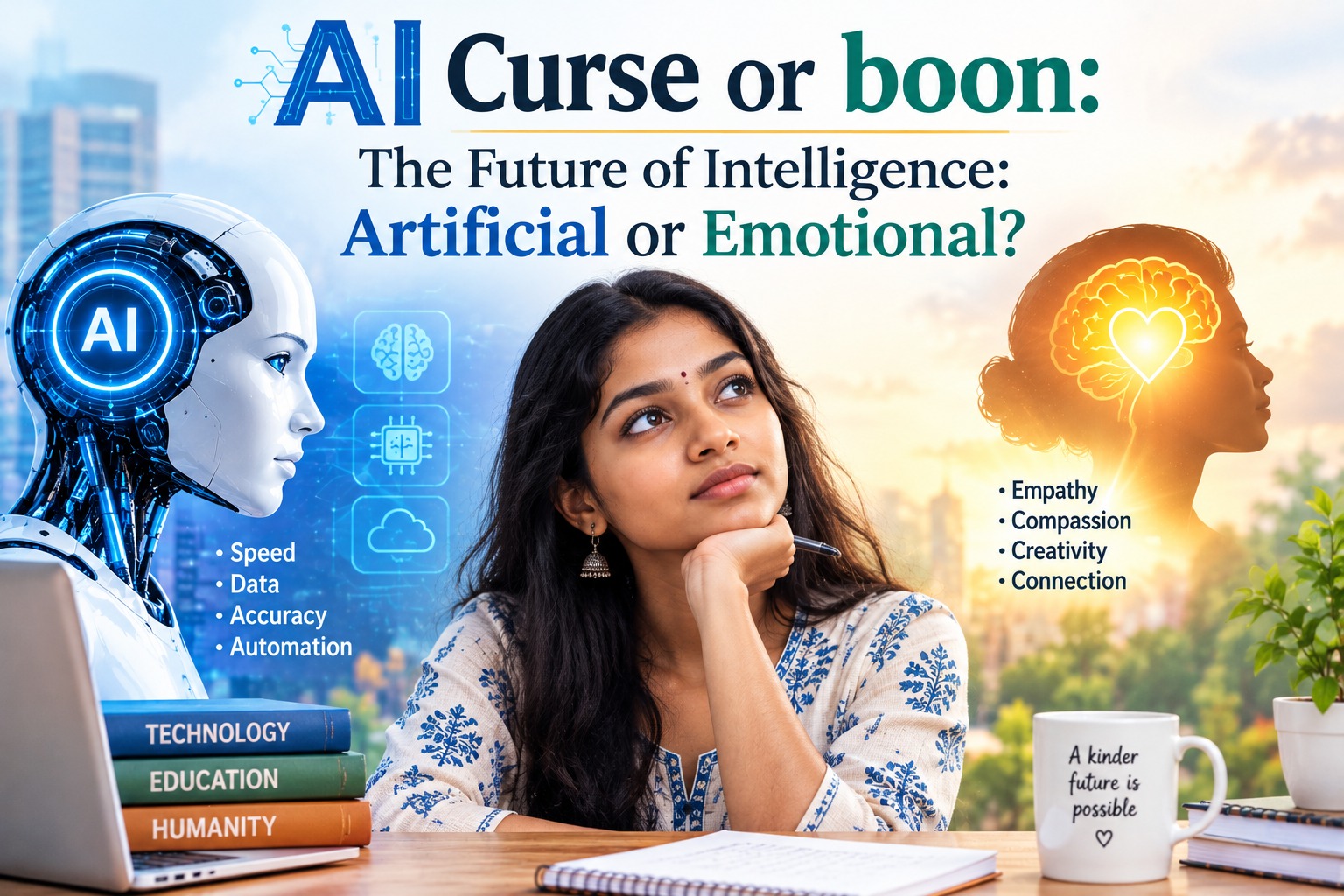
AI Curse or boon: The Future of Intelligence: Artificial or Emotional?

By Dr Sarita Bharadwaj
The Twenty-First century has changed the way we understand intelligence.
For a long time, people saw intelligence as a quality that belonged mainly to humans. The ability to think, remember, learn, communicate, and make decisions was seen as a special feature of the human mind.
Today, however, machines are performing many of these tasks with remarkable speed.
Artificial Intelligence has become a part of our everyday lives. It is present in our classrooms, workplaces, homes, and even in how we communicate with one another.
As technology continues to develop, an important question arises: What will intelligence mean in the future? Will we depend more on Artificial Intelligence, or will Emotional Intelligence remain one of the most important human qualities?
Artificial Intelligence, or AI, enables machines and computer systems to perform tasks that normally require human intelligence.
AI can process large amounts of information, recognise patterns, generate content, answer questions, and help solve complex problems. It can perform many tasks quickly and repeatedly without becoming tired or distracted. This has made AI useful in education, business, healthcare, communication, and many other areas of life. But human intelligence is not simply about collecting information or finding answers.
Human beings have emotions. We form relationships, experience happiness and sadness, face disappointment, develop attachments, and respond differently to different situations. This is where emotional intelligence matters.
Emotional Intelligence is our ability to understand our own emotions and recognise others’ feelings. It helps us control our reactions, communicate sensitively, handle difficult situations, and build meaningful relationships. Empathy, patience, self-awareness, and social understanding are important parts of emotional intelligence.
The difference between Artificial Intelligence and Emotional Intelligence becomes particularly clear in education. An AI system can explain a lesson repeatedly without getting impatient. It can correct a student’s grammar, prepare exercises, and provide immediate feedback.
It can even identify areas in which a learner needs more practice. But learning is not only about information.
A student may remain silent because of fear, lack of confidence, or personal problems. A teacher may notice a change in the student’s behaviour even before the student says anything. Instead of giving another exercise, the teacher may offer encouragement or listen.
That moment of understanding is difficult to measure through data.
The same is true in the workplace.
AI can prepare reports, analyse information, organise schedules, and perform repetitive tasks. It can save time and increase efficiency. However, a workplace is made up of people, and people have emotions. A good leader needs more than technical knowledge. A leader needs to understand employees, manage disagreements, encourage people during difficult periods, and communicate sensitive matters with care.
These situations require emotional understanding. A computer may provide information, but it cannot replace the value of human connection.
This does not mean Artificial Intelligence and Emotional Intelligence are enemies. They can work together. AI can help us deal with information, while Emotional Intelligence can help us decide how to use that information responsibly.
AI can suggest an answer, but a human must consider whether it is appropriate. Technology can make our work easier, but human judgement gives our actions meaning.
At the same time, our growing dependence on technology deserves some reflection. If machines begin to write everything for us, solve every problem, and make every decision, we may gradually stop using some of our own abilities.
Communication, creativity, independent thinking, empathy, and personal interaction need to remain part of our lives. Technology should make human beings more capable, not less human.
Perhaps the future will not be a competition between Artificial Intelligence and Emotional Intelligence. Instead, the future may require us to understand both strengths.
We may need AI for its speed, memory, and ability to process information. At the same time, we will still need human beings for compassion, understanding, ethical judgement, and relationships.
A machine can recognise that someone is sad, but a human can sit beside them and understand their silence. A machine can generate words of comfort, but a human can offer genuine compassion rooted in experience.
A machine can analyse thousands of conversations about love, friendship, and grief, but humans actually experience these emotions.
Therefore, we should not measure the future of intelligence only by how advanced our machines become. We should also measure it by how well we preserve the qualities that make us human. Artificial Intelligence may help us do things faster.
Emotional Intelligence helps us understand people better. The real challenge before us is not to choose one over the other.
It is to learn how to use technology without losing empathy, kindness, understanding, and human connection. Machines may become increasingly intelligent in the years ahead. But as we build smarter machines, we must also remain thoughtful, compassionate, and human.
Our writer, Dr Sarita Bhardwaj, has over a decade of experience in teaching and research in India. She is a proficient writer, contributing insightful articles to newspapers and academic forums. Committed to education, she mentors students, promotes critical thinking, supports innovative, interdisciplinary approaches to learning, and regularly engages in community outreach.
Edited by Shamlal Puri, Senior Editor in London.
Similar Posts by The Mt Kenya Times:
- Gachau bows out, but the passion stays
- Dr. Ekrah Ndung’u wins TVET advocacy award after 12 years
- Mt Kenya Times ePAPER October 17-18, 2026
- Ruto bets billions on Kerio Valley — with one eye on 2027
- Ruto’s health ministry kills Murang’a’s digital hospitals
About the Author