From Chuka to Embu, universities are producing developers and ideas — but talent alone will not build a technology hub
By Purity Benjamin
For years, Nairobi has been the undisputed centre of Kenya’s technology industry — the city where the major companies, investors, accelerators, innovation spaces and conferences converge. But away from the capital, a quieter and increasingly purposeful technology story is beginning to take shape.
Across the Mount Kenya region, universities are evolving beyond their traditional role as centres of academic instruction. Students are forming developer communities, competing in hackathons, building prototypes and launching startups, while institutions are carving out spaces for innovation and collaboration that did not exist a decade ago. The shift is gradual but it is real, and the people closest to it believe it is only beginning.
The broader environment supports the momentum. Kenya’s information and communication technology sector generated KSh701.3B in output in 2024, an 8.3 per cent increase on the previous year, while value added rose from KSh339.5B to KSh364.5B. Mobile subscriptions reached 71.4 million during the same period. By March 2025, that figure had climbed to 76.16 million, equivalent to a penetration rate of 145.3 per cent, with mobile-money subscriptions standing at 45.36 million. The government has also reported more than 40,000 kilometres of fibre-optic cable laid across the country, alongside continued investment in digital hubs and online services.
Technology growth, however, is no longer exclusively a Nairobi story.
Institutions such as Chuka University, Meru University of Science and Technology, Dedan Kimathi University of Technology, the University of Embu and Kirinyaga University are producing a growing and increasingly capable pool of graduates in computing, engineering and related disciplines. Government investment in economic infrastructure reinforces the picture. County Aggregation and Industrial Parks have been fast-tracked in Meru, Embu and Kirinyaga, with reported completion rates of 92, 83 and 81 per cent respectively.
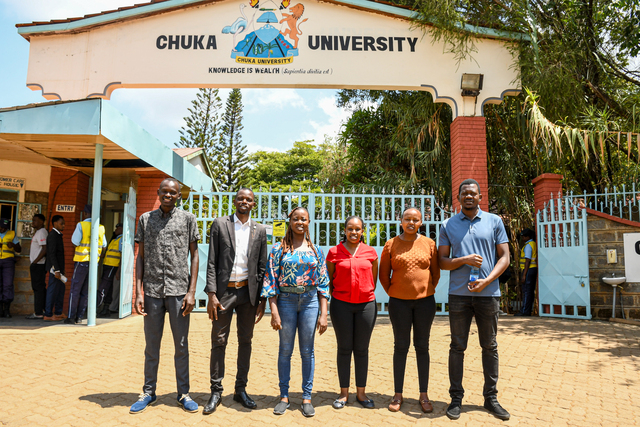
For Isaac Kahura, the Google Developer Groups lead at Chuka University, the change on campus is already visible. Over the past two to three years, he says, technology has increasingly bridged the gap between classroom theory and practical experience. Students are no longer waiting until graduation to understand what it means to build a product. Through developer communities, hackathons, workshops and technical events, they are experimenting with technologies and collaborating with peers — gaining exposure that academic qualifications alone cannot provide.
What is missing, Kahura argues, is structure. The region has a large population of young people with genuine technical skills who are already building and shipping products. The challenge is connecting them — to each other, to institutions and to the wider ecosystem. That gap is most visible in the movement of young developers who travel to Nairobi specifically to attend technology events, despite the fact that similar gatherings could be hosted closer to home. If communities across Mount Kenya coordinated their activities, the region could attract developers, entrepreneurs, mentors and companies to local events rather than continuously exporting its talent to the capital.

The benefit would extend well beyond convenience. Regular regional events could create networks that allow ideas to move between universities and give young innovators access to the people and resources needed to develop their work.
Deluxe Sande, who was active in the technology community before Kahura took over, identifies another critical gap: physical spaces where collaboration can be sustained. Sande believes Mount Kenya is capable of becoming a genuine technology hub, but says the region needs meaningful investment in co-working spaces where developers, entrepreneurs and innovators can gather, work and grow. Talent, he insists, is not the problem. The more pressing question is what happens to that talent after a competition or event ends.
Hackathons crystallise the challenge. Participants can develop compelling ideas in a matter of days, present them confidently and emerge as winners — yet the incubation that should follow often remains uncertain or entirely absent. Without structured mentorship, follow-up support and sufficient funding, a prototype can remain exactly that: a prototype.

The concern is not unique to Mount Kenya. Kenya remains one of Africa’s strongest technology markets, but access to startup capital is growing more competitive. Partech’s 2025 Africa Tech Venture Capital report placed Kenya first on the continent by total tech funding, with $1.04B raised — a 72 per cent increase on the previous year. Yet much of that capital was concentrated in a handful of large deals. Four megadeals alone accounted for approximately $610 million, or roughly 60 per cent of the country’s total funding. For young founders outside Nairobi, that concentration represents a structural disadvantage that geography only deepens.
Sande sees co-working spaces, incubation programmes and investment networks as the critical infrastructure needed to move Mount Kenya from producing ideas to producing sustainable companies.
Jimmy Kimunyi, a former GDG lead who helped organise technology activities in the university community, points to a related challenge: sustaining engagement after the event is over. A hackathon creates energy for a few days. Turning that energy into lasting momentum requires resources, mentorship and consistent community programming. The competition cannot be the destination — the ideas it generates need people who can guide founders through product development, business planning, fundraising and market entry. Mount Kenya, Kimunyi says, already has the talent. What it needs now is industry participation, structured partnerships and dependable support for local startups.
That need becomes particularly clear when you look at what event organisers actually contend with. Kahura describes the enthusiasm at Chuka University — the turnout, the hunger to learn — as evidence of genuine and substantial demand. But behind a successful event is an exhausting amount of administrative work: securing conference rooms, navigating institutional procedures and working through what he calls a complicated paper trail. That friction can test the patience of even committed organisers and slow down momentum that is hard enough to build in the first place.
Whether that persistence holds will largely determine whether Mount Kenya becomes a technology hub or remains a region of promising but disconnected pockets of talent.
The foundations are visible. Universities are producing graduates, students are participating in hackathons, developer communities are organising events, the government is investing in digital infrastructure and young people are building products. What is still missing is the ecosystem around them — the collaboration between universities, the mentorship from companies, the investment from beyond Nairobi and the structured support that turns competition winners into company founders.
The region does not need to become another Nairobi. It has the opportunity to build something different: a connected network of universities, developers, entrepreneurs and innovation spaces that allows young people to grow without having to leave to find opportunity.
Nairobi remains Kenya’s dominant technology centre. But from Chuka to Meru, Embu, Kirinyaga and Nyeri, the infrastructure of another technology corridor is beginning to emerge. The question is no longer whether Mount Kenya has the talent. It is whether the region will build what is needed to keep it.
Similar Posts by The Mt Kenya Times:
- South Korea boosts Meru potato farmers with new storage facility
- Airstrip and museum visit opens young minds to new horizons
- PIBID in Bushenyi: The factory that gave us pride but left our pockets empty
- Dr. Isha Farha Quraishy: The woman redefining the future of technology
- Manchester United set to fine Martínez after explosive attack on club hierarchy
About the Author