South Korea boosts Meru potato farmers with new storage facility
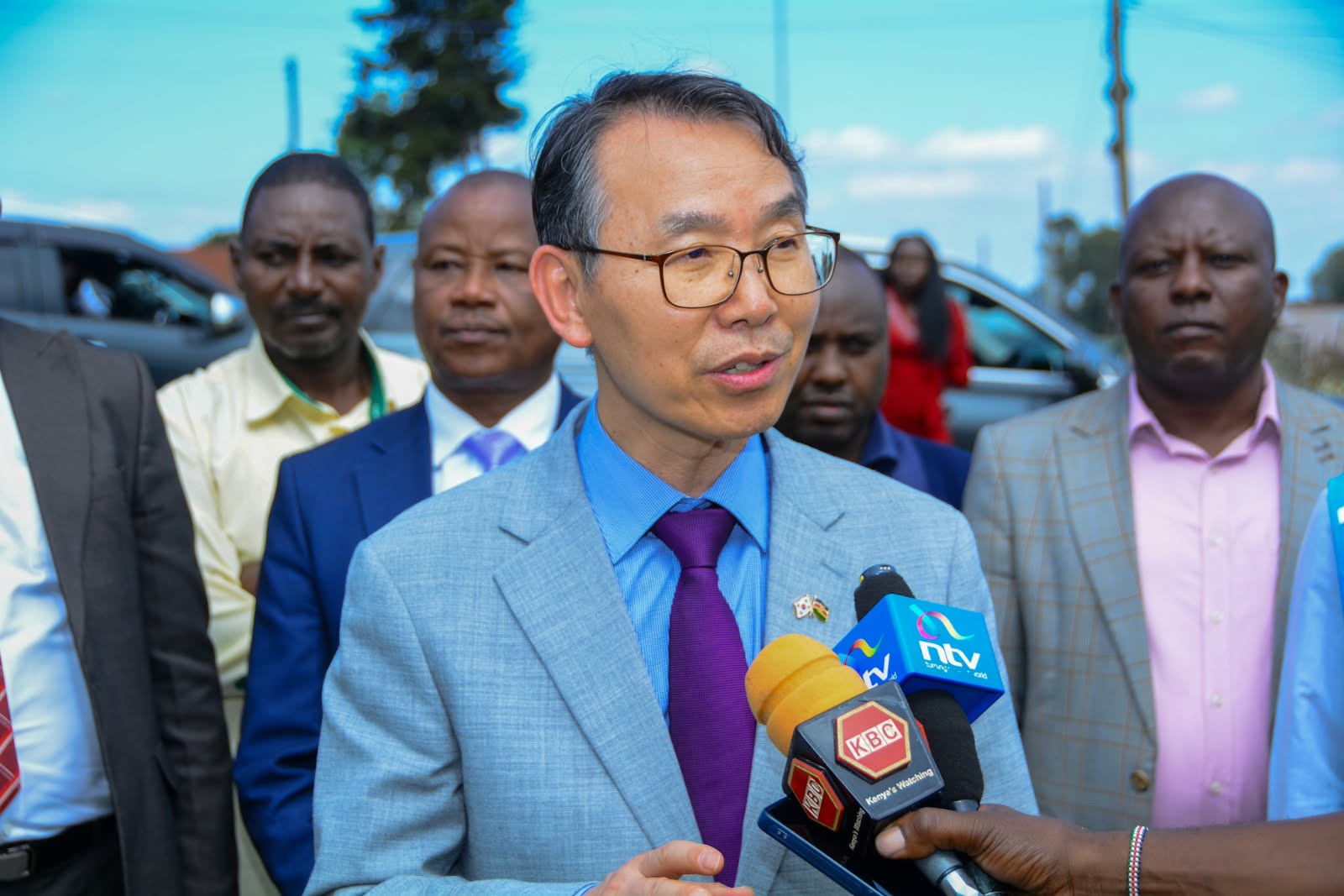
South Korean Ambassador to Kenya Kang Hyung-shik speaks to the press. Photo by Brian Gitonga
Seoul pledges expanded partnership as five-year agriculture programme delivers tangible results in Meru County
By Brian Gitonga
Potato farmers in Meru County received a significant boost yesterday when the Republic of Korea handed over a new potato storage facility and social hall to the county government, with both sides pledging to deepen agricultural cooperation and push into value addition as the next frontier.
The handover took place during Meru Potato Day celebrations in Katheri, where Governor Mutuma M’Ethingia hosted South Korean Ambassador to Kenya Kang Hyung-shik for a ceremony that marked more than five years of quiet but consequential partnership between the two governments.

M’Ethingia said the programme had genuinely changed how farmers in the county approached their work — not through directives or pamphlets, but through direct exposure to advanced farming technologies in South Korea, which he described as a transformational experience for those who participated.
“Our farmers are happy because of the capacity building they received after travelling to South Korea to learn about new agricultural technologies and modern farming methods while interacting with the Korean people,” he said.
In 2023, three farmers’ groups from Meru benefited from educational visits to South Korea through the Korea Partnership for Innovation of Agriculture programme, known as KOPIA — for many participants, their first experience of international travel and a formative encounter with large-scale modern agriculture.
KOPIA operates across several Kenyan counties, promoting agricultural technology transfer, farmer training and productivity improvements through structured cooperation between South Korea and partner governments. In Meru, the programme has focused on Irish potato and indigenous poultry farmers, supporting them through demonstration villages, improved farming practices and hands-on technical assistance aimed at raising household incomes.

M’Ethingia was emphatic about agriculture’s centrality to Meru’s economy, pushing back against any notion that the county’s national standing owed anything to industrial activity.
“We are ranked fifth nationally, not because of the industries we have in Meru or other activities, but because of agriculture,” he said, adding that the Korean partnership had helped strengthen that foundation while creating new opportunities for cooperative societies involved in potato production.
The governor made clear that he was not satisfied with stopping at potatoes and poultry. He said the county wanted to take the relationship further into value addition — processing, packaging and market access — which he argued represented the next logical step in turning agricultural productivity into sustained economic growth.
“We are grateful as a county, and our doors remain open for more collaborations and opportunities, especially in value addition,” M’Ethingia said.
Kang welcomed the governor’s ambition and praised the results the programme had delivered in Meru, describing the county initiative as one of South Korea’s flagship development projects in Kenya.

“I am grateful that KOPIA has implemented this wonderful project supporting potato and poultry farmers in Meru County. The project has enhanced farmers’ productivity and incomes,” he said, adding that he hoped to expand similar initiatives in partnership with the county government going forward.
The ambassador noted that South Korea was running comparable programmes in Kirinyaga, Kiambu and Kajiado counties, covering agriculture, healthcare, culture, climate change adaptation and technical and vocational education and training — a broad engagement that reflected Seoul’s commitment to development cooperation across Kenya.
Kang also raised the spectre of climate change, which he said was increasingly threatening agricultural productivity in both Kenya and South Korea through prolonged droughts, erratic rainfall and flooding. He said KOPIA was working with private institutions to equip Kenyan farmers with the knowledge and techniques needed to adapt to shifting weather patterns and reduce losses from climate-related disruptions.
“KOPIA is collaborating with other private institutions to help Kenyan farmers address and overcome climate-related challenges such as droughts, flooding and other effects of climate change,” Kang said.
For Meru’s farmers, the new storage facility represents something immediate and practical — a place to hold their harvest, protect it from spoilage and wait for better prices rather than selling in desperation at the farm gate. For the two governments, it marks another chapter in a partnership that has consistently delivered more than its announcements promised.
Similar Posts by The Mt Kenya Times:
- Kenya’s election countdown: DCP and Gachagua fire the opening shot in 2027 battle
- School feeding in Kenya: Can every child access a meal and an education?
- When students become the community’s hope
- Airstrip and museum visit opens young minds to new horizons
- Mount Kenya region is finding its place in Kenya’s tech map
About the Author