From information to insight: Why AI in 2026 demands a rethink of education
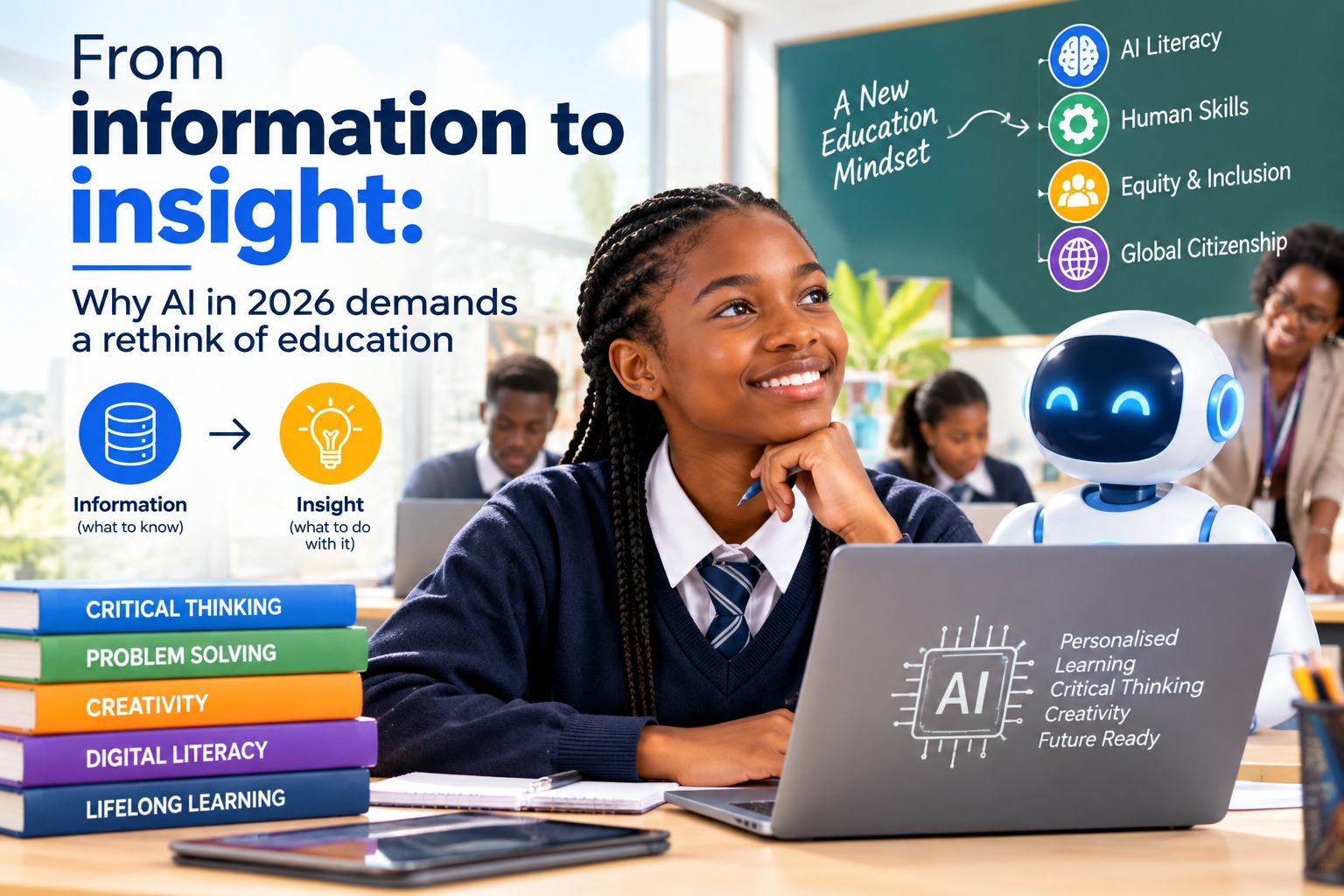
As artificial intelligence reshapes how the world works, Africa’s classrooms risk being left behind — not for lack of access, but for lack of wisdom
By Ashford Kimani
“My people are destroyed for lack of knowledge.” This oft-quoted biblical lament has, for generations, been used to justify the expansion of schooling, the proliferation of textbooks, and the relentless push for access to information. But in 2026, that statement demands reinterpretation. The crisis of our time is no longer a scarcity of knowledge. It is the inability to interpret, prioritise, and apply an overwhelming abundance of it.
A recent guide by Harvard Business School on AI in 2026 captures this shift with striking clarity. Artificial intelligence is no longer a peripheral tool deployed to enhance productivity. It has become the very infrastructure through which decisions are made, systems are designed, and organisations function. In such an environment, the question is no longer whether institutions will adopt AI, but whether they understand how to operate within its logic.
For education systems, particularly in contexts like Kenya, this transition is both urgent and unsettling. Schools were designed for an era in which information was scarce, teachers were gatekeepers of knowledge, and assessments measured recall. Today, information is abundant, instantly accessible, and increasingly generated by machines. The traditional architecture of schooling is, therefore, misaligned with the realities of the present.
One of the most celebrated promises of AI is productivity. Studies show that tasks such as writing, research, and ideation can be completed two to three times faster with AI assistance. Learners and professionals alike can now attempt work that previously required specialised training. But there is a crucial caveat: AI does not turn novices into experts. It can generate answers, but it cannot supply judgement. It can suggest solutions, but it cannot replace experience.
This distinction is where education must now concentrate its energies. If machines can provide information, schools must focus on cultivating understanding. If AI can generate content, teachers must emphasise interpretation. The value of education is shifting — decisively and irreversibly — from knowledge acquisition to knowledge application.
The Harvard Business School guide introduces a concept that deserves to become central to educational discourse: “change fitness.” This refers to the capacity of individuals and organisations to continuously adapt to shifting technological and social environments. It is not a single skill but a composite of curiosity, flexibility, data literacy, and the ability to redesign one’s approach to work as circumstances evolve.
In practical terms, learners must be prepared not for a fixed body of knowledge, but for a lifetime of learning, unlearning, and relearning. Kenya’s Competency-Based Curriculum gestures toward this ideal, but its implementation often remains tethered to old habits of content coverage and examination performance. Change fitness demands something deeper: an education system that is itself adaptive, responsive, and informed by real-time evidence.
And here lies a paradox. Even as AI promises to make decision-making more efficient, it introduces new and layered complexities. The guide distinguishes between predictive AI, which enhances accuracy and consistency, and generative AI, which fosters creativity and diversity of thought. These two forms of intelligence pull in different directions. An overreliance on predictive systems risks producing rigid, standardised outcomes. An overreliance on generative systems risks sacrificing rigour for novelty. Education must navigate between them.
Assessment frameworks, for instance, must move beyond narrow standardisation without descending into subjectivity. The ongoing conversations at forums such as the Kenya National Examinations Council Annual Educational Assessment Symposium are timely in this regard. The challenge is no longer simply to collect data on learner performance, but to use that data intelligently — to inform teaching, guide interventions, and shape policy with precision rather than guesswork.
Yet the integration of AI also brings risks that cannot be wished away. There are security concerns, as AI systems become both targets and instruments of sophisticated cyber threats. There are cognitive risks, including bias and the now well-documented phenomenon of AI hallucinations — where systems generate plausible but factually incorrect information with disarming confidence. And there are strategic risks, particularly when institutions automate decisions without fully understanding the processes they are delegating to machines.
These risks point to a critical need. AI literacy must go beyond technical proficiency. It must encompass critical thinking, ethical reasoning, and a clear-eyed awareness of the limitations of machine intelligence. Learners must not only know how to use AI — they must know when to question it.
Perhaps the most counterintuitive insight from the Harvard guide is this: as AI becomes more powerful, distinctly human qualities become more valuable, not less. Judgement, empathy, contextual understanding, and ethical reasoning are not diminished by technology; they are amplified in importance. In a world where machines can process data at unprecedented speed, the ability to make sense of that data — to weigh it, contextualise it, and act wisely on it — becomes the defining human advantage.
This has profound implications for teaching and learning. The teacher is no longer merely a transmitter of knowledge but a curator of meaning. The classroom is no longer a site of information delivery but a space for dialogue, inquiry, and critical engagement. Assessment is no longer a measure of what learners know, but of what they can do with what they know.
At a systemic level, education must also respond to the changing nature of work. AI is not eliminating jobs wholesale, but it is reshaping them. Routine and repetitive tasks are increasingly automated, while demand grows for roles that require analytical thinking, creativity, and complex problem-solving. This calls for an education system that prepares learners not just for employment, but for adaptability, innovation, and entrepreneurship.
The Kenyan context adds another layer of urgency. Schools already grapple with large class sizes, limited resources, and significant disparities in access and quality. AI’s arrival into this landscape could either deepen those inequalities or help address them — the outcome depends entirely on how the transition is managed. Leveraged wisely, AI can support personalised learning, enhance teacher effectiveness, and improve data-driven decision-making. Adopted uncritically, it risks widening the very gaps it promised to close.
The central lesson of AI in 2026 is deceptively simple: access to information is no longer the problem. Making sense of it is. Education systems must pivot from accumulation to application, from content to competence, from data to decision-making.
The lament of Hosea may still hold, but its meaning has evolved. We are no longer destroyed for lack of knowledge. We are at risk of being overwhelmed by it. The task before educators, policymakers, and institutions is not to provide more information, but to cultivate the wisdom to use it well.
Ashford Kimani teaches English and Literature in Gatundu North Sub-county and serves as Dean of Studies.
Similar Posts by The Mt Kenya Times:
- Six businesses campus students can start with almost no cash
- Bikeke school leads the way on competency-based learning
- Lucinda Hughes Afzal: Where compassion meets courage
- Uasin Gishu has the water: Why leaders must now turn the president’s irrigation call into food, wealth and opportunity
- Africa’s fuel crisis crosses its own borders
About the Author