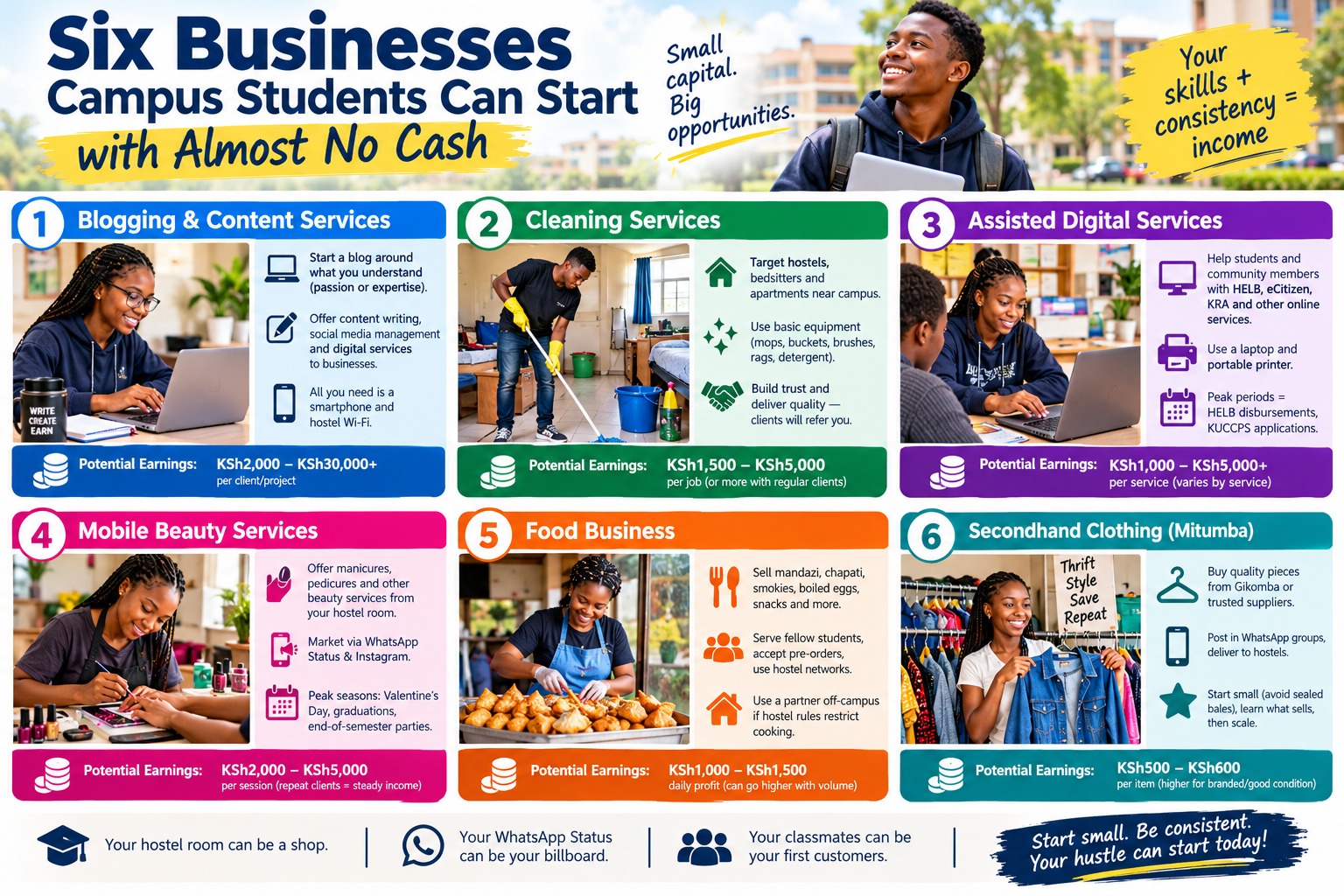
Across Kenya’s universities, a quiet generation of student entrepreneurs is proving that HELB is not the only lifeline
By Njeri Mickeydan Kioko
Let me be straightforward with you. I am not a business guru or a motivational speaker. I am simply someone who has lived through campus life in Kenya, watched friends struggle with empty pockets, and seen others turn small, unglamorous hustles into reliable streams of income. This is not theory. It is observation.
University life in Kenya comes with relentless financial pressure. Fees are steep, accommodation swallows a significant portion of Higher Education Loans Board disbursements, and by the third week of semester, many students are already calculating how to survive until the next payment arrives. But some students have quietly discovered that they do not need large capital to make money. They simply started small, started where they were, and stayed consistent.
None of what follows is a get-rich-quick scheme. These are practical businesses — proven in Kenyan campus environments — that can be started with relatively little money and run alongside a full course load.
Blogging is often dismissed as a hobby, but the real opportunity has never been advertising revenue alone. It lies in using a blog as a shopfront for your skills. Google AdSense pays according to traffic volume, and Kenyan traffic generally earns less than traffic from markets such as the United States or United Kingdom. At roughly $1.50 per thousand views, 10,000 monthly pageviews yields only about $15. That model, on its own, is frustrating.
The smarter approach is to use a blog as proof that you can write, create content, and attract an audience — then offer those skills to businesses. Content writing earns between KSh2,000 and KSh10,000 per piece. Social media management can bring in KSh10,000 to KSh30,000 per client each month. A Nairobi personal-finance blogger with roughly 60,000 monthly pageviews earned just $34 from AdSense — but she held a KSh25,000 content-writing retainer with a SACCO, an KSh18,000 social media management contract with a small lender, and a KSh15,000 sponsored post arrangement. Her blog generated close to KSh58,000 a month through services, not advertising.
For a student, the lesson is simple: build a blog around something you understand, develop a portfolio, and use it to approach businesses near campus. A smartphone and hostel Wi-Fi are enough to begin.
Cleaning is not glamorous. It is also genuinely profitable. Residential cleaning in Kenya commands between KSh1,500 and KSh5,000 per job, depending on the property and scope of work. A student who builds a base of regular clients — targeting hostels, bedsitters, and apartments near campus — can turn the work into a steady monthly income without employing anyone or paying rent on premises. Basic equipment: mops, buckets, brushes, rags, and detergent. The real asset is trust. Do the job well and clients refer you. Target deep-cleaning requests during exam periods and semester breaks, when students vacating rooms need help. Reliability, not academic credentials, determines whether you are hired again.
The growth of eCitizen, Kenya Revenue Authority online platforms, HELB applications, and other government digital services has created a new and underserved market. Smartphones have not killed the cyber business — they have changed what that business looks like. Assisted digital services are where the opportunity now sits. A student with a laptop and a portable printer can help fellow students and community members navigate HELB applications, eCitizen processes, document uploads, and online registrations. A lean setup of one or two computers costs roughly KSh50,000 to KSh80,000, though starting smaller is entirely possible. The highest-demand periods — HELB disbursement cycles, Kenya Universities and Colleges Central Placement Service application windows — are predictable, which makes planning straightforward.
A mobile beauty service eliminates the single biggest cost in the industry: rent. Basic manicure and pedicure equipment costs between KSh20,000 and KSh50,000, though starting with core essentials and reinvesting as income grows is a well-worn path. Clients pay between KSh2,000 and KSh5,000 per session, and the repeat-business cycle — customers returning every few weeks — makes revenue reasonably predictable. There is a well-known story from Nakuru of a man named Mbugua who reportedly started his nail business with KSh100, bought supplies, served people he knew, and built steadily from there. A hostel room can function as the salon. WhatsApp Status and Instagram, used consistently, are the marketing. Valentine’s Day, graduation ceremonies, and end-of-semester parties are the peak seasons.
Few businesses are more straightforward, or more honest, than selling food to hungry people. Winfridah Mukhwaya — known widely as Mama Mandazi in Ongata Rongai — has run her mandazi and chapati business for more than nine years. From 2kg of wheat flour she produces roughly 80 mandazis, selling each at KSh5, generating KSh400 in sales with a reported profit of around KSh150 per packet. At five packets a day, that translates to more than KSh22,500 a month. Elizabeth Kanyara, who sells smokies, boiled eggs, and chapatis in Kiambu town, reports between KSh1,000 and KSh1,500 in daily profit on a good day.
A student need not operate as a full-time vendor. Morning mandazis sold to students heading to lectures, chapati orders taken in advance, snacks supplied to study groups — all are viable entry points. If hostel rules prohibit cooking, a partner who lives off-campus solves the problem simply.
Secondhand clothing remains one of the most accessible campus businesses precisely because the market is right there in front of you. Viola Dola started her thrift operation in her second year. She and friends would buy clothes from Gikomba Market, post them in a WhatsApp group, and deliver to hostels. She eventually built a proper thrift shop. With KSh2,000 a student can buy carefully selected pieces and resell them — dresses sourced for KSh50 to KSh100 can move at KSh500 or KSh600. Secondhand shoes cleaned and presented well can command significantly higher prices, particularly branded pairs in good condition.
The student advantage here is genuine: you already know your market. You know what your classmates wear, what is trending, and what people can realistically afford. One practical caution — avoid sealed bales early on. They can contain damaged or slow-moving stock that ties up your capital. Buy individual pieces first, learn what sells, then scale.
Across all six of these businesses runs a single truth: you do not need to wait until you have thousands of shillings in reserve. Your hostel room can be a shop. Your WhatsApp Status can be your billboard. Your classmates can be your first customers. The obstacle is rarely money — it is the fear that the business is too small, too ordinary, or somehow beneath you.
The mandazi does not care whether you hold a degree. The cleaning job does not care whether you are a first-year or a finalist. The mitumba rack does not care what you are studying. What matters is whether you show up, provide something people genuinely need, and do it consistently.
Start small. Learn as you go. Reinvest your profits. And do not wait for HELB. Your hustle can start today.
Similar Posts by The Mt Kenya Times:
- Wamuchomba leaves UDA: What her exit means for Ruto and Mt Kenya
- Wamuchomba demands suspension of tea levy as farmer bonuses collapse
- Fatuma Ali joins PSC with pledge to build consensus
- The silent crisis in our classrooms
- Bikeke school leads the way on competency-based learning
About the Author