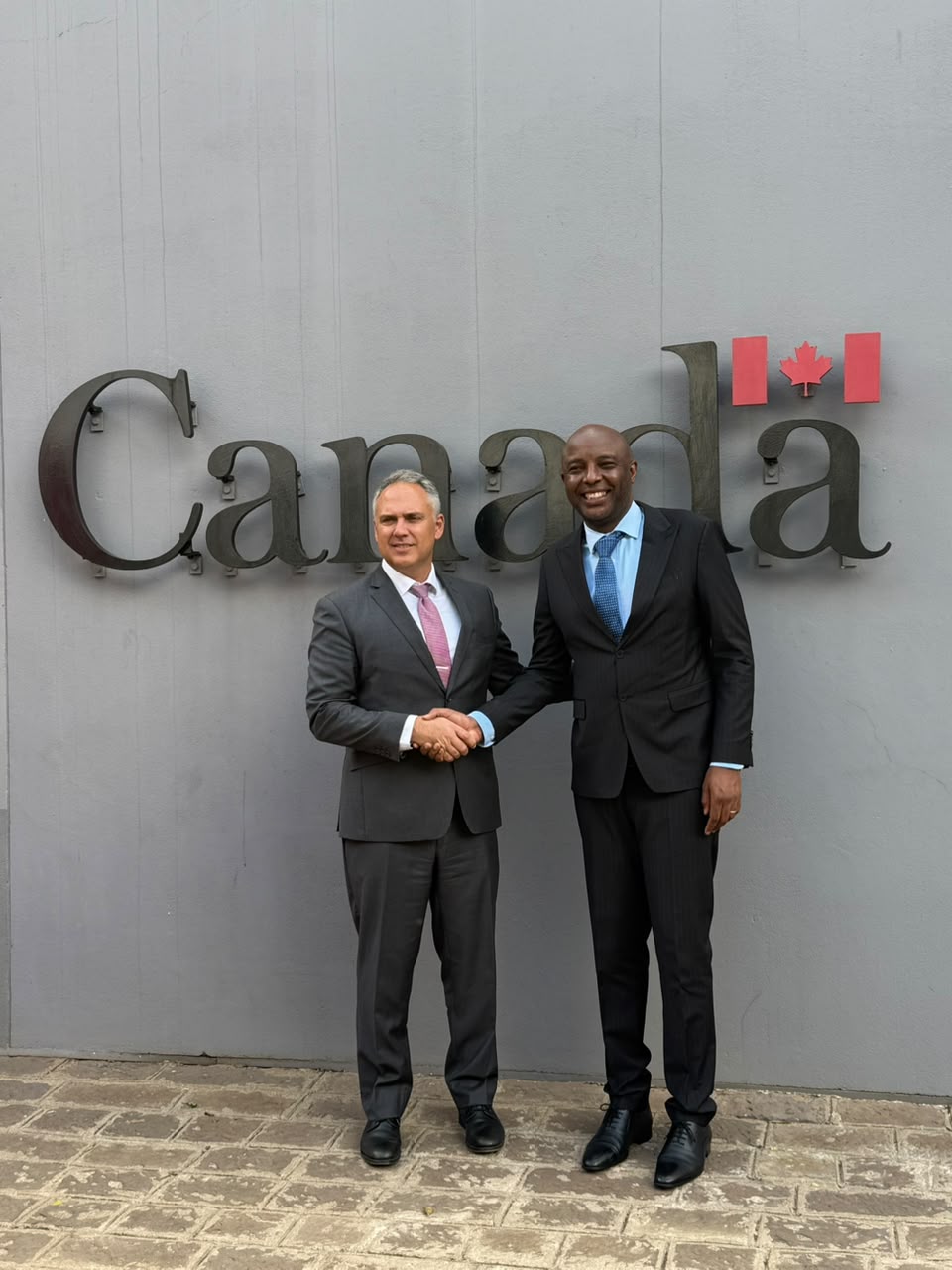
Murang'a Governor Irungu Kang'ata yesterday called on Canadian High Commissioner Joshua Tabar at the Canadian High Commission in Nairobi
The Murang’a governor takes his county’s investment pitch to Nairobi’s diplomatic circuit as the race to attract foreign capital ahead of 2027 intensifies
By Grace Wanja
Murang’a Governor Irungu Kang’ata yesterday called on Canadian High Commissioner Joshua Tabar at the Canadian High Commission in Nairobi, opening discussions on investment opportunities in the county’s planned industrial city and potential partnerships with Canadian businesses in agro-processing, manufacturing and value addition.
The meeting signals an increasingly deliberate effort by Kang’ata to position Murang’a County as a serious destination for foreign direct investment, at a moment when Kenya’s devolved units are competing with growing urgency to attract capital, generate employment and demonstrate economic results ahead of the August 2027 general election.
At the centre of the pitch is the Murang’a Industrial City, an ambitious project the county government is developing as an anchor for industrial growth and job creation in the region. Agro-processing sits at the core of the proposal — a natural fit for a county whose agricultural output, particularly tea, coffee and avocado, has long outpaced the local infrastructure needed to add value before produce leaves the county.
The political timing is not incidental. With less than a year before campaigns formally intensify, governors across Kenya are under mounting pressure to show tangible development gains to their constituents. For Kang’ata, who has staked much of his tenure on an economic transformation agenda for Murang’a, the industrial city represents both a policy ambition and an electoral statement. Securing credible international partners — and being seen to do so — carries weight in both registers.
Canada presents a particular opportunity. Canadian agribusiness and manufacturing firms have an established footprint across East Africa, and the High Commission has in recent years been an active facilitator of business links between Canadian companies and county governments pursuing industrial development. Whether those conversations translate into binding commitments, however, will depend on the county’s ability to offer competitive land terms, reliable infrastructure and a regulatory environment that gives investors confidence.
Kang’ata has been direct about what he is offering. “Murang’a is open for business and ready to partner with global investors to create jobs, grow industries and build shared prosperity,” he said — language calibrated as much for the investors he is courting as for the voters he is serving.
The broader context is a Kenyan devolution landscape in which counties are increasingly behaving like small states, sending their own diplomatic signals and cultivating bilateral relationships independently of the national government. That dynamic is likely to intensify as 2027 approaches and governors seek to differentiate themselves through visible economic achievement.
For Murang’a’s farmers, youth and small manufacturers, the industrial city remains a promise yet to be tested by concrete ground-breaking and secured investment. The Canadian conversation is one step in a longer process. Whether it becomes a partnership — or remains a promising meeting — will determine how much political currency Kang’ata can ultimately draw from it.
The governor is making his pitch. The world is being asked to listen.
Similar Posts by The Mt Kenya Times:
- Ruto leads nation in honouring Raila at Bondo mausoleum dedication
- From devotion to the stage: Niranjanaa’s Bharatanatyam Arangetram
- Kenyatta steps back — but never away
- Kenya’s public universities shut as lecturers’ strike enters sixth day
- When the mirror becomes a threat
About the Author