From mobile money to AI: How technology is reshaping small businesses across Mount Kenya
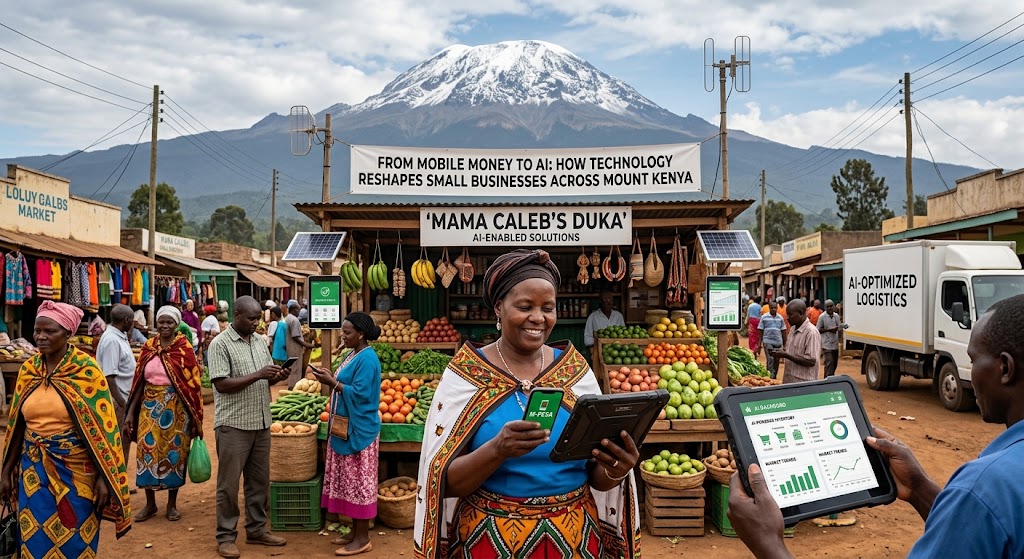
The smartphone has evolved from a payment tool into a full business platform — and for small enterprises across the region, the shift is already under way
By Purity Benjamin
For millions of Kenyan businesses, the words “money received” have become the simplest confirmation that a sale is complete. A customer chooses a product, sends payment through mobile money, and the business owner checks the phone. Transaction done.
But the more interesting part of that journey is increasingly happening before the payment arrives. A customer may first discover a product on TikTok, Instagram, or WhatsApp — watching a short video, comparing prices, sending an enquiry — long before any money changes hands. Others encounter a business through a Google search, an online recommendation, or a digitally targeted advertisement. Artificial intelligence is now part of that chain too, helping businesses create promotional content, analyse customer behaviour, spot trends, and automate routine tasks.
The traditional customer journey — see a product, walk into a shop, pay — is giving way to something far more connected. Mobile money remains at the centre of the payment, but the technologies surrounding it are changing how businesses find customers, communicate with them, and understand what they want. Across Kenya, the smartphone has evolved from a communication device into a combined marketing platform and payment terminal.
The scale of mobile money alone explains why this moment matters. Safaricom reported 35.82 million one-month-active M-Pesa customers in the financial year ending March 2025. During that year, M-Pesa processed KSh38.29 trillion in transaction value, while active Lipa na M-Pesa merchants reached 675,860 and Pochi tills stood at approximately 1.15 million. Mobile money is not being displaced by the digital economy — it is one of the foundations on which the next stage is being built.
Sharon, a fourth-year Communication and Media Studies student at Chuka University, is already living that evolution. She runs a beauty business selling hair products and cosmetics while offering services including lash fixing and makeup. Her experience offers a clear window into how a young entrepreneur can weave several technologies together without thinking of herself as a technology business at all.
TikTok has become part of how she acquires customers. Instead of waiting for someone to walk past her stall, Sharon places her products in front of potential buyers through short videos. The technology changes the sequence entirely — discovery happens before the visit. She also uses ChatGPT to generate promotional posters for her services. For a technology professional, that may sound like a straightforward application of generative AI. For a small-business owner, it is something more practical: a way of producing content that keeps the business visible without spending time or money she does not have.
This is one of the most significant shifts taking place across small-business technology. The entrepreneur no longer needs to understand the technical architecture behind an AI model to benefit from it. What matters is knowing which problem the technology solves. For Sharon, the problems are simple: visibility and content. TikTok handles reach. AI handles creative production. Mobile money handles payment.
In Chuka itself, the digital transformation of small businesses has become visible at market level. In April 2026, the Kenya News Agency reported that traders at Chuka Market were using government-provided public Wi-Fi to market products, communicate with customers, and access wider markets. A cobbler described receiving photographs of shoes from customers requesting repairs. A clothing vendor said she could post new stock online and receive orders before customers arrived at the market. For a trader, public Wi-Fi represents access to customers. For a small enterprise, it means access to markets that geography previously placed out of reach.
Academic evidence from the region reinforces what these individual stories suggest. A 2026 study published in the Journal of Strategic Management examined AI use among medium-sized enterprises in Meru County, surveying 205 enterprise owners and managers. It found a statistically significant relationship between AI applications and enterprise growth, with AI explaining 32% of the variation in growth within the sample. The applications identified included customer analytics, demand forecasting, automated responses, and data-driven decision-making — technologies that answer the questions entrepreneurs have always asked: What do my customers want? When are they buying? Which products should I stock?
The difference is that technology can now answer those questions using data rather than instinct. M-Pesa creates a transaction record. Analytics can identify patterns within it. AI can help interpret those patterns and inform decisions. Auni, an AI-powered business intelligence tool developed by Kenyan startup Fastagger and integrated into the M-Pesa Business Super App, demonstrates this directly. Built to help entrepreneurs examine sales patterns, cash-flow trends, and customer behaviour without advanced technical skills, it represents perhaps the clearest bridge yet between mobile money and artificial intelligence. The payment does not stop moving through M-Pesa. Instead, the information surrounding that payment becomes useful.
Safaricom’s 2025 M-Pesa Sokoni campaign, which specifically engaged customers and small-business owners across Mukurweini, Karatina, Nyeri, and Chaka, illustrated that mobile money remains deeply embedded in the region’s commerce. Karatina is a useful reminder that the digital transition does not mean abandoning traditional markets — it means adding a layer to them. A trader can still rely on the physical customer walking in while simultaneously using digital platforms to attract someone who has never visited the stall.
DataReportal estimated Kenya had 23.4 million internet users at the end of 2025, representing penetration of 40.5%, with 18.4 million social media user identities recorded in October 2025. For a small business, those numbers reframe the fundamental question. The old question was: where is my shop? The emerging question is: where is my customer?
None of this means AI is a guaranteed route to growth. A professionally generated poster may produce no sales. A TikTok video can reach thousands without converting a single viewer. Algorithms recommend content without understanding local business realities, and concerns around privacy, cybersecurity, and platform dependency remain real. Technology does not eliminate the need for human judgement — it raises the bar for it.
The future of small business across Mount Kenya may therefore not be about choosing between mobile money and AI. It may be about combining them — mobile money providing the transaction layer, social media creating visibility, and AI turning raw business information into insight and action. That combination may be what transforms an ordinary digital payment into something a great deal smarter.
Purity Benjamin is a 21-year-old Bachelor of Science in Computer Science student at Chuka University.
Similar Posts by The Mt Kenya Times:
- Garang’s ghost: What South Sudan does with its liberation ideals
- When the teacher breaks: TSC’s quiet battle for mental health in the classroom
- Patel makes history with third African crown
- From menstrual health to AI: Kenya keynote tour puts youth voices at the centre
- The Kenyan paradox: How political elitism and social stratification are mortgaging the ambitions of future generations
About the Author