Garang’s ghost: What South Sudan does with its liberation ideals
 The Mt Kenya Times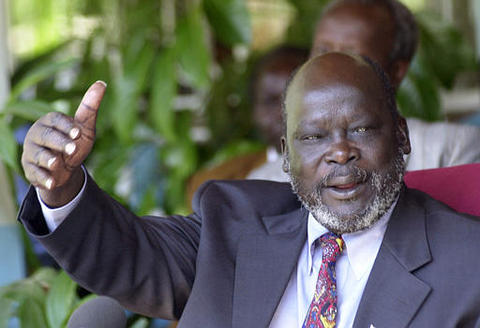
The late John Garang de Mabior
As the transitional government dissolves and elections approach, the question is not whether John Garang will be remembered — but whether his principles will survive
By Dennis Wendo
The dissolution of South Sudan’s transitional government has closed another difficult chapter in a country that has known very few easy ones. It has also brought renewed attention to those who served within that administration and, more importantly, to the political ideas that have shaped South Sudan since the liberation struggle first gave them form.
Among those now departing office is Captain Mabior Garang de Mabior, who served as Minister of Environment and Forestry before the transitional cabinet was dissolved. His ministerial exit would, under ordinary circumstances, attract little more than passing notice. But Mabior is the son of the late John Garang de Mabior — founding leader of the Sudan People’s Liberation Movement and one of the most consequential figures in the modern political history of the region. That connection makes his departure from government something more than a routine reshuffle. It raises, again, a question that South Sudan has never quite managed to answer: what has become of the vision in whose name so much was sacrificed?
The question matters more urgently now because the country is approaching its scheduled general election on 22 December 2026. The National Elections Commission has confirmed the date and begun preparations for voter registration and related electoral processes. Another defining moment is arriving for a country that has seen several such moments come and go without the transformation they promised.
John Garang’s New Sudan vision was not primarily about geography or statehood. It was about transforming a political system that had excluded vast sections of society for generations. It emphasised equality, democratic governance, human rights, political pluralism and equitable development. His argument, pursued across decades of armed struggle and political negotiation, was that capturing power was not the point. The point was what you did with it — whether government delivered services, restored dignity and answered to the people it claimed to represent.
South Sudan achieved independence in 2011, fulfilling an aspiration that had defined a generation. But independence was never meant to be the destination. It was meant to create the conditions in which citizens could build a state that actually served them. The years since have demonstrated, painfully, how wide the gap between that ambition and the reality has grown. Political instability, conflict, mass displacement and protracted transitional arrangements have consumed the space that institution-building requires. The country arrives at December’s election carrying the weight of that history.
An election, by itself, cannot resolve it. The more consequential question is what political culture emerges from the process. Whether citizens develop greater confidence in public institutions. Whether political competition learns to accommodate diversity rather than deepen the divisions that have already cost so much. Whether elected bodies provide genuine accountability. Whether public resources are managed for the benefit of communities across the country rather than for the benefit of those who control them.
These are not abstract governance questions. They are the practical content of what the Garang legacy actually means — or should mean.
Mabior’s former portfolio offers an unexpected angle on that legacy. Environmental protection may seem distant from the debates of the liberation era, but it connects directly to the question of what independence means in the lives of ordinary people. South Sudan holds extraordinary natural wealth: forests, wetlands, agricultural land and resources whose management will determine the quality of life available to its citizens for generations. A farmer whose land is protected from degradation, a community shielded from preventable flooding, a young person who finds meaningful work in a sustainable economy — each is experiencing, in concrete terms, what responsible government looks like. That, too, is part of what Garang argued government should be for.
Mabior cannot carry the weight of that legacy alone, nor should he be expected to. John Garang’s legacy does not belong to his family or exclusively to the political movement with which his name is associated. A national legacy becomes genuinely meaningful only when its principles extend beyond individuals and become embedded in institutions, in public policy and in the expectations of citizens themselves. The real test is not whether the Garang name endures in South Sudanese political life — it will — but whether the principles behind it remain alive in the country’s institutions once the generation that lived the liberation struggle has passed from the scene.
The danger, as December approaches, is precisely that detachment. Not that John Garang will be forgotten. History will not permit that. The greater risk is that the ideals associated with his political vision — equality, inclusion, accountability, dignity — gradually become ceremonial rather than operational. Slogans invoked on anniversaries but absent from the daily conduct of government.
South Sudan therefore faces a specific opportunity in December: not simply to hold an election but to begin rebuilding a democratic culture capable of outlasting the election itself. Political competition will produce winners and losers. That is its nature. But the country cannot afford for the pursuit of political victory to consistently outweigh the stability and cohesion of the nation. The measure of whether this election means anything will be whether political differences can be managed peacefully, whether institutions can mediate competing interests without violence and whether citizens can participate without fear.
For Mabior and his generation, the end of this ministerial chapter is, perhaps, not an ending at all. They inherited the memory of a liberation struggle. They now carry the harder responsibility of building the state that independence was supposed to make possible.
That responsibility is considerably larger than preserving a family name. It is about preserving an idea — that government should serve citizens, that diversity is a strength rather than a threat, that natural resources belong to present and future generations alike, that justice and equality should be more than words on a founding document.
The ideals of the liberation era were forged in a different context. South Sudan has since taken its own path. But the principles remain relevant, and the gap between what was promised and what has been built remains wide. December offers a chance to begin closing it. What the country needs is not merely another election. It needs a stronger democratic culture when the voting is done.
That is the unfinished inheritance. And it belongs to everyone.
Dennis Wendo is a governance and social policy commentator.
Similar Posts by The Mt Kenya Times:
- Wicknell Chivayo: The man Africa loved, hated and never fully understood
- Kenyans abroad are sending billions home — but are they getting a bigger seat at the table?
- A passport or a laptop: How young Kenyans are finding work beyond home
- Why schools lose parents — and how words can win them back
- Her pen is your lifeline
About the Author