The Kenyan paradox: How political elitism and social stratification are mortgaging the ambitions of future generations
 The Mt Kenya Times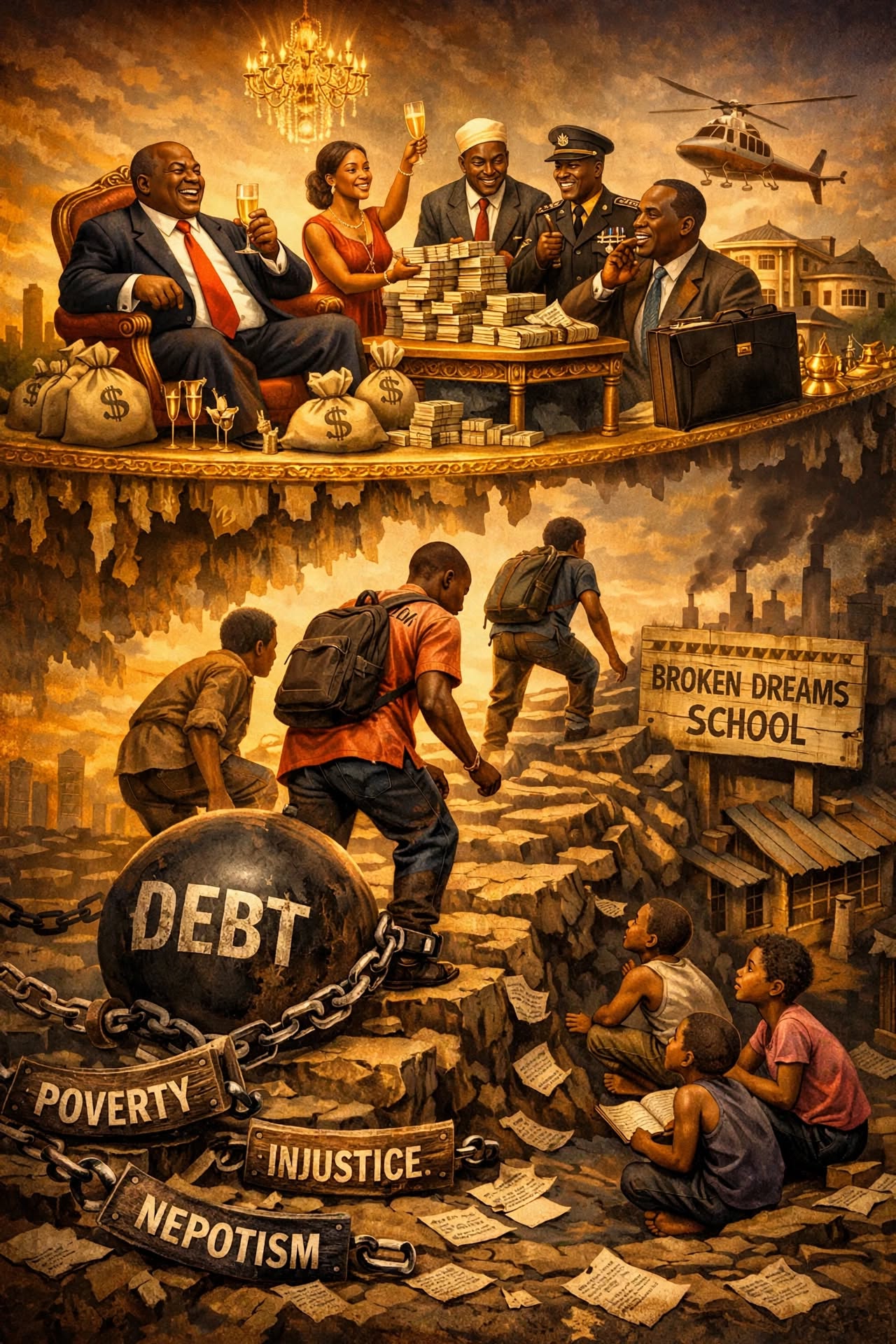
By Mr. Fredrick Kipchumba Chelimo – PWD
Email; fkipchelimo@yahoo.com
\When political connections command greater recognition than competence, and locally acquired knowledge is sacrificed at the altar of privilege, a nation gradually loses faith in the very people upon whom its future depends
A nation does not impoverish itself only when it loses money. It also impoverishes itself when it fails to recognise its brightest minds, disregards the sacrifices of its educated generation and allows privilege to stand where competence should prevail. There is something profoundly troubling about the direction Kenya’s development journey is taking. Beneath the country’s ambitious economic declarations, expanding institutions of higher learning and persistent promises of opportunity lies a painful contradiction that deserves an honest national conversation.
Kenya is producing educated young people, experienced professionals, researchers, innovators and entrepreneurs, yet the society they are expected to build increasingly appears unable to recognise, accommodate or adequately utilise their intellectual and practical contributions. The tragedy is not necessarily a shortage of knowledge. It is the growing disconnect between knowledge, opportunity, recognition and the exercise of power.
At the centre of this contradiction lies an entrenched culture of political elitism and social stratification, where access to influence can sometimes matter more than demonstrated competence. Political proximity, economic privilege and established networks have increasingly become important currencies in accessing opportunities, institutional recognition and decision-making spaces. For many ordinary Kenyans, however, the journey from education to meaningful employment, professional advancement and economic independence remains an exhausting struggle. The result is a society in which the promise of meritocracy increasingly collides with the realities of privilege.
Consider the young Kenyan who spends years in university, often supported by parents who sacrifice their savings, borrow money or surrender opportunities of their own to finance an education they believe will secure a better future for their children. Upon graduation, that young person enters a labour market where qualifications do not necessarily translate into employment, and professional competence does not automatically create opportunity. Some remain unemployed; others accept positions unrelated to their training, while many abandon their original ambitions altogether. What makes this situation particularly painful is that society continues to demand excellence from a generation to which it has failed to provide sufficient avenues for expressing that excellence.
Equally disturbing is the treatment of experience. Across Kenya are individuals who have spent decades acquiring practical knowledge in agriculture, administration, engineering, education, business management and community development. Their expertise has been forged through years of responsibility, experimentation, failure and achievement. Yet institutional systems can sometimes treat their experience as inferior to formal credentials, even where their demonstrated competence is unquestionable. This is not an argument against academic qualifications, which remain indispensable in many professions. It is an argument against credentialism becoming a bureaucratic instrument that disregards knowledge already acquired and proven through practice.
The contradiction becomes even more uncomfortable when examined against public expenditure on international benchmarking and institutional exposure. There is nothing inherently wrong with learning from other countries. Indeed, international cooperation and the exchange of knowledge are essential to development. However, when institutions repeatedly spend public resources seeking expertise abroad without clearly demonstrating what they intend to learn, what local capacity already exists and what measurable improvements will follow, legitimate questions arise. Kenya cannot continually finance the search for knowledge while overlooking the professionals, universities, researchers and institutions already equipped to address many of its challenges. Travel is not expertise, observation is not competence, and reports are not development. The ultimate measure of any learning exercise must be what changes after the participants return.
This is where political elitism becomes a national development concern rather than simply a question of fairness. When political visibility overshadows technical ability, public institutions risk becoming less responsive to evidence and more dependent on personal influence. When opportunities are perceived to favour connections over competence, young people begin questioning the value of education, hard work and professional integrity. A society cannot sustainably inspire its next generation while simultaneously creating conditions that make merit appear insufficient.
The consequences extend far beyond the present generation. Young people who lose confidence in the relationship between education and opportunity may disengage from productive pursuits, seek opportunities beyond the country’s borders or abandon aspirations that could otherwise contribute to national transformation. Those who remain may increasingly conclude that success depends less on what one knows or can accomplish and more on whom one knows. Such a perception, if allowed to deepen, threatens institutional trust, social mobility and the country’s capacity to retain its intellectual capital. The greatest casualty may ultimately be a generation that inherits diminished confidence in the very institutions established to protect its future.
Kenya must therefore reconsider what it values and rewards. Public appointments should respect professional competence; employers should recognise demonstrated ability alongside academic achievement; universities should connect education more meaningfully to innovation and productive enterprise; and government should establish clear accountability for expenditure undertaken in the name of knowledge acquisition. Recognition of Prior Learning should also become a meaningful pathway for experienced citizens whose competencies deserve formal acknowledgement.
Ultimately, the country must confront an uncomfortable question: what kind of future are we preparing for our children when political privilege can appear more rewarding than intellectual investment? National ambition cannot be sustained through political declarations, impressive delegations or the accumulation of academic certificates alone. It requires institutions that recognise talent wherever it exists and create opportunities for that talent to serve society.
Kenya’s greatest untapped resource may not be beneath its soil, within its minerals or in the size of its public expenditure. It may be in the minds of millions of citizens whose potential remains constrained by a system that has yet to appreciate the full value of their contribution.
The future generation deserves more than promises of opportunity. It deserves a country in which knowledge matters, experience counts, hard work has meaning and leadership recognises competence beyond the boundaries of political and social privilege.
“History will not judge Kenya merely by the wealth its privileged accumulated, but by the opportunities it created, the talent it recognised and the future it secured for generations that had no seat at today’s table.”
Similar Posts by The Mt Kenya Times:
- A passport or a laptop: How young Kenyans are finding work beyond home
- Why schools lose parents — and how words can win them back
- Her pen is your lifeline
- Kampala’s last cathedral
- Xadicha Sulaymonova was the First Uzbek Female Legal Scholar
About the Author