Kenyan-led forces in Haiti implicated in four confirmed rape cases, UN report reveals
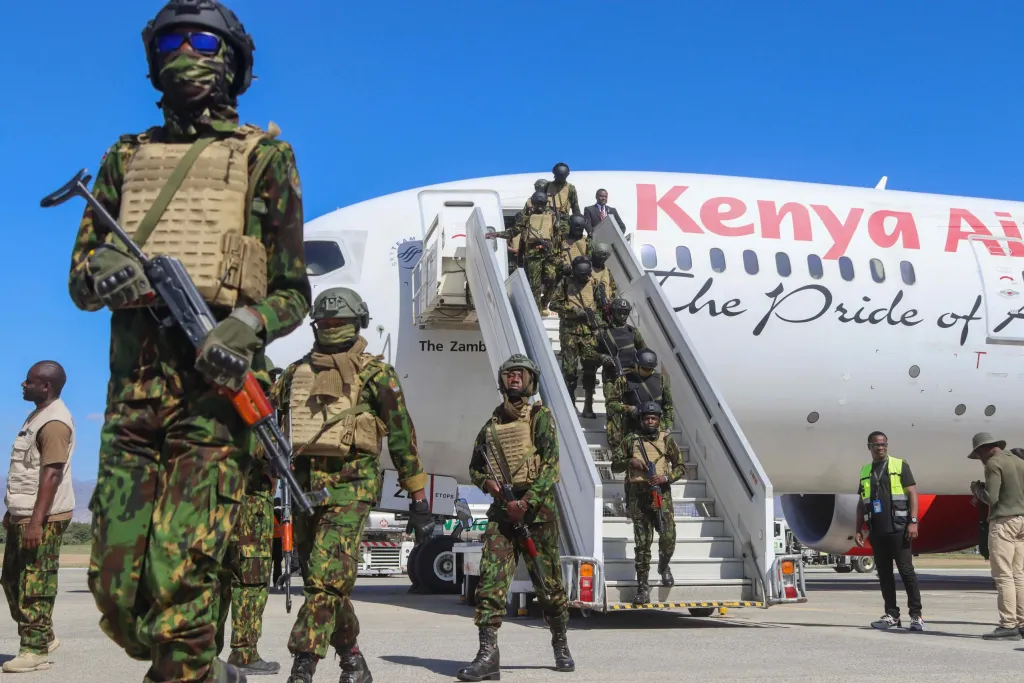
Kenyan police officers leave Kenya Airways, the East African country’s commercial airliner, after landing at Toussaint Louverture International Airport in Port-au-Prince on January 18, 2025.
A damning United Nations report confirms that personnel from the Kenya-led Multinational Security Support Mission sexually exploited and abused victims aged as young as 12 — raising urgent questions about accountability and oversight in one of Kenya’s most high-profile international deployments.
By MKTReporter | The Mt Kenya Times | Published: April 2025
Four personnel from the Kenya-led Multinational Security Support (MSS) Mission in Haiti have been implicated in confirmed cases of sexual exploitation and abuse, according to a report by United Nations Secretary-General António Guterres presented to the UN General Assembly.
The report, one of the most detailed annual reviews of conduct across UN-affiliated peace operations, identifies a total of 568 victims of sexual exploitation and abuse across all UN operations in 2024 alone — among them 158 children. The four MSS cases were all investigated by the Office of the United Nations High Commissioner for Human Rights (OHCHR) and found to be substantiated.
“Sexual exploitation and abuse represent a fundamental betrayal of the trust placed in the United Nations and its partners by the communities it serves,” the Secretary-General’s report states, warning that such acts “inflict devastating and lifelong harm on victims.”
The report confirms that the four allegations were referred to the commander of the Gang Suppression Force and to the MSS Mission leadership “for appropriate investigation and remedial measures.” Most cases are listed as pending action, though the report notes that an internal mission investigation was conducted in at least one instance — that involving a 12-year-old victim.
External reporting by the Miami Herald, drawing on the same UN findings, indicates that all four victims were between the ages of 12 and 18, and that every case was marked as corroborated under the report’s findings. The Miami Herald further reports that it reached out to MSS Force Commander Godfrey Otunge, mission spokesman Jack Mbaka, and the OHCHR for comment but received no response at the time of publication. The four allegations are said to have first been reported by AyiboPost, a Port-au-Prince-based online news service.
The MSS Mission, which is composed primarily of Kenyan National Police Service officers, was authorised by the UN Security Council and deployed to Haiti in June 2024 with a mandate to combat the devastating gang violence that has paralysed the Caribbean nation. Although operating under a UN Security Council resolution, the mission is classified as a non-United Nations force — a distinction the report flags as requiring particular vigilance.
“As peace operations evolve, including deployments of non-United Nations forces under Security Council mandates, ensuring consistent standards across configurations is essential to protecting populations, fostering trust and upholding the legitimacy of international efforts,” the report states.
Kenya’s deployment to Haiti was widely seen as a test of the country’s capacity and credibility as a contributor to international security. Nairobi lobbied extensively for the mission, and President William Ruto championed Kenya’s leadership role as a mark of the country’s growing stature in global affairs. The mission concluded in early 2025, with officials declaring the operational phase complete. These allegations now cast a long shadow over that legacy.
On the question of accountability, the UN is unambiguous: the primary responsibility for investigating allegations and prosecuting offenders rests with the troop- or police-contributing countries, in this case Kenya. “Member states are responsible for holding their personnel accountable,” the report states, adding that timely investigations and full transparency are not optional but expected.
The report does note that MSS personnel completed both pre-deployment and in-mission training specifically addressing sexual exploitation and abuse. Critics, however, argue that training alone is insufficient without robust enforcement mechanisms — particularly in non-UN missions where the organisation’s direct disciplinary reach is limited.
The revelations are not occurring in a vacuum. Haiti has a painful institutional memory of sexual abuse by foreign security forces. The UN’s own Stabilisation Mission in Haiti, known as MINUSTAH, which operated from 2004 to 2017, was plagued by widespread allegations of sexual abuse and even linked to a cholera outbreak that killed thousands. The current findings risk reopening those wounds and deepening the Haitian public’s distrust of foreign interventions — however well-intentioned.
For Kenya, the immediate question is whether its authorities will conduct a thorough, credible, and transparent investigation. Human rights organisations are watching closely. So is the United Nations. So, too, are the victims — four individuals, the youngest of them just twelve years old, whose lives have been irrevocably altered, and who deserve nothing less than justice.
The Kenyan government and the National Police Service had not issued a public statement on the matter at the time of this report’s publication.
Accountability deferred is accountability denied — and for the survivors of Kenyan-led forces in Haiti, the world is watching to see whether Nairobi will act.
Similar Posts by The Mt Kenya Times:
- Mt Kenya Times ePAPER October 17-18, 2026
- Ruto bets billions on Kerio Valley — with one eye on 2027
- Ruto’s health ministry kills Murang’a’s digital hospitals
- Kenya bets on Mount Kenya to drive a billion-shilling tourism revival
- Do you have a wealth vision? Or are you just working until you die?
About the Author