Kenya Airways plots comeback with fresh capital and bold African expansion
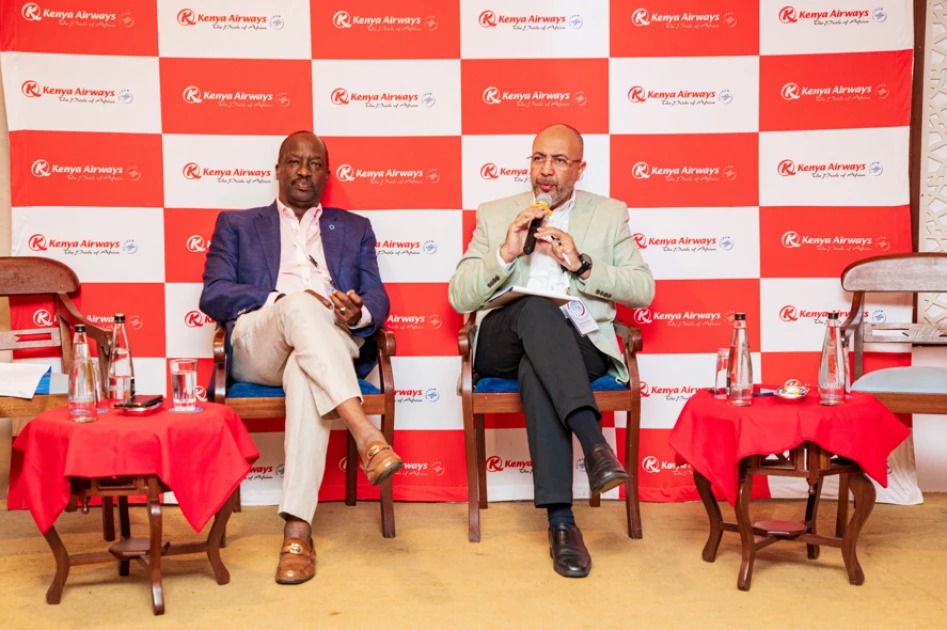
KQ chairman Kiprono Kittony and acting CEO George Kamal at the Aviation Media Lab in Mombasa
From record losses to a $2 billion investor hunt — Kenya’s national carrier is betting its future on ambition, not survival.
By MKT Reporter
Kenya Airways has launched a multi-pronged capital recovery drive, including plans to bid to become the national carrier of another African country, as its new chairman and acting chief executive set out the clearest public account yet of the airline’s path back to sustained profitability.
The disclosures were made on Thursday at the Aviation Media Lab in Mombasa, where Chairman Kiprono Kittony and Acting Chief Executive Captain George Kamal addressed journalists with a candour that the airline’s leadership has not always been known for. The mood was neither defensive nor triumphalist. It was the measured confidence of people who understand the scale of what they are dealing with — and believe they have a credible plan to deal with it.
The plan has several layers. In the immediate term, the airline is seeking short-term emergency funding to address liquidity needs while it pursues the larger prize: a strategic investor willing to inject up to $2 billion into the carrier. Acting Chief Executive George Kamal has confirmed talks with four strategic investors drawn from across the globe, including one from Africa, in what would represent the most significant infusion of outside capital in the airline’s history. The airline’s current market capitalisation stands at approximately Ksh46 billion — making the investor target roughly 5.6 times its current value on the Nairobi Securities Exchange, where its PLC listing remains a vehicle for broader public investment.
Kamal said Kenya Airways is targeting a fleet of over 50 aircraft by 2035, up from its current 37, eyeing a mix of long-range and medium and short-haul planes — but he was clear that the expansion is contingent on securing a strategic investor. “So we are looking at over 50 aircraft by 2035. But for this we require an investor to be in place,” he said.
The most arresting disclosure of the Mombasa briefing was the plan to bid to operate as the national airline of a second country. Mr. Kittony did not name the country, but the ambition is significant — it would transform Kenya Airways from a single-nation carrier into a multi-state aviation asset, generating new revenue streams while extending the KQ brand across the continent. “There is a plan and you’re going to see a stronger and more robust airline. We are planning to bid for becoming a national airline for another country,” Mr. Kittony said. The strategy aligns with a broader vision of positioning Nairobi not merely as a Kenyan hub but as the principal gateway to the African continent for international capital and commerce.
Captain Kamal framed the airline’s strategic value in terms that go beyond aviation. “Kenya Airways is more than an airline — it is a strategic national instrument. Nairobi serves as the main investment entry in the nation,” he said. The language is deliberate. Kenya Airways has long struggled to translate its strategic importance into financial performance, but the argument that it is an irreplaceable piece of national economic infrastructure has gained new credibility as Nairobi’s position as Africa’s business hub has strengthened.
Mr. Kittony was equally direct about the structural challenges the airline faces. “The fundamentals for our business remain strong. We are not responding to a demand problem but a structural problem,” he said, adding: “This is a period of reset and not retreat. We are making decisions today to build a stronger, more resilient future.”
The chairman also acknowledged, with notable frankness, that the airline’s revolving door of leadership has not served it well. Since 2003, Kenya Airways has cycled through a succession of chief executives, each inheriting a different configuration of the same underlying problems. Titus Naikuni expanded the fleet aggressively between 2004 and 2014 but left behind significant debt exposure. Mbuvi Ngunze presided over record losses exceeding Ksh25 billion between 2014 and 2017. Sebastian Mikosz focused on renegotiating debt and cutting costs until 2019 but could not return the airline to profitability. Allan Kilavuka took the helm during the Covid-19 pandemic — perhaps the worst moment in commercial aviation history — and managed to steer the carrier back toward financial health. In 2024, Kenya Airways recorded its first pretax profit in many years, reporting Ksh5.53 billion against a loss of Ksh22.86 billion the previous year, aided significantly by foreign exchange gains of Ksh10.55 billion and a strengthening shilling.
Captain Kamal was elevated from Chief Operating Officer to Acting Chief Executive in December 2025, following Kilavuka’s departure after six years in the role. The reconstituted board — which includes economist Dr. David Ndii, corporate strategist Chris Diaz, and finance scholar Prof. Winnie Iminza Nyamute alongside Mr. Kittony — is tasked with overseeing the capital raise, fleet expansion, and route development strategy while a competitive recruitment process for a permanent chief executive runs in parallel.
The operational context is not without complication. Three wide-bodied Boeing 787 Dreamliners were grounded in the first quarter of 2025, reducing operating capacity by 20 percent — a constraint that has weighed heavily on revenue. Yet load factors have hit nearly 100 percent as the Middle East conflict reroutes passengers through Nairobi instead of disrupted Gulf hubs, providing the airline with an unexpected demand tailwind at a moment when it most needs it.
On cargo — long an underperforming area relative to the airline’s potential — Kamal said KQ is targeting a jump from its current 11 percent market share at Jomo Kenyatta International Airport to 30 percent, underpinned by four dedicated cargo aircraft and plans for long-range freighter capacity. Cargo growth, combined with fleet expansion, a strategic investor, and the possible addition of a second national carrier mandate, would fundamentally reshape the airline’s revenue base.
Mr. Kittony said the 2025 results should be seen “within the broader context of an industry facing unprecedented operational constraints, but still underpinned by strong fundamentals, mainly strong travel demand.” It is a fair characterisation. Kenya Airways is not a broken airline. It is a structurally constrained one, operating in a market that is growing faster than almost any other in the world, in a hub city whose connectivity is increasingly indispensable to the continent.
The board appointments followed a public commitment by President William Ruto to refresh the airline’s leadership as part of a broader push to stabilise the carrier and attract new capital. That political backing matters — but it is the $2 billion investor conversation, the fleet expansion plan, and the audacious bid to fly under a second nation’s flag that will ultimately determine whether this particular chapter of Kenya Airways’ story ends differently from the ones that came before.
The Pride of Africa has been through tougher moments. The question is whether, this time, the plan is bigger than the problem.
Similar Posts by The Mt Kenya Times:
- Ruto passes the baton as Africa’s trade bloc faces a fragmenting world
- Kenya’s recall law: Parliament sets the threshold — but the real test comes in 2027
- Kenya’s deadliest bridge to be replaced in KSh7.5B project
- Shell V-Power Tanker among seven merchant shipping tankers calling at the port of Mombasa
- KRA’s new import rules: Will mandatory cargo insurance push up the cost of goods?
About the Author