Kagwe calls for global ban on hazardous agrochemicals, puts farmers at centre of reform agenda

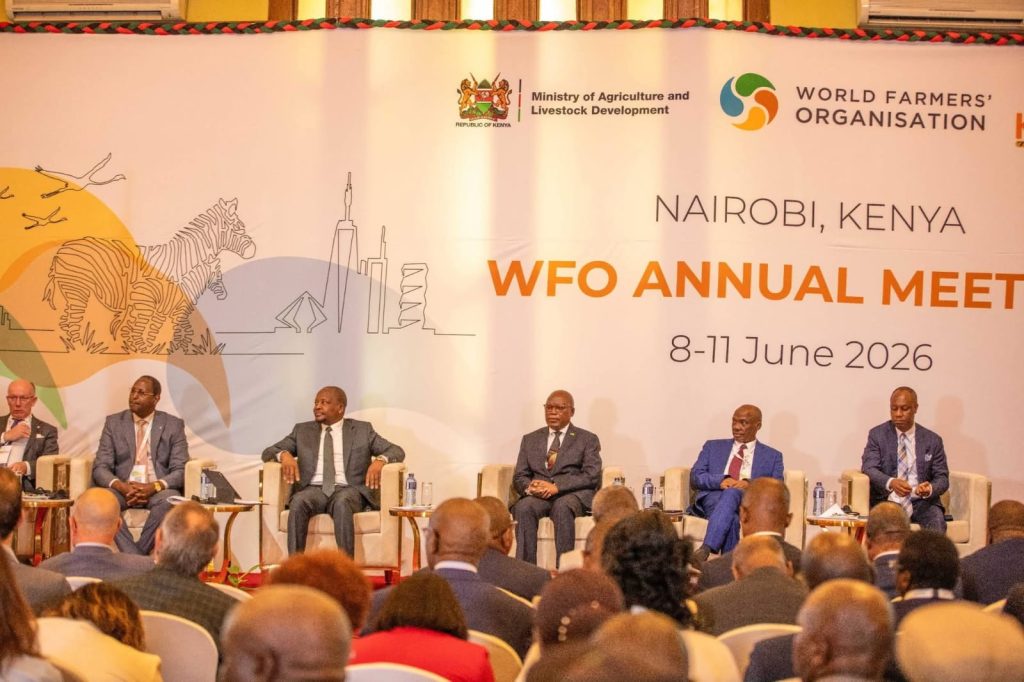
CS Mutahi Kagwe addressing the forum yesterday.
By WMW
Cabinet Secretary for Agriculture and Livestock Development Mutahi Kagwe has called for urgent global action to eliminate hazardous agricultural chemicals and end what he described as a long-standing double standard that exposes farmers in developing countries to substances banned elsewhere due to health and environmental risks.
Speaking yesterday during the opening of the 2026 World Farmers’ Organisation (WFO) General Assembly in Nairobi, Kagwe urged governments, regulators, manufacturers and international organisations to harmonise global standards governing agricultural chemicals and place farmers’ welfare at the centre of agricultural policy and investment.
“The world cannot continue operating under a double standard when it comes to agricultural chemicals,” Kagwe said. “If a pesticide is considered unsafe for use in one country because it poses unacceptable risks to human health or the environment, it should not find a market elsewhere simply because farmers are poorer or regulations are weaker.”
Addressing delegates drawn from farmers’ organisations, development partners, agribusiness leaders and policymakers from across the world, the Cabinet Secretary argued that the lives and health of farmers in developing countries must be valued equally.
“The life of an African farmer is not worth less than the life of a farmer in other parts of the world. The health of consumers in developing countries matters just as much as the health of consumers anywhere else in the world,” he said.
Kagwe warned that unsafe agricultural chemicals and counterfeit farm inputs continue to pose a major threat to food safety, public health, environmental sustainability and access to international markets. He called for stronger collaboration among governments, regulators, traders, manufacturers and farmers to combat the illegal trafficking, counterfeiting and misuse of agricultural inputs.
“Unsafe chemicals entering our markets through informal channels undermine public confidence, threaten export markets and expose farming communities to unnecessary risks,” he noted.
The Cabinet Secretary emphasized that protecting farmers must go beyond increasing productivity and market access to include safeguarding their health and wellbeing.
“Food safety begins at the farm. Consumer confidence begins at the farm. Public health begins at the farm. Therefore, protecting farmers must begin with protecting their health,” he said.
Kagwe used the forum to challenge the international community to rethink agricultural development by placing farmers—not merely food systems—at the centre of global policy discussions. He observed that while global conversations on food security, climate adaptation, financing and agricultural productivity have intensified, insufficient attention has been paid to the welfare, dignity and prosperity of farmers themselves.
“The farmer has become the missing centre in discussions about agriculture. This Assembly must therefore be about more than food systems. It must be about the people who sustain those food systems,” he said.
The CS also highlighted long-standing inequalities in global agriculture, noting that farmers in developed countries continue to benefit from extensive public support while smallholder farmers in developing nations are often expected to compete in the same markets with limited assistance. He argued that investment in farmers should be viewed as a strategic investment in economic growth, food security and national stability rather than a cost.
Kagwe further called for reforms in agricultural financing, urging financial institutions to develop products tailored to agricultural realities, including crop cycles, climatic risks and long-term investment horizons.
At the same time, he highlighted Kenya’s efforts to modernise agriculture through technology and data-driven systems, citing the Kenya Integrated Agricultural Management Information System (KIAMIS) as a key tool in improving service delivery, digital subsidies, traceability and planning.
He emphasized that technology should be used to empower farmers rather than replace them and urged researchers to ensure innovations move beyond laboratories and academic journals to deliver practical solutions on farms.
As delegates begin deliberations at the WFO General Assembly, Kagwe challenged global leaders to ensure that every policy, investment and recommendation emerging from the conference is guided by one principle: putting farmers first.
Similar Posts by The Mt Kenya Times:
- Mt Kenya Times ePAPER September 19-20, 2026
- Kenya joins US and UK to put citizens on the terrorism frontline
- Kenya’s parliament races to tame the AI frontier
- Kalonzo calls Ruto to order over Uhuru attacks
- Gachagua takes his 2027 campaign to America
About the Author