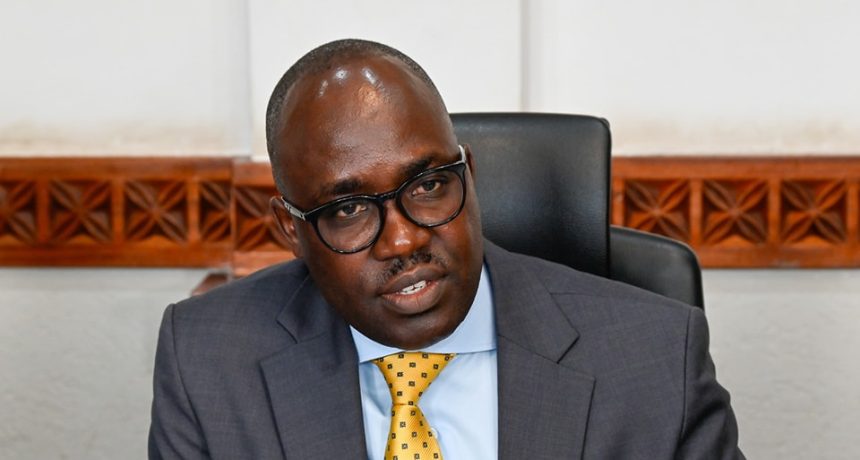
Dr Korir Sing'Oei, Principal Secretary for Foreign Affairs
Nairobi welcomes reversal after a sharp diplomatic protest, but Uganda, South Sudan and the Democratic Republic of the Congo remain on Israel’s restricted list
By MKT Reporter
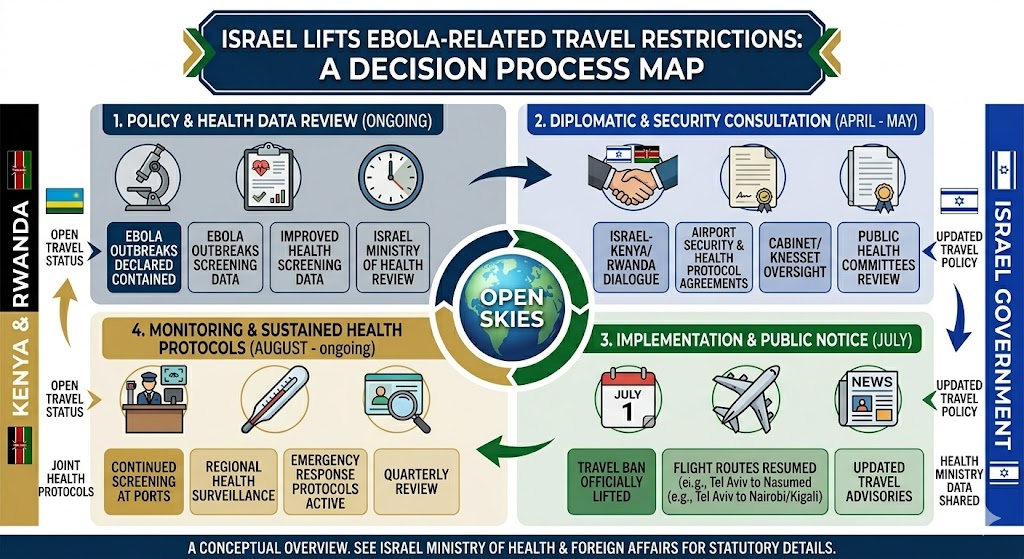
Israel has removed Kenya and Rwanda from its list of countries subject to temporary Ebola-related entry restrictions, the country’s Ministry of Health confirmed at the weekend, ending a five-day travel dispute that had strained relations between Nairobi and Jerusalem. In a statement, the ministry said it was pleased to announce the decision to lift the restrictions on the two countries, which had been introduced as a precautionary measure amid concern over the worsening Ebola outbreak in the wider region.
The reversal follows a directive issued by Israel’s Border Control Department on 10 June, which had barred airlines from allowing passengers from Kenya, Uganda, Rwanda, South Sudan and the Democratic Republic of the Congo to board flights bound for Israel. The order also applied to foreign nationals of any country who had visited any of the five states within 21 days of their planned arrival. Airlines were instructed to screen passengers before departure and to deny boarding to anyone meeting the criteria, although the measures did not apply to Israeli citizens or permanent residents, who would instead face health screening on arrival.
Israel’s Ministry of Health said the original recommendation had been informed by a professional risk assessment that considered the spread of the outbreak in the DRC, confirmed infections in Uganda, and the movement of at-risk populations toward South Sudan, Rwanda and Kenya. The ministry stressed that the move was precautionary, citing the severity of Ebola, its high mortality rate and the complexity of managing suspected or confirmed cases, even though there was no known case of the disease in Israel and the overall public risk to the country remained low.
Kenya’s reaction to its initial inclusion on the list was swift and pointed. Dr Korir Sing’Oei, Principal Secretary for Foreign Affairs, issued a formal protest yesterday, describing the decision as unjustified given the country’s public health record. “Kenya strongly protests the decision by Israel to include the country amongst those whose travellers it will restrict,” he said, adding that the move was unfortunate given Kenya’s support for regional Ebola surveillance and response. He noted that the country had carried out more than 80,000 Ebola tests without recording a single confirmed case.
 When Israel reversed its position on Kenya and Rwanda, Sing’Oei welcomed the decision in markedly warmer terms. “We welcome very much the decision of Israel to vacate the inclusion of Kenya from the list of countries subject to Ebola-related restrictions,” he said. “We are grateful for your sensitivity, friendship and partnership.” The exchange, in the space of a few days, illustrates how quickly a public health measure introduced thousands of kilometres away can ripple into the heart of bilateral diplomacy, and how readily it can be resolved once both sides are seen to engage constructively.
For travellers, the practical implications of the reversal are immediate. The lifting of the restrictions is expected to ease disruption for passengers and restore normal aviation links between Kenya and Israel, routes that had been thrown into uncertainty by the original directive. Business travellers, tourists, students and members of the Kenyan diaspora who had faced the prospect of being turned away at check-in counters can now plan journeys without that additional barrier. For Rwanda, the decision carries similar weight, removing a restriction that had grouped Kigali alongside countries with active transmission despite Rwanda recording no outbreak of its own.
The episode also has a reputational dimension for Kenya that extends beyond Israel. Health authorities in Nairobi have continued to stress that the country remains free of any confirmed Ebola case despite heightened vigilance linked to the outbreak in the DRC and Uganda. Officials say more than 100,000 international travellers have been screened at airports and border crossings since the regional outbreak intensified, with roughly 3,000 people now screened daily at designated points of entry. The government has also outlined plans, developed in partnership with the United States, to establish 23 Ebola isolation and treatment centres across the country, part of a broader effort to demonstrate readiness rather than merely respond to restrictions imposed by others.
Not every element of that partnership has proceeded smoothly. A separate proposal to build a 50-bed isolation and quarantine facility at Laikipia Air Base, intended for American citizens potentially exposed to the virus in the DRC, has drawn public opposition in Kenya and prompted scrutiny from senior officials, underlining how sensitive the politics of Ebola preparedness have become even when the underlying intention is cooperative.
Crucially, Israel’s decision to lift restrictions on Kenya and Rwanda while keeping Uganda, South Sudan and the DRC on its restricted list suggests an approach calibrated to the epidemiological picture rather than a blanket regional response. Uganda has recorded confirmed Bundibugyo cases linked to cross-border transmission from the DRC, while the DRC itself remains the epicentre of an outbreak that has spread across more than 30 health zones in three provinces. By contrast, Kenya and Rwanda have not recorded confirmed cases, a distinction that Nairobi’s diplomats argued should have been reflected from the outset.
For Kenya, the outcome offers a measure of vindication, but also a reminder. The country’s standing as a regional hub for travel, trade and diplomacy depends on its public health credibility being recognised promptly by partners abroad, not asserted after the fact. As the Ebola outbreak in the DRC and Uganda continues to evolve, further reviews of travel advisories by Israel and other states are likely, and Nairobi will be watching closely to ensure that its record of zero confirmed cases continues to count for something on the world stage.
Similar Posts by The Mt Kenya Times:
- Mt Kenya Times ePAPER October 1, 2026
- Museveni backs Lamu but keeps Uganda’s money at home
- Sifuna’s party wins its name — and Kenya’s opposition race begins in earnest
- Lamu’s $16B gamble: Africa’s biggest refinery divides the region
- Ruto launches KSh2.2 trillion Lamu refinery in East Africa’s biggest energy bet
About the Author