
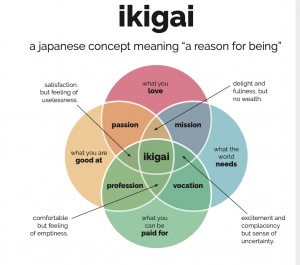
Ikigai.


By: Firdaus H. Salim
Worth Noting:
- The media loves peddling stereotypes of the “geeky, awkward tech nerd,” such as a reclusive genius working out of a basement. The reality is different. Lots of people work in tech — extroverts, people with rich lives outside of their day jobs, and people from all walks of life. But the media reports do have one thing right: There is still a lot of room for improvement when it comes to diversity.
- According to the World Economic Forum Global Gender Gap 2021 Report, Women take just 14% of the workforce in cloud computing, 20% in engineering, and 32% in data and AI.
- Another recent report that asked 9,000 technologists about racial discrimination at work found that Black respondents were most likely to experience it (48%), followed by Hispanic/Latino(a) respondents (30%), Asian/Pacific Islanders (25%), and Asian Indian respondents (23%), compared to just 9% of white respondents.
Ikigai (pronounced as ee-key-guy) is a Japanese concept that means your ‘reason for being.’ ‘Iki’ in Japanese means ‘life,’ and ‘gai’ describes value or worth. Your ikigai is your life purpose or your bliss. It’s what brings you joy and inspires you to get out of bed every day.
Jobs in the tech industry are expected to grow exponentially in the next few years. All companies, in one way or another, need to transform to keep up with the future of work. If you are planning to enter the job market soon, you may be considering one of the many opportunities in this field.
When you think of working in tech, your mind floods with the idea of owning BIG money and leading a fancy lifestyle. But there’s much more to it than that. There are as many challenges as there are advantages, and success requires hard work.
Here’s what you need to know before considering this career path.
1. You need to be open to continuously learning.
Ironically, the only constant factor in the tech industry is change. Everything is rapidly evolving to improve the user experience, meet the demand market, among other factors. The way things were done last year is not the way things are done this year, and will definitely be done differently next year.
When you work in tech, you have to be comfortable with this: Your expertise may become obsolete in a couple of years. You also have to be ready to jump into the next significant shift. If you’re not interested in continuous learning or think exams are part of your past, then this is not the right path for you. But if you are like me, excited about the role you will play in building the future, tech is definitely for you.
2. Fast pace, big rewards.
While constant change may feel exhausting to some, others find it exhilarating. The fast pace of a career track in tech means more opportunities for upward mobility. Recent graduates who take an entry-level role at a Silicon Valley startup or big tech corporation will likely see quick growth in the short term. In this industry, an internship may very well lead to a permanent job. Companies want to retain the people they’ve invested in training, as well as compete to attract new talent.
The caveat, however, is that landing these roles is not easy. The application processes are usually rigorous, but they can be aced if you’re willing to practice and prepare.
3. You don’t need to be a “techie” to work in tech.
Technology is a broad term. Many jobs require technical expertise, but that doesn’t always equate to what you may imagine: an engineer hunched over a desk coding the next big app. The roles available in tech vary from company to company, and contrary to the myth, you need soft skills — communication, collaboration, critical thinking, and flexibility — to do them well. Here are some of the common roles in the tech industry System managers, analysts, administrators, data scientists and researchers, programmers and developers, IT support, customer-facing technical roles, evangelists e.t.c
4. You should be comfortable with the remote work.
In 2020, the majority of the business world rediscovered working from home. Memes about commuting from bed and joining videoconferences with your dog, cat, or kid appeared all over the internet.
Is this new? Not for the tech industry. Tech employers have historically been more welcoming of remote work arrangements. Part of that is because some tech jobs are not 9-to-5, but are instead driven by objectives. For example, most developers work under deadlines, and people who work in critical service support handle emergencies at all hours, including the middle of the night.
While specific work arrangements will depend on your company, in my experience, most tech roles encourage employees to manage their own time and prioritize their own tasks.
At the same time, if you are not comfortable collaborating online and digital dexterity is not your strong point, you may find this kind of arrangement tedious.
5. Diversity in tech matters.
The media loves peddling stereotypes of the “geeky, awkward tech nerd,” such as a reclusive genius working out of a basement. The reality is different. Lots of people work in tech — extroverts, people with rich lives outside of their day jobs, and people from all walks of life. But the media reports do have one thing right: There is still a lot of room for improvement when it comes to diversity.
According to the World Economic Forum Global Gender Gap 2021 Report, Women take just 14% of the workforce in cloud computing, 20% in engineering, and 32% in data and AI.
Another recent report that asked 9,000 technologists about racial discrimination at work found that Black respondents were most likely to experience it (48%), followed by Hispanic/Latino(a) respondents (30%), Asian/Pacific Islanders (25%), and Asian Indian respondents (23%), compared to just 9% of white respondents. No matter your race, color or origin, this industry discriminates against no one. It is driven by innovation needs to attract people from different backgrounds.
6. It can be about purpose.
As a tech expert, you can do so much to give back to society at large — you just have to choose the right role or career path.
The health care industry, for instance, relies on new tech innovations to serve the greater good. During the pandemic, we’ve seen a surge of governments and health care providers using technologies to enable everything from remote patient consultations to diagnostic testing — solutions that were made possible thanks to the people working in tech, from developers to solution architects.
In conclusion
If you want to join an ever-changing field full of new discoveries and potential, one where you’ll never get bored, and have a chance to make an impact — then your answer may be “yes.” Tech will put you right where the growth and disruption are happening. It will take hard work, but if you are willing to adapt and learn, you will thrive.
Written by Firdaus H. Salim
Aspiring software engineer with interest in solving real-world problems with technology and dependable leadership. An avid reader exploring information technology advancements and personal development through books. Contact www.linktr.ee/firdaus_h_salim
Similar Posts by The Mt Kenya Times:
- Gen Z and religion: Are we losing faith or learning to question?
- Heckling mars Kindiki’s Tharaka-Nithi tour as Mbiuki calls for unity
- KEBS moves to strengthen fight against lead poisoning in paints
- Eastleigh collapse: Who is accountable when Nairobi’s buildings fail?
- Nairobi building collapse: Are Kenyans safe in buildings under construction?
About the Author


