How Women Chiefs In Kisii And Nyamira Are Shaping The Data Behind Kenya’s Digital Governance
 The Mt Kenya Times
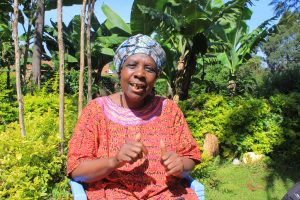
Judith Kwamboka says that digital tools are beginning to influence administration. Photo/Elizabeth Angira
By Elizabeth Angira
Few, if any, people believed that Mary Kemunto would succeed when she was appointed chief of Bogiakumu Location in Bonchari Constituency, Kisii County, in 1997.
In the highly patriarchal Gusii community, the idea of a woman chief was almost unthinkable.
“When I arrived for public meetings commonly referred to as barazas, sections of elders refused to sit when I addressed them,” recalls Kemunto. “They would ask me where my husband was and whether he approved of me being in office.”
Trailblazer who opened doors for many
Chiefs were arbiters of land disputes, custodians of law and order, and gatekeepers of state power. Kemunto stepped into this leadership position when the office of the chief symbolised male authority.
“I never imagined I would become a chief,” she says. “I was a teacher aide then, just doing my work quietly.”
Out of 12 applicants, she was the only woman.
Kemunto holds the distinction of being the first female chief in the Gusii region, which covers Kisii and Nyamira counties.
“My appointment shocked many, with some residents swearing that they would move away rather than be led by a woman,” she says.
Others, however, welcomed her, hopeful that female leadership would bring a new approach to governance.
Her appointment opened doors for many more women to pursue careers in the State Department for Administration and Field Services in the Ministry of Interior and National Administration.
Backed by the two-thirds gender rule enshrined in Article 27 of the Constitution, which provides for gender equality in governance, more women have joined the department. Data from the Kenya National Bureau of Statistics (KNBS) shows that the number of women serving as chiefs and assistant chiefs has risen over the past decade, although they still account for just one in five of grassroots administrators. In 2014, only 574 women held these positions nationally, compared to 7,902 men. By 2024, the number of women had increased to 2,367, compared to 9,262 men.
Chiefs and assistant chiefs form part of the national administration system, acting as the government’s representatives at the community level. They are often the first point of contact for reporting domestic violence, child marriage, land disputes and school dropout cases. The incidents they document feed the data used to track trends and shape policy. When women are absent from these roles, many of the issues affecting women and girls risk going undocumented. This leaves gaps in the data that increasingly informs digital governance systems, yet the national artificial intelligence (AI) strategy envisions the use of AI in public administration even as it acknowledges that the country still lacks sufficient data to train AI models.
Some of that national data could come from the cases chiefs handle daily in their communities.

Stella Achoki, the director for the Centre for Community Mobilization and Empowerment (CECOME), a community-based organisation, says that for survivors of gender-based violence (GBV), women chiefs have become first responders.
Some chiefs recount receiving distress calls at midnight from women fleeing abuse, girls escaping child marriages, or parents seeking help for children who have been sexually abused.
In extreme cases, a few chiefs have opened their own homes as temporary safe spaces when formal shelters were inaccessible.
Achoki says that these actions reveal a form of governance that centres on human dignity, particularly for those historically excluded from justice systems. The impact is that women and girls are more willing to report abuse.
“Before, we feared going to the chief,” says Rodah Nyagaka. “Now we know she will listen.”
Kisii County Woman Representative Dorice Donya says that citizen engagement has improved under women chiefs. Barazas are more inclusive, giving women, youth and persons with disabilities a voice in community discussions.
“When women lead, people talk more,” says Donya. “And when people talk more, governance improves.”
Leadership rooted in care
Despite the resistance many faced in their early days in office, including from male colleagues, what distinguishes many women chiefs is the way they wield authority
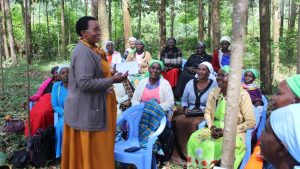
Jane Moraa, 50, emerged as the best – and only woman – among 17 shortlisted candidates to be appointed the assistant chief of Nyoera Sub-Location in Bobasi Constituency, Kisii County, in 2003.
“Some male applicants went to the county commissioner to complain,” she says. “But the results spoke for themselves, and the county commissioner stood firm.”
“Whenever a woman is appointed a chief, her leadership is scrutinised, her decisions questioned and her authority openly challenged,” says Moraa.
“You have to use dialogue rather than force, relationships rather than raw power, and, over time, scepticism gives way to trust,” adds Kemunto.
Over time, it becomes clear that the very qualities critics dismiss as weakness—patience, listening and negotiation—are some of the most effective leadership tools. Their leadership style often centres on empathy, an attribute frequently dismissed as “soft” yet proving transformative at the grassroots.
Instead of confrontation, many choose persistence.
During her tenure, Kemunto worked closely with elders, respecting cultural structures while firmly upholding the rule of law.
“I consulted elders when handling cases, but I never compromised on justice,” she says.
Jane Bosibori, a widow, recalls how Kemunto intervened when relatives tried to evict her from her late husband’s land.
“She did not come with police,” Bosibori recalls. “She came alone, engaged the elders and amicably resolved the matter, protecting my right to stay on the land my late husband left me.”
Samwel Bosire, the Secretary General of the Abagusii Council of Elders, says this kind of gender-inclusive governance expands leadership approaches to better reflect community needs.
New tools of trade
 As women chiefs join the ranks of grassroots administration in communities that once resisted their leadership, the tools they rely on to manage communities and document their needs have also evolved.
When Kemunto began her career in the late 1990s, long before smartphones, the internet, dashboards, or data analytics, administering a location depended almost entirely on physical presence and personal networks.
She covered long distances on foot and discharged her duties under trees, in churches or in people’s homesteads. She would often learn of disputes needing her intervention from a neighbour or a child running barefoot to her home.
“This was the only way to reach my people and enlighten them about government policy, resolve disputes or attend to a security matter,” says Kemunto.
Judith Kwamboka, 38, the assistant chief of Ichuni Sub-Location in Nyaribari Masaba, says that while much of the work of chiefs still unfolds face-to-face, digital tools are beginning to influence administration.
Today, phone calls, email and mobile messaging platforms are reshaping how administrators interact with communities and respond to their problems.
“Now I do not need to knock on doors and sit with families long after the sun has set to engage my people,” Kemunto explains.
Moraa uses her phone to plan her schedule, track cases and trends, and monitor gender-based violence. Through messaging platforms, like WhatsApp, linking chiefs, county officials and civil society organisations, the administrators also get updates in real time.
While chiefs are not currently using AI-enabled tools, the information they gather and the reports they file are helping create the datasets that could form the foundation for the country’s future AI-driven public administration.
Currently, chiefs use this information to identify patterns such as violence hotspots and seasonal spikes in child labour, allowing them to respond proactively.
“Technology helps us see what the eye may miss,” explains Kwamboka. “It supports evidence-based decision-making.”
However, even as chiefs use digital platforms to make their work easier, the digital divide remains stark. Many rural residents lack access to smartphones, reliable internet, and digital literacy, raising concerns that technology could reinforce inequalities if not deployed thoughtfully.
Kwamboka says women chiefs are aware of these gaps and ensure that technology complements rather than replaces community engagement.
Gender, data, and bias
The use of data-driven systems in governance also raises critical questions. Artificial intelligence systems rely on large datasets to identify patterns and guide decisions, and algorithms are only as fair as the data they are trained on. In many rural communities, cases affecting women and girls—such as domestic violence, marital property disputes or child marriages—often go unreported. When such incidents are missing from official records, they may also be absent from the datasets used by automated analysis and monitoring systems.
Women chiefs play a crucial role in closing this gap, documenting cases that might otherwise remain invisible and ensuring that women’s realities enter official data streams.
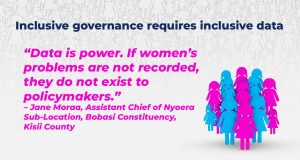
“Data is power,” says Moraa. “If women’s problems are not recorded, they do not exist to policymakers.”
Inclusive governance requires inclusive data, informed by those closest to community realities.
Resistance, risks, and resilience
Even as women chiefs change the face of governance in communities, they continue to face threats, social isolation and, in some cases, physical danger, says Henry Okari, chairperson of Amnesty International, Kisii Chapter.
“Challenging entrenched power structures, particularly around land and patriarchal authority, comes at a cost,” says Okari.
He adds that while national policies promote gender equality, implementation is inconsistent and support systems are uneven.
As Kenya moves toward digitisation and the use of artificial intelligence in governance, the data recorded by chiefs like Moraa and Kwamboka may shape how policymakers understand rural communities. Supporting the chiefs who document these experiences is critical to ensure that women’s experiences are captured and that the data shaping Kenya’s future reflects the full reality of communities they serve.
This article was produced as part of the Gender+AI Reporting Fellowship, with support from the Africa Women’s Journalism Project (AWJP) in partnership with DW Akademie. The journalist used AI tools as research aids to review and summarise relevant policy and research documents and extract key statistics. All interviews, analysis, editorial decisions and final wording were done by the reporter, in line with Mt Kenya Times’ editorial standards.
Similar Posts by The Mt Kenya Times:
- Your certificate has no power of its own: It borrows power from the brand you are killing
- Kinoti Marete backs Samburu security operation, rallies Meru aspirants to PPK
- Gusii innovators call for collective action to advance climate-smart food systems
- The blind lady’s dagger: When “social justice” sharpens Kenya’s laws into political blades
- A relational school will always outperform a transactional one
About the Author