The Mt Kenya Times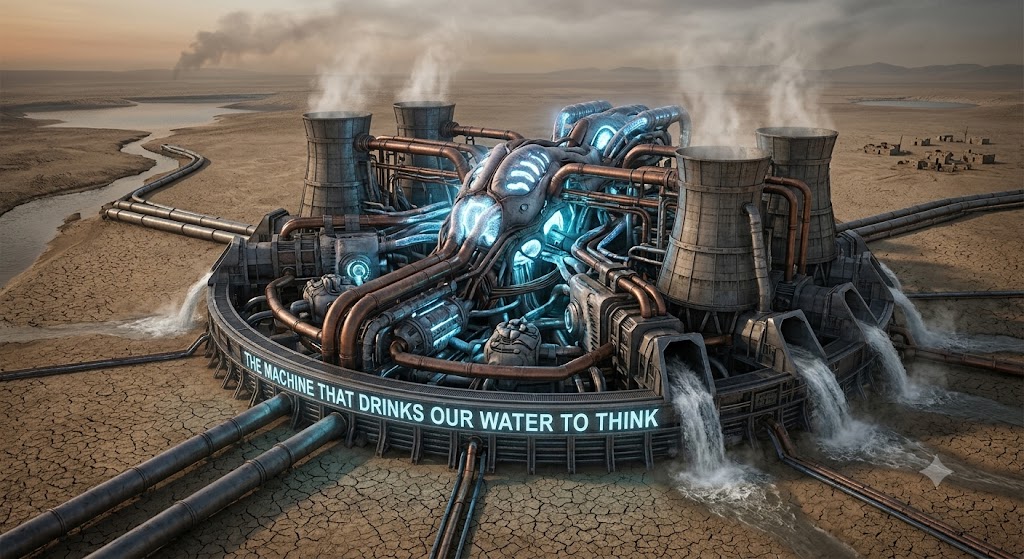
By Jerameel Kevins Owuor Odhiambo
By 2030, the servers holding up the world’s artificial intelligence will draw down close to 945 terawatt-hours of electricity in a single year. Set that figure beside the combined national consumption of Pakistan, Bangladesh, and Nigeria three countries carrying more than 650 million lives between them and the machine’s appetite outpaces theirs nearly threefold. It does not stop at electricity. Every kilowatt a data centre burns arrives with two silent companions: a thirst measured in water, and a hunger measured in land. Researchers at the United Nations University have now put figures to both. Water drawn to cool these facilities and generate their power could, within four years, match what 1.3 billion human beings need for basic domestic survival in a year. Land claimed for power generation and its supporting supply chains could exceed 14,500 square kilometres, an area twice the footprint of greater Jakarta.
These are not projections whispered in activist pamphlets. They sit inside a peer-reviewed study, and they demand to be read the way one reads a title deed carefully, because someone’s boundary is being redrawn.
Here is the part that should trouble anyone who has ever queued at a borehole at five in the morning: the conversation about AI’s environmental toll has been trained, almost obsessively, on carbon. Emissions from building and training the large models get the headlines, the summits, the pledges. Meanwhile, the study finds that everyday use the ordinary asking, generating, and querying that happens billions of times a day accounts for eighty to ninety percent of total energy demand. One popular AI service alone processes an estimated 2.5 billion prompts daily, burning through hundreds of gigawatt-hours annually just answering questions. A single AI-generated image can cost over a thousand times the energy of a simple text classification task. Video, naturally, costs more still. The bill for convenience is not paid at the training stage. It is paid every single day, quietly, by grids and rivers that never asked to be billed.
There is a second deception worth naming plainly. Something can wear the colour green and still leave a scar. Renewable energy, celebrated for cutting carbon, can in certain configurations drink more water and eat more land than the fossil alternative it replaces. A solution to one crisis becomes the seed of another, and the places absorbing that trade-off are rarely the places enjoying the convenience. This is the oldest arrangement in the extractive playbook, simply wearing new fabric.
Consider, too, the seduction of efficiency. Engineers keep making the models leaner, the chips faster, the algorithms less wasteful per query. It sounds like relief. It is not. The study names the phenomenon its proper term the rebound effect where cheaper, faster access does not reduce total consumption but multiplies it, because more people ask more of the machine more often. Efficiency, in this arrangement, functions less like a brake and more like an accelerant dressed as caution.
 Now walk the map. More than ninety percent of AI-specialized computing capacity sits inside two countries. More than one hundred and fifty nations hold no meaningful AI infrastructure of their own. This is not a footnote it is the architecture of the entire system. The intelligence gets pooled in a handful of capitals; the water, the land, the minerals, and increasingly the waste, get sourced from everywhere else. Up to 2.5 million tonnes of electronic waste a year are expected to flow from this infrastructure by 2030, and the receiving end of that flow has a familiar geography lower-income countries with the least capacity to handle it safely. The cobalt, lithium, and rare earths that make the hardware possible are pulled from ground that, more often than not, belongs to communities who will never log into the systems their soil makes possible. A continent can host the mine and miss the miracle.
None of this is an argument against intelligence, artificial or otherwise. It is an argument against amnesia the convenient forgetting of where the cost lands once the benefit has been enjoyed elsewhere. And forgetting is a choice, which means remembering can be one too.
Start with disclosure. No data centre should be permitted to expand in a water-stressed basin without publishing its water and energy footprint the way a company discloses its financial statements audited, public, comparable. Investors have learned to read a balance sheet; regulators must now learn to read a watershed.
Follow with siting discipline. Infrastructure planning should treat drought maps and grid capacity as load-bearing decisions, not afterthoughts bolted on after the ribbon-cutting has been scheduled. A facility proposed for a region already rationing water is not a development project it is a wager against the people who live there.
Insist on shared infrastructure for the excluded majority. Regional computing hubs, cooperatively financed and hosted across the more than 150 nations currently locked out, would let countries capture some share of the value their resources help generate, rather than exporting minerals and importing bills. Kenya, sitting on geothermal capacity that is both abundant and comparatively water-light, is better positioned than most to make that argument from strength rather than supplication.
Price the externality properly. A carbon tax that ignores water and land is only reading half the ledger. Any serious climate framework applied to digital infrastructure must account for all three footprints together, because a policy that fixes emissions while quietly draining an aquifer has not solved a problem it has relocated one.
And finally, build the right to refuse into law. Communities asked to host a data centre deserve the same standing as those asked to host a mine or a dam: the right to see the full environmental accounting before ground is broken, and the standing to say no.
The cloud, for all its weightless branding, is one of the heaviest things humanity has ever built. It sits on rivers, on soil, on the backs of nations that will never see the dashboard. A civilisation that can teach a machine to think might yet manage the harder task teaching itself to remember who pays when it does.
The writer is a legal researcher
Similar Posts by The Mt Kenya Times:
- Mt Kenya Times ePAPER October 17-18, 2026
- Ruto bets billions on Kerio Valley — with one eye on 2027
- Ruto’s health ministry kills Murang’a’s digital hospitals
- Kenya bets on Mount Kenya to drive a billion-shilling tourism revival
- Do you have a wealth vision? Or are you just working until you die?
About the Author