We have normalised the abnormal: The quiet crisis eating away at Kenya
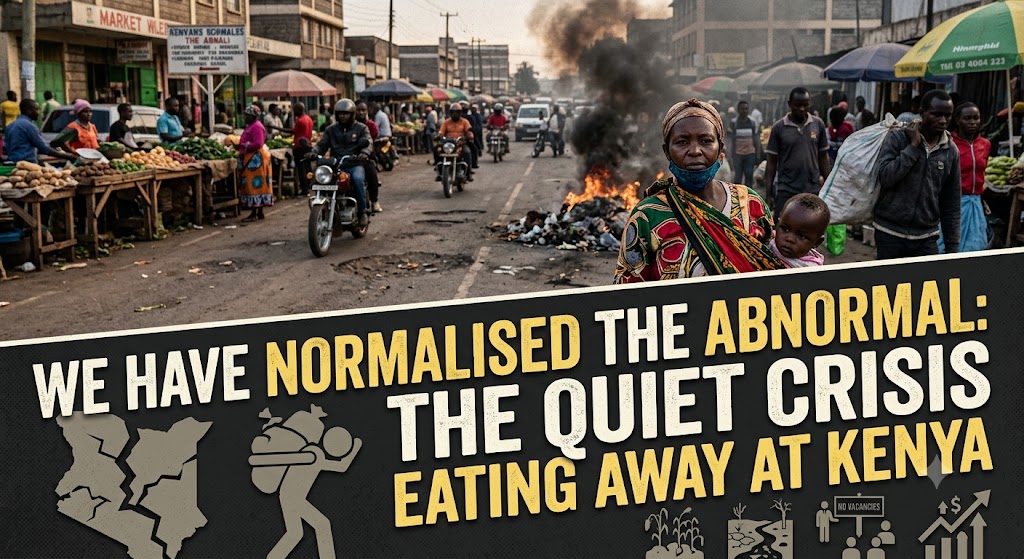
The greatest threat facing this nation is not the problems we face — it is the moment we accept them as permanent
By Levis Wangamati
Some crises arrive with sirens, protests, and breaking news alerts. Others come quietly — settling into daily life until we no longer notice them, becoming routine, then culture, and finally our definition of normal. The slow ones are always the most dangerous, precisely because they do not trigger alarm. They do not demand a response. They simply wait, patient and persistent, until the people they afflict have forgotten that things were ever different.
That is the crisis confronting Kenya today.
Somewhere along the way, we stopped being shocked. We stopped demanding better. We adjusted our expectations downward and convinced ourselves that survival was the same thing as progress. The abnormal became ordinary. The unacceptable became acceptable. Outrage turned seasonal, and accountability became optional — something we reached for briefly during elections and set aside just as quickly once the votes were counted.
We now celebrate what should be unremarkable because we have forgotten what excellence looks like. We applaud basic service delivery as though it were an extraordinary achievement. We praise a public official for simply doing the job they were hired and paid to do. We treat honesty as though it were a rare gift rather than a basic expectation, and integrity as though it deserves a standing ovation rather than being the minimum standard we ought to demand. In doing so, we have quietly lowered the bar — for ourselves, and for those entrusted to lead us.
The consequences of that lowered bar accumulate in ways that rarely make headlines. They show up in the patient who waits three days on a hospital corridor because the ward has no beds and the staff have no supplies. They show up in the student who passes her examinations with distinction and still cannot find a job without a connection to someone who knows someone. They show up in the small business owner who pays his taxes faithfully and still has to budget for the unofficial fee that makes his licence application move. These are not dramatic moments. They do not trend. But they are the texture of daily life for millions of Kenyans, and we have grown so accustomed to them that we have stopped seeing them as failures of the state. We see them instead as facts of life.
This culture extends well beyond politics. It lives in our schools, our offices, our businesses, and our homes. We criticise corruption at the dinner table, yet sometimes offer a bribe the following morning to avoid an inconvenience at the roadside. We condemn dishonesty loudly, yet excuse it quietly when it works in our favour or when the person practicing it is someone we like. We demand integrity from leaders while hesitating to practise it in our own daily dealings. The gap between what we say we believe and what we actually do has become one of Kenya’s most consequential and least discussed problems.
Before we blame the country, we must first examine ourselves. Nations do not become dysfunctional on their own — they reflect the accumulated choices of their people. Every time we defend incompetence because it favours us, stay silent when truth demands that we speak, look away when we witness wrongdoing in our own workplaces, or excuse dishonesty because it is committed by “our own,” we become active participants in the very culture we claim to oppose. Complicity dressed in silence is still complicity.
Social media has deepened this habit considerably. Every scandal dominates our screens for a few intense days before vanishing beneath the next trending topic, the next viral video, the next outrage that demands our immediate attention and receives our immediate forgetting. We move from one national crisis to another without pausing long enough to insist on lasting solutions, without following up, without holding anyone to account for the promises made during the previous news cycle. We have become a society that remembers headlines but forgets lessons — and that collective forgetfulness is something that those who benefit from impunity understand and rely upon.
The greatest victims of this normalisation are the young. They are told to dream big, to work hard, to trust the system. Yet they grow up watching merit compete with connections, integrity struggle against shortcuts, and patience lose repeatedly to instant gratification. They see the evidence every day — in who gets the job, who gets the contract, who faces consequences and who does not. If this is the normal they inherit, if this is the Kenya we hand them without apology or effort to change it, then we have failed the very generation that should build something better.
The danger is not merely that young Kenyans are frustrated. The deeper danger is that they are adapting. That the most talented among them are concluding that the only rational response to a broken system is to learn how to navigate it rather than fix it. A nation loses something essential the moment its youth stop believing that things can be different.
Yet there is another path available to us, and it begins not with a policy or a politician but with a decision.
Kenya has never lacked talent. It has never lacked resilience or creativity or the capacity for hard work under difficult circumstances — these qualities are evident every single day in markets, in classrooms, in clinics, and on construction sites across the country. What we lack is the collective refusal to accept mediocrity as our ceiling. Nations rise when citizens raise their expectations and refuse to lower them. They prosper when honesty becomes ordinary rather than exceptional, when competence becomes non-negotiable rather than a pleasant surprise, and when accountability becomes a daily expectation rather than an election-season slogan that evaporates the moment the results are declared.
The future of this country will not be decided solely by those who occupy public office. It will also be decided — perhaps more fundamentally — by the standards that ordinary citizens choose to uphold every single day. Every classroom, every workplace, every business transaction, every ballot cast, and every conversation held at a kitchen table is a moment in which Kenya’s national character is either strengthened or weakened. The aggregate of those private choices is what a nation actually is, beneath the speeches and the ceremonies.
The quiet crisis eating away at Kenya is not simply corruption, unemployment, or political rivalry, damaging as each of those things is. It is our growing willingness to believe that these conditions are permanent — that this is simply how Kenya works, how it has always worked, and how it will always work. That fatalism is more corrosive than any single scandal, because it removes the one thing that every genuine reform requires: the belief that change is possible.
The day Kenyans stop accepting the unacceptable is the day genuine change becomes possible. A nation does not rise by learning to live with the abnormal. It rises the moment it refuses — firmly, collectively, and without apology — to call the abnormal normal.
Similar Posts by The Mt Kenya Times:
- Porsche 911 GT3: The driver’s car that defies the spec sheet
- Name, shame, ban: Police put violent political actors on notice ahead of 2027
- Kanja puts recruits through their paces ahead of Kiganjo passing-out
- Humbelani Priscilla Nemanzemba: Building Africa’s entrepreneurial future, one business at a time
- Salary: The sweetest contraceptive ever invented
About the Author