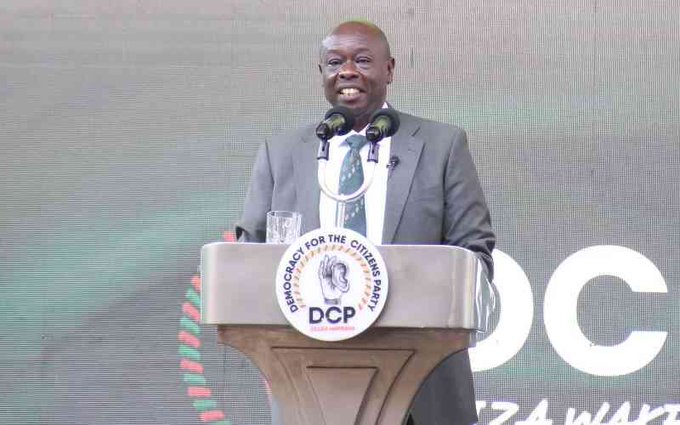
Democracy for the Citizens Party (DCP) leader Rigathi Gachagua
Kenya’s impeached former deputy president has delivered his most forensic assault yet on William Ruto’s government, accusing the president of state capture, systematic looting and engineering his own billionaire status on the backs of 55 million Kenyans.
By David Kimani
Rigathi Gachagua stood before journalists in Nairobi yesterday and did what Kenya’s political establishment has rarely seen done so openly: he named figures, cited institutions, quoted valuations and accused a sitting president of being a dollar billionaire built on stolen public wealth. It was not a political rally speech. It was a prosecutorial address — methodical, detailed and deliberately designed to follow William Ruto into the 2027 election campaign like a shadow that will not lift.
The Democracy for the Citizens Party leader, impeached as deputy president in October 2023 after a falling-out with Ruto that has since curdled into open warfare, has spent months sharpening his critique of the administration he once served at the second-highest level. Yesterday’s address in the capital represented the sharpest edge yet — a speech that moved beyond political rivalry into something closer to a documented indictment, one that the government will find difficult to dismiss with the usual denials.
“Over the last four years, William Ruto has captured the state,” Gachagua said, his voice measured and deliberate. “He has focused on centralising control of independent constitutional commissions, state entities, public sector procurement and the sale of strategic national assets. All these measures are aimed at achieving the objective of enriching himself at the expense of 55 million Kenyans.” He did not stop there. “He has achieved the milestone of being certified as a US dollar billionaire in a four-year record, courtesy of looting Kenyan public coffers.”
The allegation of dollar billionaire status is extraordinary even by Kenya’s turbulent political standards. Gachagua offered no independent audited evidence to substantiate the claim, and the presidency has consistently denied wrongdoing in relation to Ruto’s personal finances. Yet the specificity of the charge — and the platform from which it was made — ensures it will circulate far beyond yesterday’s press conference and lodge itself in the public consciousness precisely when Ruto needs to be constructing his re-election narrative.
The numbers Gachagua cited were designed to be remembered. He claimed the current administration borrows an average of KSh3.5B daily while simultaneously stealing KSh3B daily from public resources. He broke that figure down with the precision of a forensic accountant: KSh125 million stolen per hour, KSh2 million per minute, every minute, around the clock. Whether or not the arithmetic withstands independent scrutiny, the rhetorical effect was immediate. These are not abstract policy failures. These are figures that translate into the cost of a classroom, a hospital bed, a borehole — and Gachagua knows it.
He turned next to what he described as the systematic weaponisation of flagship government programmes. The Hustler Fund, which Ruto championed as a financial lifeline for ordinary Kenyans during the 2022 campaign, has become, in Gachagua’s framing, a hollow symbol of broken faith. The Affordable Housing project — announced with considerable fanfare as a plan to build 250,000 units annually — has delivered nowhere near that figure in four years, and Gachagua alleged it has been converted into a mechanism for acquiring public land and cornering construction material supply chains for the benefit of those connected to power. The Social Health Authority, introduced to replace the National Hospital Insurance Fund, has attracted its own controversy since launch, with widespread complaints about functionality and access that have made it politically toxic in many constituencies.
The most pointed section of Gachagua’s address concerned Sidian Bank. He alleged that the financial institution, in which Ruto has an interest, has undergone a transformation in asset base that correlates directly with the president’s time in office. “Sidian is valued at KSh95B, comprising KSh74B in customer deposits and a reported KSh1.7B net profit in the year ending 2025,” Gachagua said. “Notice the sudden change in fortune — it had KSh42B in assets in 2022 and KSh30B in customer deposits. Since William Ruto bought it, you can see the transformation.” He alleged that state institutions and the Nairobi County Government had been directed to deposit public funds into the bank, inflating its balance sheet to the benefit of its owner. Sidian Bank has not publicly responded to the allegations. The Central Bank of Kenya has not commented.
What makes yesterday’s speech politically significant is not merely what was said, but who is saying it and why it is likely to be heard differently from what any opposition leader could offer. Gachagua was there. He sat in Cabinet. He attended the security briefings. He was in the room when decisions were made. His accusations carry the implicit weight of insider knowledge, even when they cannot be independently verified, and that is precisely what makes them so difficult for the government to neutralise. Dismissing him as a disgruntled former ally is possible. Explaining away the specificity of the figures he cites is considerably harder.
The broader political context sharpens the significance further. Kenya is entering the gravitational pull of the 2027 election cycle, and the battle lines are being drawn with unusual clarity. Gachagua’s DCP is positioning itself as the vehicle for Mount Kenya’s political grievances, a region that delivered decisive votes for Ruto in 2022 and now feels, in the assessment of many community leaders, that the bargain was not honoured. The former deputy president’s public profile in that region remains substantial, and his ability to frame Ruto’s record in terms of personal enrichment rather than policy failure gives the critique a populist edge that resonates well beyond Nairobi’s political class.
Gachagua closed with a direct challenge. He warned Ruto that his four-year track record would be subjected to intensive scrutiny as the election approaches, and urged him to seek a second term on the basis of results rather than a fresh set of promises. “Kenyans,” he said, “have heard the promises. What they are waiting for now is the reckoning.”
It was a closing line calibrated for a campaign, not a press conference. Rigathi Gachagua is no longer merely an impeached former official nursing his wounds. He is a candidate in all but formal declaration, and yesterday’s address in Nairobi was less a speech than an opening statement to a jury that will deliver its verdict in August 2027.
The trial, in every meaningful sense, has begun.
Similar Posts by The Mt Kenya Times:
- Mt Kenya Times ePAPER October 1, 2026
- Museveni backs Lamu but keeps Uganda’s money at home
- Sifuna’s party wins its name — and Kenya’s opposition race begins in earnest
- Lamu’s $16B gamble: Africa’s biggest refinery divides the region
- Ruto launches KSh2.2 trillion Lamu refinery in East Africa’s biggest energy bet
About the Author