The extortion charge: Ichung’wah fires back at Gachagua with KSh300M allegation
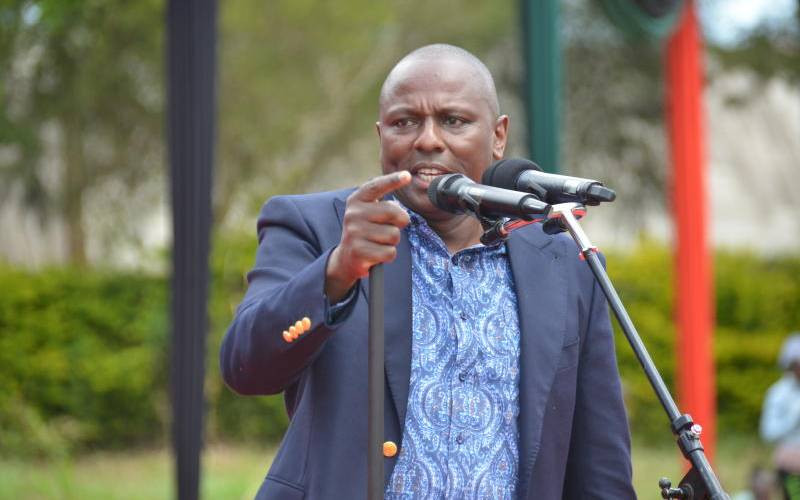
Kimani Ichung'wah
The government’s parliamentary front man has accused Kenya’s most vocal opposition critic of attempting to extort millions from a Chinese state firm while serving as deputy president — a counter-strike that signals the ruling coalition is done playing defence.
By Grace Wanja
National Assembly Majority Leader Kimani Ichung’wah yesterday accused former Deputy President Rigathi Gachagua of attempting to extort KSh300 million from the China Road and Bridge Corporation while serving as the country’s second-in-command, escalating the most combustible political feud in Kenya’s recent history into territory that could have serious legal consequences for both sides.
The accusation, delivered at Parliament grounds in Nairobi with a phalanx of broad-based lawmakers standing behind him, was the government’s most direct and specific counter-offensive yet against Gachagua, who a day earlier had accused President William Ruto of state capture, systematic looting and achieving dollar billionaire status through the plunder of public coffers. Where Gachagua had spoken in the language of financial forensics, Ichung’wah responded in the language of criminal allegation — and the charge he levelled was unambiguous.
“Rigathi’s bitterness with China Road and Bridge Corporation exposes his insatiable greed,” Ichung’wah said. “While calling others corrupt, Gachagua is the high priest of corruption. He attempted to extort KSh300 million from CRBC when he was deputy president for their alleged transgressions during the Uhuru Kenyatta regime.” The Kikuyu MP added that CRBC, as a state-owned enterprise of the Chinese government, had declined the alleged demand, citing the fact that its contracts are governed by Kenyan law and subject to scrutiny by institutions including the Public Procurement Regulatory Authority.
The allegation is significant on multiple levels. CRBC is one of the most prominent Chinese contractors operating in Kenya, responsible for major infrastructure projects including sections of the Standard Gauge Railway and various road construction programmes. Any suggestion that a serving deputy president sought to leverage the corporation’s past conduct for personal financial gain would, if substantiated, constitute a serious abuse of office. Gachagua has not yet formally responded to the specific CRBC allegation. His office did not issue a statement by the time of publication.
Ichung’wah did not stop at the CRBC claim. He also alleged that Gachagua had separately demanded KSh10B to, in his words, “fix Mount Kenya politics” during his tenure in government — a charge that, if true, would suggest the former deputy president ran a political operation of extraordinary financial ambition from within the executive itself. No supporting documentation was produced at the press conference, and the majority leader did not indicate whether the matter had been referred to investigative authorities.
What the press conference made clear, however, is that the Kenya Kwanza administration has made a strategic decision to confront Gachagua’s narrative with a counter-narrative of equal aggression rather than the studied silence or mild rebuttals that characterised earlier responses. The choreography of the event — Ichung’wah flanked by legislators, the Parliament grounds as backdrop, the timing a day after Gachagua’s own high-profile address — left nothing to interpretation. This was a coordinated political response, not an impromptu reaction.
Ichung’wah dismissed Gachagua’s sweeping critique of the government’s economic record with a line that was equal parts dismissive and cutting. He claimed that Gachagua had himself previously admitted to lacking a grasp of economics during his time in office, and that a man who was excluded from economic recovery meetings while serving as deputy president was poorly positioned to deliver lectures on public debt management. “He has made numerous, wild and frivolous allegations without proof,” Ichung’wah said. “He is determined to dilute objective national security agencies by aiming his petty political arsenals at diligent security officers.”
The majority leader also returned to the constitutional grounds on which Gachagua was removed from office, framing the impeachment not as a political act — which is how Gachagua and his supporters consistently characterise it — but as a necessary institutional correction. “We continue to remind Kenyans why he was impeached: violating the constitution, undermining institutions and the rule of law,” Ichung’wah said. It is a formulation the government has repeated consistently, and one it clearly intends to keep repeating as 2027 approaches.
The political context surrounding this exchange is as important as the allegations themselves. Gachagua’s Democracy for the Citizens Party is in the process of consolidating an opposition identity anchored in Mount Kenya grievance politics — the argument that the region delivered the presidency to Ruto in 2022 and has received inadequate returns on that political investment. His attacks on the government’s economic record, his detailed allegations about Sidian Bank’s asset growth and his accusations of systematic corruption are all designed to speak directly to that constituency and to position himself as its most credible champion heading into the next election cycle.
The government’s calculation, reflected in yesterday’s press conference, appears to be that the most effective way to neutralise that positioning is not to defend the economic record — which is genuinely mixed, with debt levels, the cost of living and public service delivery all presenting political vulnerabilities — but to destroy the credibility of the messenger. If Gachagua can be made to appear not as a principled whistle-blower but as a corrupt former official exploiting his insider knowledge for political rehabilitation, the moral authority of his critique evaporates regardless of whether the underlying allegations have merit.
It is a high-risk strategy. Accusations of extortion made at a press conference without accompanying evidence or referral to investigative agencies can quickly appear to be political theatre rather than genuine accountability. And if Gachagua and his team produce documentation or witnesses that contradict the CRBC narrative, the government will have handed its most dangerous critic a gift it cannot easily retrieve.
For now, both sides are speaking to their own audiences and measuring success in social media reach, rally sizes and the daily temperature of public sentiment in Mount Kenya’s county headquarters. The 2027 election is still more than a year away. But the war has already started, and yesterday made clear that neither combatant intends to fight it quietly.
Kenya’s political season has arrived early, and it has arrived loud.
Similar Posts by The Mt Kenya Times:
- Mt Kenya Times ePAPER October 1, 2026
- Museveni backs Lamu but keeps Uganda’s money at home
- Sifuna’s party wins its name — and Kenya’s opposition race begins in earnest
- Lamu’s $16B gamble: Africa’s biggest refinery divides the region
- Ruto launches KSh2.2 trillion Lamu refinery in East Africa’s biggest energy bet
About the Author