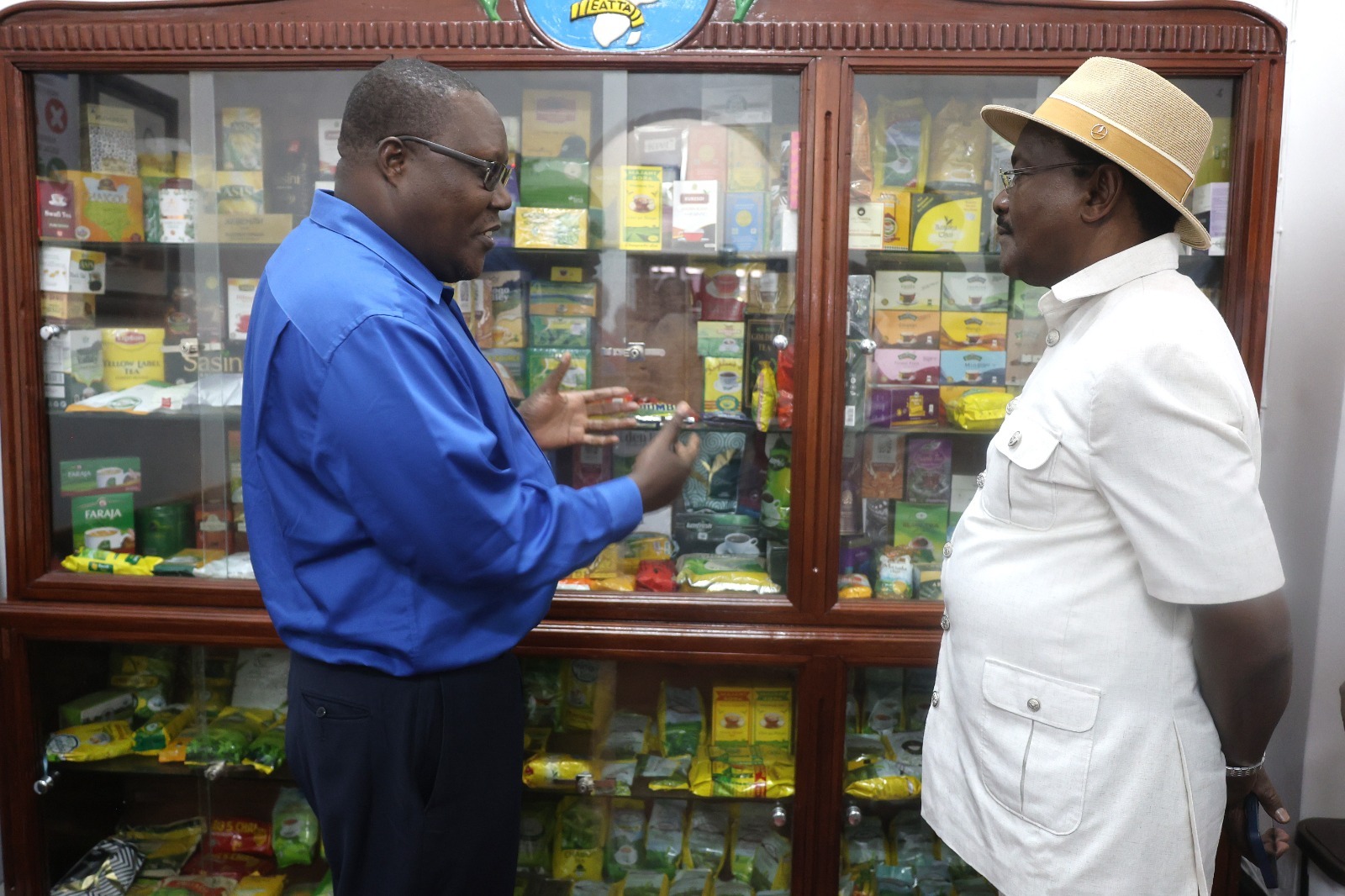
Wiper Patriotic Front leader Kalonzo Musyoka (R)
The Wiper Patriotic Front leader has visited the East African Tea Trade Association’s headquarters to press for the reopening of the Sudanese market — and to signal that his 2027 campaign will be built on economic grievance, not political theatre.
By James Mwangi
Wiper Patriotic Front leader Kalonzo Musyoka yesterday visited the East African Tea Trade Association headquarters in Mombasa for direct talks on the crisis gripping Kenya’s tea sector, with Sudan’s ban on Kenyan tea exports emerging as the central concern of an industry that supports millions of livelihoods across the country.
The visit, which Kalonzo described as a follow-up to a recent engagement with the Embassy of the Republic of Sudan, brought him face to face with the association’s leadership, including Managing Director and Chief Executive George Omuga. The discussions, by Kalonzo’s own account, were candid — a word that in political parlance usually signals that what was said in the room was considerably more alarming than what is said for the cameras.
Sudan has historically been one of Kenya’s most significant tea export destinations, and its decision to ban Kenyan tea has sent tremors through an industry already navigating volatile global commodity prices, climate-related production pressures and the chronic challenge of ensuring that smallholder farmers receive a fair share of the value generated by one of the country’s most important agricultural exports. The ban has not only reduced revenue — it has exposed a structural vulnerability that successive governments have failed to address: Kenya’s dangerous over-reliance on a narrow band of export markets for a crop that anchors the rural economy of entire regions.
“Our tea farmers deserve a government and leadership that will stand with them and fight for their interests wherever those interests are at stake,” Kalonzo said following the meeting. “That is why I am engaging directly with the industry and pressing for the reopening of the Sudanese market, while working to secure and diversify markets for Kenyan tea.”
The framing is deliberate. Kalonzo is not positioning himself as a sympathiser dropping in for a photo opportunity in an industry town. He is positioning himself as an operator — someone willing to engage embassies, sit with trade association chief executives and follow up on commitments. The sequence matters: embassy engagement first, industry leadership second, public statement third. It is the architecture of a man running a shadow foreign economic policy, and it is aimed squarely at a farming constituency that has felt invisible to the current administration.
The East African Tea Trade Association, which manages the Mombasa Tea Auction — the largest in the world — occupies a unique position in Kenya’s agricultural economy. The auction sets benchmark prices that ripple through the incomes of hundreds of thousands of smallholder farmers, the majority of whom operate through Kenya Tea Development Agency factories across the central highlands, the Rift Valley and the Nyanza tea-growing belt. When export markets contract, the auction feels it, the factories feel it and the farmers feel it in the prices paid at the weighing bridge. Sudan’s ban is not a diplomatic abstraction. It is money out of farmers’ pockets.
Kalonzo acknowledged the breadth of the challenge, committing not only to pressing for the Sudanese market’s reopening but also to working on market diversification — an implicit acknowledgement that Kenya cannot continue to be caught flat-footed when a single importing country closes its doors. The tea sector has long needed a coherent export diversification strategy, and the current crisis has given political opposition figures an opening to make that case more forcefully than the government has been willing to do.
“I thank the leadership of EATTA for their frankness and for the confidence they have placed in this engagement,” Kalonzo said, adding that the Mombasa visit was part of a wider programme of sector engagements he intends to carry out across the country. “I will keep listening. I will keep engaging. I will keep pressing Kenya’s case.”
The pledge has the rhythm of a campaign promise, and that is precisely what it is. With the 2027 election cycle drawing closer by the week, Kalonzo is building a case for economic stewardship one sector visit at a time — tea in Mombasa today, agriculture elsewhere tomorrow. Whether the government responds to the pressure on the Sudanese market or leaves the opposition to own the issue entirely may well determine which side of the argument Kenya’s farming communities find more compelling when they finally cast their votes.
For now, the farmers are waiting. And Kalonzo is making sure they know someone is listening.
Similar Posts by The Mt Kenya Times:
- Mt Kenya Times ePAPER October 1, 2026
- Museveni backs Lamu but keeps Uganda’s money at home
- Sifuna’s party wins its name — and Kenya’s opposition race begins in earnest
- Lamu’s $16B gamble: Africa’s biggest refinery divides the region
- Ruto launches KSh2.2 trillion Lamu refinery in East Africa’s biggest energy bet
About the Author