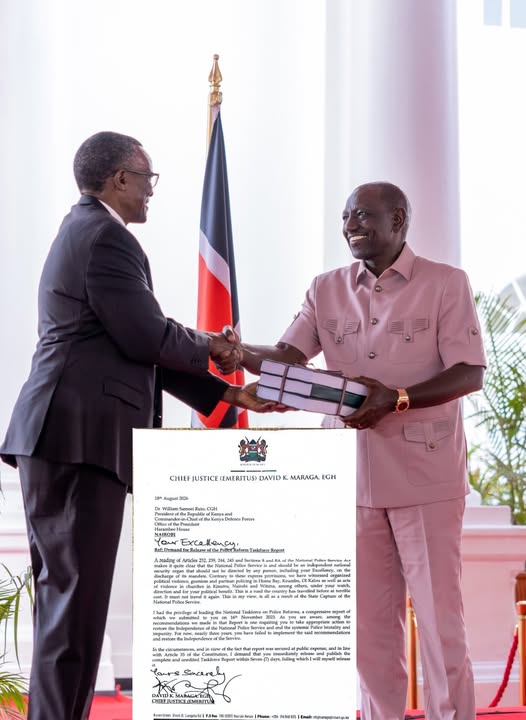
Maraga’s ultimatum to Ruto: release the police report — or I will
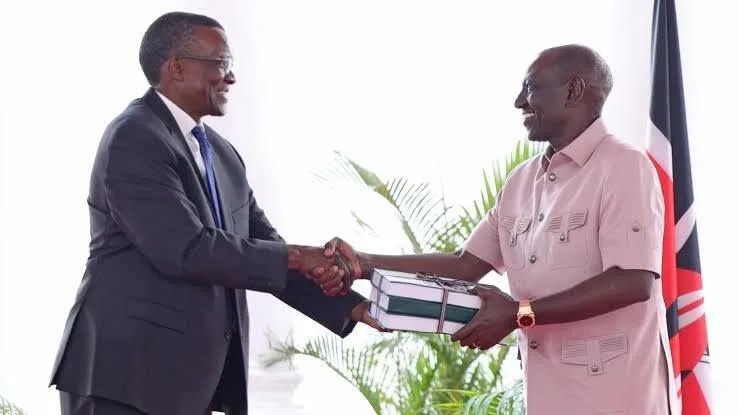
Former Chief Justice David Maraga with President William Ruto. File photo.
Kenya’s hate speech watchdog delivers its most explicit warning yet to the DCP leader, setting a 27 August deadline and threatening arrest warrants if he fails to appear.
By James Mwangi
The National Cohesion and Integration Commission yesterday summoned Democracy for the Citizens Party leader Rigathi Gachagua to appear before it on 27 August to answer for a series of public utterances under investigation for possible hate speech and ethnic incitement, warning that failure to comply could result in arrest warrants and criminal proceedings.
The summons, signed by NCIC Chief Executive Officer Daniel Mutegi Giti and dated 18 August 2026, directs Gachagua to present himself in person at the commission’s offices at Britam Towers, Upper Hill, Nairobi, at 2pm on Thursday next week. The language is unambiguous. “Take notice that failure to appear in person at the aforementioned place, date, and time, will lead to warrants of arrest being issued for your arrest and production before the Commission and/or the institution of criminal and/or contempt proceedings against you,” the notice states.
The commission says it is investigating Gachagua’s utterances under Sections 27, 29 and 63C as read with Section 63E of the National Cohesion and Integration Act. Among the specific incidents cited is an alleged statement made on 23 February 2026 at Gusii Stadium in Kisii County. The commission also cites statements allegedly made during Gachagua’s tour of Meru between 25 and 28 July 2026, when he is alleged to have used the phrases “tuta ua nyoka pamoja na mayai” and “kufukuza William Ruto kwa kura” while addressing a public gathering. NCIC further alleges that Gachagua accused President William Ruto of seeking to eliminate the political leadership of the Mt Kenya region, criticised leaders who had supported the administration and urged residents to send a “very strong signal” to those he accused of betraying the community.
Gachagua has not been shy about the remarks in question. Speaking in Buuri, Meru County, last month, he offered his own translation with characteristic directness. “When we say we will kill the snake, we mean removing Ruto from office through the ballot. When we talk about destroying its eggs, we mean ensuring those who support him are also voted out,” he said, insisting his words were figurative language used in the literary tradition. “We are not engaging in hate speech. We are using figurative language because we are students of literature,” Gachagua told his audience, challenging the NCIC to write to him if it needed clarification.
The commission, however, is not persuaded by the literary defence, and the timeline tells a story of its own. On 28 July, the NCIC and the Inter-Religious Council of Kenya issued a joint statement in which NCIC Chairperson Bishop Dr Kepha Nyamweya Omae confirmed that the commission’s Investigations and Compliance Department had opened independent probes into ten prominent political figures, including Gachagua, Health Cabinet Secretary Aden Duale, Public Service Cabinet Secretary Geoffrey Ruku, Busia Governor Paul Otuoma and six others. The two institutions described themselves as witnessing a troubling rise in political intolerance across counties, airwaves and social media platforms, warning that language was increasingly being used to dehumanise opponents and cast entire communities as adversaries. “Hate speech is not free speech. It is an assault on human dignity and on the constitutional order that binds this nation together,” their joint statement read.
The decision to issue formal summons specifically against Gachagua — three weeks after that announcement — represents an escalation, and it arrives against a backdrop of competing political pressures that have complicated the commission’s position. Nandi Senator Samson Cherargei formally petitioned the NCIC on 27 July to investigate Gachagua over remarks he argued linked members of the Kalenjin community to criminality, insecurity and organised violence — grounding his request in Article 27 of the Constitution, which bars ethnic discrimination, and Article 33, which strips hate speech of free-speech protection. From the other side of the political fence, Duale publicly declared he would not honour the NCIC’s own summons against him unless Gachagua was simultaneously compelled to appear. “The day I will go to NCIC, I must go with Gachagua. If there is anyone with the number one Kenyan hate speech, it is Gachagua, and I am not sorry about it,” Duale said in Garissa. The commission’s decision to issue an arrest warning exclusively against Gachagua while the broader investigation into all ten individuals remains ongoing will do nothing to defuse accusations of selective enforcement — a charge Gachagua has consistently levelled and will now undoubtedly amplify.
Gachagua has dismissed the NCIC as “an appendage of the government and not the independent commission that it ought to be” and has previously suggested its interventions are designed to shield Duale rather than address incitement impartially. He has also positioned the investigations as politically motivated, designed to suppress opposition voices ahead of 2027 rather than to genuinely enforce national cohesion law.
That context matters enormously. Gachagua, who served as Deputy President from 2022 until his impeachment and removal from office in October 2024, has since emerged as one of the most energetic and disruptive opposition figures in the country. His DCP is being positioned as the nucleus of a wider anti-Ruto political coalition ahead of the 2027 General Election, and his public rallies — particularly across Mt Kenya — have drawn large and enthusiastic crowds. The more confrontational his rhetoric becomes, the larger his audience grows. The NCIC summons, whatever its legal merit, hands him another grievance to prosecute on the campaign trail.
For the commission itself, the coming week is as much a test of its own credibility as it is of Gachagua’s compliance. NCIC has in the past struggled to enforce its summons against prominent political figures. Records presented to the National Assembly’s Committee on Administration and Internal Security earlier this year showed that Gachagua was among several individuals who had previously ignored commission summons without consequence. The explicit arrest warning in yesterday’s notice suggests the commission has decided it can no longer afford to be ignored.
What happens on 27 August will determine whether the warning was real — or whether Kenya’s pre-election season produces yet another confrontation between a political figure and a state institution that finds itself without the authority to match its ambition.
Kenya has walked this road before, and it knows the cost.
Similar Posts by The Mt Kenya Times:
- Mt Kenya Times ePAPER August 20, 2026
- Ruto gives officials one week to resolve health workers’ salary arrears
- Powering Khwisero’s next chapter of inclusive development
- El Niño and Kenya’s 2027 election: Why preparedness must begin before the rains
- The untouchable goons: Why Kenya’s protest violence keeps disappearing into the crowd
About the Author