The untouchable goons: Why Kenya’s protest violence keeps disappearing into the crowd
When peaceful demonstrations are hijacked by violence, the bigger question is not only who caused the chaos — but who benefits from it
By Levis Wangamati
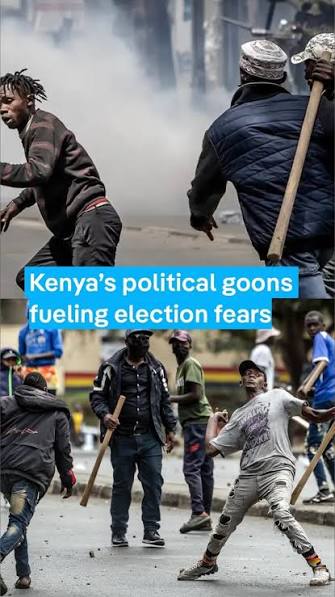
They do not arrive with placards. They arrive when the crowd is already gathering, when the chants have found their rhythm and the cameras have begun rolling. Then, almost without warning, the mood shifts. Men carrying clubs or crude weapons materialise among people who came to demonstrate peacefully. Stones fly. People scatter. Journalists are attacked. Bystanders are swept up in the confusion. And then the story changes.
The citizens who came into the streets to demand answers become the story. The violence becomes the headline. The original grievance is pushed into the background. That is the part Kenya should be paying far closer attention to — because the uncomfortable question is no longer simply whether violence occurs during protests. It is who brings the violence into otherwise peaceful demonstrations, and why those responsible so consistently seem to vanish once the damage is done.
This is not a question that can be dismissed as political gossip. In June 2025, the Judiciary itself raised concern over rising incidents of police brutality and what it described as the growing infiltration of peaceful protests by hired goons. The warning carried weight precisely because it acknowledged a pattern Kenyans had repeatedly witnessed: the line between a peaceful demonstration and organised violence can be crossed by people who appear to have come for an entirely different purpose. The Kenya National Commission on Human Rights later reported credible accounts of alleged hired goons infiltrating demonstrations in several counties during the June 25 protests. That finding should have triggered a sustained national conversation. Instead, Kenya has largely waited for the next protest.
The pattern is becoming grimly familiar. Citizens assemble to raise concerns about taxes, governance, corruption, the cost of living or the conduct of those in power. The demonstration begins peacefully. Then violence enters. The public sees destruction, confrontation and frightened crowds. By evening, the original question has been displaced. A demonstration about government accountability becomes a story about insecurity. A citizen demanding answers becomes a suspected rioter. A journalist covering events becomes a target. And a government facing uncomfortable questions suddenly has an easier question to answer: who is responsible for the chaos?
This is where the politics of the goon matters far more than the goon himself. A violent group can do more than attack people — it can change the narrative entirely. Once a protest has been reframed from a political grievance into a security problem, almost everyone has a reason to stop talking about the grievance. There is a quieter effect as well. When citizens begin to associate demonstrations with attacks and uncertainty, some simply stay home. A government does not necessarily have to ban a protest to weaken it. Fear can do much of the work.
That is why the question of the goons cannot be separated from the question of police conduct. The difficult issue is not simply who these groups are. It is what happens when they appear. Do police intervene? Do they protect protesters and journalists? Do they arrest those committing violence? Or, as rights groups and observers have alleged in some instances, do officers sometimes stand aside? Such allegations demand investigation rather than political convenience — but they cannot simply be brushed aside either.
When violence is carried out by unidentified civilians rather than uniformed officers, responsibility becomes harder to establish. The uncertainty creates space for everyone to point elsewhere. The goon points to the crowd. The crowd points to the police. The police point to criminals. Politicians condemn the disorder. Somewhere between all those explanations, accountability disappears.
The numbers behind this pattern are stark. Amnesty International reported that at least 38 people were killed and more than 500 injured during one wave of demonstrations in 2025, with unlawful use of lethal force documented across more than 20 counties. Human Rights Watch separately raised concerns about the failure to investigate or prosecute security forces in most cases of excessive and lethal force documented between 2023 and 2025. These figures are not about isolated clashes. They describe a recurring national problem in which violence and accountability consistently move in opposite directions.
The more uncomfortable reckoning begins after the streets have emptied. Who gets investigated? Who gets prosecuted? Who is convicted? Kenya is not short of institutions designed to answer those questions — the Independent Policing Oversight Authority, the Internal Affairs Unit and the National Police Service Commission exist precisely because accountability cannot depend on political speeches after each crisis. But having institutions is not the same as making them work. Witnesses fear retaliation. Investigations stall. Evidence becomes difficult to secure. Cases move through the courts for years while public attention drifts to the next crisis.
Each failure can be explained individually. Together, they construct something far more dangerous: a system in which accountability rarely reaches the people who matter most. A case does not have to be deliberately killed for accountability to fail. Sometimes delay is enough. Sometimes fear is enough. Sometimes the public simply forgets. That is how impunity becomes ordinary.
There is a political dimension that also deserves careful examination. If those in power view protests primarily as threats to be contained rather than constitutional rights to be protected, there may be limited appetite for aggressively pursuing everyone responsible for surrounding violence. That does not prove that every violent group is state-organised — it would be irresponsible to assert that without evidence. But it raises a harder question: whether the recurring presence of violence around protests produces outcomes that benefit those who would rather see a demonstration discredited than its demands answered.
Kenya needs to stop treating every protest as an isolated episode. When violence occurs, investigators must establish who committed it, who enabled it and, where evidence exists, who organised or financed it. Witnesses must be protected. Evidence must be preserved. Investigations must not lose momentum because the cameras have moved on.
The most disturbing thing about Kenya’s protest violence may not be that goons keep appearing. It may be that they can appear, change the character of a peaceful demonstration, bury its message beneath chaos — and then disappear into the crowd before the country seriously asks who sent them.
That is the question Kenya must not allow the next protest to bury.
Similar Posts by The Mt Kenya Times:
- Nigeria Starts Making Its Own Next-Generation Malaria Nets
- Diaspora Times Global Oct 3 – Oct 9, 2026
- Kwale’s electricity push moves from grid to growth
- Linguistic Features Of Chromatonyms In English And Uzbek
- A Poem, a Universe: A poetry book gaze at Jumaniyoz Jabborov’s “Ko‘zgudagi sanam”
About the Author