A wholly Nigerian-owned factory in Ogun State is now producing dual-ingredient mosquito nets for 31 states — and rewriting how Africa’s most malaria-burdened nation defends itself.
By Jacob Kitee
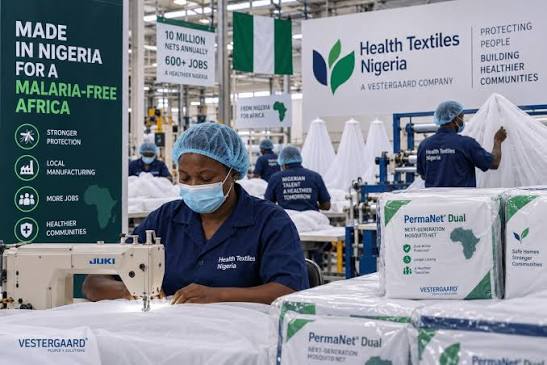
Nigeria has taken a significant step toward health manufacturing self-sufficiency with the commercial launch of locally produced next-generation insecticide-treated mosquito nets, in a development that carries implications far beyond a single factory opening. Harvestfield Healthcare FZE commenced production of Synera DuoForte at its facility in the Harvestfield Free Trade Zone in Ogun State on September 13, 2026, making it the first wholly Nigerian-owned manufacturer of dual active ingredient long-lasting insecticidal nets of the pyrethroid-chlorfenapyr class in the country. Within weeks of opening, the facility was already supplying a World Bank-funded programme covering 31 states.
The significance of what is being manufactured matters as much as the fact of local production itself. Conventional insecticide-treated nets have long formed the backbone of Nigeria’s fight against malaria, the disease that kills more people in Nigeria than anywhere else on earth. But decades of exposure to pyrethroid insecticides — the chemical class most commonly used in standard treated nets — has allowed Nigerian mosquito populations to develop resistance, blunting the effectiveness of those nets in precisely the communities most dependent on them. Synera DuoForte addresses that problem directly by combining a pyrethroid with a second insecticide that operates through an entirely different biological mechanism, making it effective even where pyrethroid resistance has taken hold. The World Health Organisation recommends this class of net for areas with established pyrethroid resistance, and Synera DuoForte carries WHO prequalification, a standard that certifies both the product and the Ogun State facility as an approved manufacturing location. The facility is additionally certified by Nigeria’s National Agency for Food and Drug Administration and Control and holds ISO certification.
Harvestfield manufactures the nets under a manufacturing agreement with GDM Health Products, the British company that developed and holds prequalification for Synera DuoForte. Jon Bastow of GDM Health Products described the partnership as a strategic one. “GDM is pleased to strategically partner with Harvestfield to bring Synera DuoForte to Nigeria, the country with the biggest global malaria burden, and support the prequalification of Harvestfield’s Ogun State manufacturing facility,” he said.
For Harvestfield, the move into production is the logical culmination of more than two and a half decades embedded in Nigeria’s vector control landscape. The group has operated in the sector for 26 years, distributing more than 42 million insecticide-treated nets across all 36 states and serving since 2018 as an exclusive national distribution partner for WHO-prequalified nets. The company’s decision to transition from distribution to manufacturing carries structural significance for Nigeria’s healthcare supply chain. Locally produced nets eliminate the 45 to 60-day ocean shipping journey associated with imports, reduce dependence on overseas production schedules and create the kind of domestic flexibility that allows programmes to respond as resistance patterns and malaria control needs evolve.
The political architecture supporting this development is substantial. The Federal Government’s Renewed Hope agenda explicitly prioritises domestic health manufacturing, and the factory fits squarely within that framework. Coordinating Minister of Health and Social Welfare Professor Muhammad Ali Pate welcomed the development in direct terms. “Building the capacity to manufacture our own health products is central to Nigeria’s health security,” he said. “A Nigeria-based facility producing next-generation insecticide-treated nets to international standard, and already supplying programmes across thirty-one states, is the kind of capability the Renewed Hope agenda was created to build.”
The Presidential Initiative for Unlocking the Healthcare Value Chain, known as PVAC, also weighed in. Its representative, Dr Abdul Mukhtar, framed the factory not as an industrial milestone in isolation but as proof of a policy thesis. “PVAC exists to move Nigeria from importing its health products to making them,” he said. “What matters is not only that a factory exists, but that it meets the standards international buyers accept and can supply at national scale. A facility based in Nigeria doing both is precisely the outcome this initiative was created to unlock.”
That last point — meeting international standards while supplying at national scale — is where many previous African manufacturing ambitions have stalled. The combination of WHO prequalification, NAFDAC certification and ISO accreditation at the Ogun State site signals that Harvestfield has not built a factory for appearances. The facility is designed to compete on the same technical terms as the overseas manufacturers it is now positioned to displace, at least partially, from Nigeria’s procurement pipelines.
Harvestfield has indicated that the net manufacturing facility is not the ceiling of its ambitions but the foundation. The company describes it as the first platform in a broader effort to build healthcare manufacturing capability in Nigeria, suggesting that the Ogun State site is intended to develop technical, quality and regulatory infrastructure that can eventually extend to other health products. For a country that imports the overwhelming majority of its pharmaceutical and health commodity needs, the implications of that trajectory, if sustained, extend well beyond malaria.
Nigeria still carries the heaviest malaria burden of any nation on earth. The nets leaving the Ogun State facility will not resolve that burden alone. But a country that can manufacture its own next-generation malaria prevention tools to WHO standard, supply 31 states within weeks of opening, and build the institutional knowledge to do so independently has changed something fundamental about its relationship with the disease — and with the global health supply chains that have, for too long, determined the terms of that fight on Nigeria’s behalf.
Similar Posts by The Mt Kenya Times:
- Diaspora Times Global Oct 3 – Oct 9, 2026
- Kwale’s electricity push moves from grid to growth
- Linguistic Features Of Chromatonyms In English And Uzbek
- A Poem, a Universe: A poetry book gaze at Jumaniyoz Jabborov’s “Ko‘zgudagi sanam”
- Wicknell Chivayo: The Story That Wasn’t Told
About the Author