Kenya ditches the SHA portal and bets everything on HMIS — but a KSh104.8B question still hangs over the system
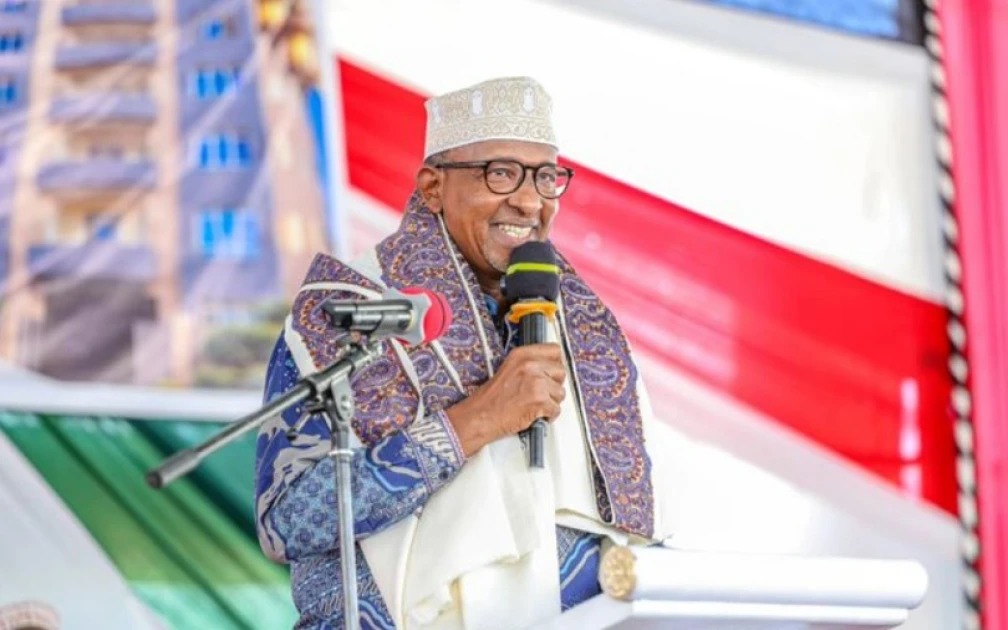
Health CS Aden Duale commissions a landmark Waqf project in Ngala, Nakuru County on October 1, 2026. Photo/Courtesy
The Ministry of Health has granted facilities another month to complete the digital transition, but the unresolved controversy over who owns the infrastructure they are all migrating to remains the story nobody wants to answer
By David Kimani
The Ministry of Health has granted Kenya’s health facilities a further one-month extension to complete their migration from the Social Health Authority’s Provider Portal to the new Health Management Information System, with Health Cabinet Secretary Aden Duale confirming that all public Level 5 facilities, faith-based providers, and the country’s two national referral hospitals must complete the transition by 30 October 2026.
The announcement marks a significant moment in Kenya’s turbulent journey towards a fully digital health financing system — but it also arrives under the long shadow of a KSh104.8B question that neither the government nor the technology consortiums behind the system have answered to the satisfaction of the country’s Auditor General.
The numbers on transition, at least, look encouraging. All 6,427 public Level 2 to 4 health facilities have already crossed over to the new HMIS. Among public Level 5 facilities, four have completed the transition and 23 are at various stages of the process. Kenyatta National Hospital and Kenyatta University Teaching, Referral and Research Hospital are expected to complete their migrations before the end of next week. For faith-based facilities, 38 of the 518 contracted providers have transitioned, with the remainder working towards the October 30 deadline. In the private sector, 28 existing HMIS platforms have already received certification from the Digital Health Agency. “No patient will be denied access to healthcare services because a facility has not yet fully transitioned to HMIS,” the Ministry stated, an assurance aimed at calming nerves in a sector that has lurched from one system crisis to another.
The HMIS transition is the latest chapter in a story that began in October 2024 when President William Ruto formally launched the Social Health Authority and its companion platform, TaifaCare, as replacements for the National Hospital Insurance Fund. The NHIF, by then widely regarded as a byword for institutional failure, was dissolved after decades during which it is estimated to have lost more than KSh50B to fraud, ghost patients, and what investigators described as systemic corruption. SHA was sold to Kenyans as something fundamentally different — cleaner, digital, accountable, and built around universal health coverage. The Provider Portal was its first technological face.
That portal is now being retired. In its place sits the SHA HMIS — or more precisely, the Taifa Care Health Management Information System — which went live for Level 4 public hospitals at midnight on 29 June 2026, following the completion of system testing and approval by both SHA and the Digital Health Agency. The rationale is straightforward: a unified, interoperable digital system that can verify eligibility, process claims, detect fraud, and generate real-time health data across more than 11,000 accredited facilities nationwide. Healthcare providers that do not meet the prescribed HMIS requirements will not be eligible for contracting, contract renewal, or continued participation in SHA-funded schemes during the 2026/28 contracting cycle, SHA CEO Mercy Mwangangi has made clear.
But here is the question the government has been less eager to answer cleanly: what exactly did Kenya pay KSh104.8B for, and does the state actually own what it bought?
A consortium led by Safaricom, which includes Apiero Limited and Konverge Network Solutions Limited, secured a KSh104.8B contract to provide the technology infrastructure underpinning the transition from NHIF to the Social Health Insurance Fund — structured as a ten-year investment with no upfront capital or operational expenditure from the Ministry. The arrangement was presented as a model of financial prudence: a pay-as-you-go digital health superhighway that would cost the government nothing to establish.
The Auditor General saw it differently. The procurement of the KSh104.8B Healthcare Information Technology Digitization System was criticised, with the Auditor General concluding that value for money on the procurement could not be confirmed. More sharply, the Auditor General warned that the government does not even own the KSh104.8B IT system running SHA, despite spending billions on it.
President Ruto has pushed back. In August 2026, he dismissed reports of a single KSh104.8B government outlay, arguing that payments were tied to services rendered rather than a lump-sum purchase. Digital Health Agency CEO Anthony Lenaiyara said SHA has paid only KSh500M to digital system service providers, and that the infrastructure supports 43 digital health services under Universal Health Coverage. The consortium model, the government insists, was designed precisely to avoid a capital expenditure that the Treasury could not absorb.
Yet the gap between those positions — KSh104.8B contracted versus KSh500M paid, with the Auditor General unable to confirm value for money — is not a minor accounting discrepancy. It is the foundational question about whether Kenya’s entire digital health architecture rests on infrastructure that the state controls or merely rents. As every health facility in the country is now being directed to integrate with this system, and as SHA’s contracting power is being used to enforce compliance, that question becomes more urgent, not less.
Health facilities have submitted claims to SHA totalling KSh82.7B, against which SHA has paid KSh53B. The fraud detection function of the digital system has produced tangible results: the intensified crackdown resulted in the closure of 728 non-compliant facilities and the downgrading of an additional 301, with SHA rejecting KSh10.6B in fraudulent claims. CS Duale has not been shy about citing these numbers. “Our comprehensive digital system was specifically designed to detect and eliminate the very vulnerabilities that plagued the defunct National Health Insurance Fund,” he said.
Those outcomes are real. But a system that detects fraud effectively is not automatically a system that represents good value for public money, and it is not automatically a system that the public owns. The Digital Health Agency will conduct what the Ministry calls Rapid Results Initiatives throughout October to provide technical support and accelerate the final wave of transitions. The October 30 deadline is firm. The Ministry will meet health sector associations today to agree on facility-by-facility transition plans.
Kenya is building something significant in its digital health infrastructure. The shift from a paper-based, fraud-riddled claims environment to a certified, interoperable, nationally standardised system is exactly the reform the sector has needed for years. But transformative ambition and financial accountability are not mutually exclusive demands. As the last hospitals cross over to HMIS and the Provider Portal is finally switched off, Kenyans deserve a straight answer to a straight question: for KSh104.8B, what exactly does this country own?
Similar Posts by The Mt Kenya Times:
- Garang’s ghost: What South Sudan does with its liberation ideals
- When the teacher breaks: TSC’s quiet battle for mental health in the classroom
- Patel makes history with third African crown
- From menstrual health to AI: Kenya keynote tour puts youth voices at the centre
- The Kenyan paradox: How political elitism and social stratification are mortgaging the ambitions of future generations
About the Author