Name, shame, ban: Police put violent political actors on notice ahead of 2027
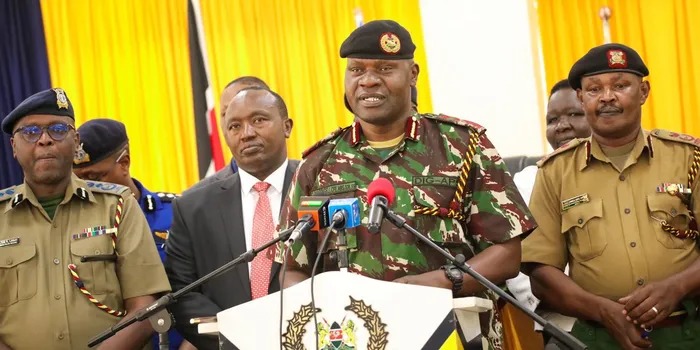
Deputy Inspector General of the Administration Police Service Gilbert Masengeli
With Homa Bay’s bloodied rally fresh in memory, security agencies have drawn a line — and warned that crossing it may cost a candidate their ballot paper
By Brenda Atieno
The National Police Service yesterday told political actors linked to violence that it will submit their names to the Independent Electoral and Boundaries Commission for potential disqualification from the 2027 General Election, marking the sharpest warning yet from security agencies as Kenya enters its most politically charged pre-election year in a decade.
Deputy Inspector General of the Administration Police Service Gilbert Masengeli, speaking at the launch of the Roadmap to a Peaceful General Election 2027 in Nairobi, said recommendations would target individuals whose track records show they have promoted or perpetrated violence. “We will recommend to the IEBC those individuals who are not fit to run for office based on their track record of promoting or perpetrating violence in Kenya,” he said.
The announcement lands at a moment when the connection between organised political violence and electoral ambition has rarely felt more direct. Nine days earlier, violence disrupted a Linda Mwananchi political rally in Homa Bay County, prompting the National Police Service to intensify investigations and arrest 37 suspected gang members found in possession of crude weapons, including machetes, metal rods, knives, ropes and rungus. Police vehicles were attacked, journalists were targeted, and one officer died when a vehicle lost control during the incidents. Eight officers were injured across two days of operations.
The Homa Bay episode was not an isolated flashpoint. It was a preview. As political mobilisation accelerates toward the August 10, 2027 election date, the use of organised criminal groups to intimidate opponents, disrupt rallies and silence critics has emerged as one of the defining security threats of the electoral cycle. Masengeli’s language yesterday was calibrated to confront that threat directly. “Investigation, arrests, prevention of crime, and instances of political-instigated violence — we will deal with goons firmly and their sponsors,” he said. The inclusion of sponsors in that formulation was deliberate. Financiers and organisers, not merely foot soldiers, are now explicitly in the crosshairs.
IEBC Chairperson Erastus Ethekon has separately indicated that the commission could act on police recommendations, stating that sanctions could include fines and, in serious cases, disqualification from contesting. “We will take appropriate action, including fining them and if it is really tough we will even disqualify some of them from contesting,” he said.
Chief Justice Martha Koome added institutional weight to that position at the launch of the IEBC’s Strategic Plan in June, urging the commission to enforce the Electoral Code of Conduct without hesitation. “If someone breaches the code of conduct, then you must disqualify them from participating in the general election. There is a growing trend of goonism in this country to silence opponents. We must reject it in totality,” she said. She questioned pointedly why politically linked protests frequently turn violent while demonstrations by teachers and doctors remain peaceful — a distinction that pointed an uncomfortable finger at deliberate orchestration rather than spontaneous disorder.
The legal architecture supporting these warnings is now formally in place. The IEBC gazetted Notice No. 13497 on August 20, bringing the Electoral Code of Conduct and the Election Offences Act into operation for the election period, placing political actors under a binding legal framework governing campaigns, nominations, voter registration and conduct. The window of informal impunity that characterises pre-formal campaign periods has effectively closed.
Masengeli was careful to define the boundaries of police authority. The NPS does not possess the power to disqualify candidates directly. Its role is to gather evidence, build records and refer cases to the IEBC, which retains the final determination of eligibility under the electoral and legal framework. He also called for cooperation among independent commissions and security agencies, noting that institutions may be independent in their mandates but remain interdependent in protecting Kenya’s peace and stability.
The roadmap was launched under the campaign hashtag #UchaguziBilaNoma — elections without trouble — and NCIC Chairperson Bishop Kepha Omae Nyamweya described it as a deliberate shift from reacting to electoral violence to preventing it before tensions escalate. He said peaceful elections could not rest with any single institution, calling on political leaders, security agencies and civil society to share the responsibility.
The stakes are high and the calendar is unforgiving. With exactly one year separating yesterday’s launch from polling day, every rally, every ward meeting and every act of political intimidation now occurs within a framework in which consequences — legal, electoral and institutional — are being actively assembled.
Kenya has heard warnings before. What distinguishes this moment is the specificity: names will be gathered, records will be checked, and the ballot paper may yet become the price of political violence.
Similar Posts by The Mt Kenya Times:
- Mt Kenya Times ePAPER October 17-18, 2026
- Ruto bets billions on Kerio Valley — with one eye on 2027
- Ruto’s health ministry kills Murang’a’s digital hospitals
- Kenya bets on Mount Kenya to drive a billion-shilling tourism revival
- Do you have a wealth vision? Or are you just working until you die?
About the Author