
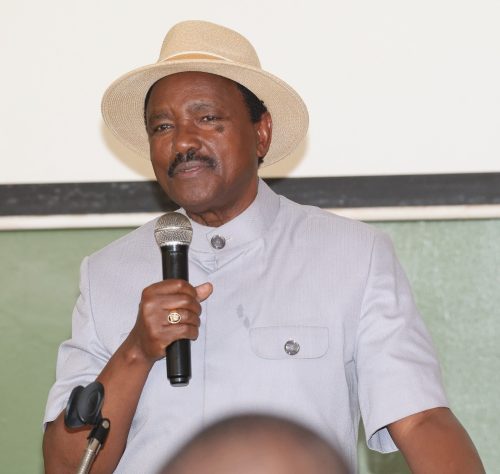
Wiper Democratic Movement leader Kalonzo Musyoka
Wiper leader Kalonzo Musyoka’s three-county tour tomorrow is far more than a listening exercise — it is the opening move of what his allies say will be his most serious and best-organised presidential bid yet
By Anne Mueni
Wiper Democratic Movement leader Kalonzo Musyoka tomorrow carries his Meet the People Tour across three southern counties — Makueni, Kajiado and Taita Taveta — in a single-day grassroots sweep that his party is billing as community engagement but which, read against the backdrop of Kenya’s accelerating political calendar, amounts to something considerably more significant: the ground-level launch of a presidential campaign that Musyoka’s allies say will be unlike anything he has attempted before.
The tour, conducted under the Wiper Front banner and its rallying slogan “Pamoja Tutakomboa Kenya” — Together We Shall Liberate Kenya — opens at noon in Emali, Makueni County, where Musyoka will address residents on development priorities and national cohesion. The convoy moves to Kimana, Kajiado County, at 2.30pm for a rally centred on youth empowerment and cross-county cooperation, before concluding at Njukini, Taita Taveta County, at 4.30pm, with discussions focused on regional infrastructure and agricultural recovery. The tagline for the tour — “Tukutane, Tujuzane, Tusemezane” — translates simply: let us meet, let us share, let us talk.
It is a deliberately human framing for what is, at its core, a political offensive.
Kenya is now exactly one year away from its next general election, and Musyoka marked that milestone earlier this month with a pointed declaration of intent. “As we begin the election year, I share a glimpse of my plan for Kenya,” he wrote, framing his emerging presidential platform around what he described as the urgent need to fix the nation’s policies, systems and leadership. Tomorrow’s tour is where that abstract vision meets tarmac, dust and the hard reality of voter expectations in communities that have heard similar promises before.
The choice of counties carries its own political logic. Makueni is Musyoka’s home territory, governed by his Wiper ally Mutula Kilonzo Jnr, and a county where the party’s support has historically been deep enough to take for granted — which is precisely why it cannot be taken for granted. In a competitive multi-candidate race, margins in your own backyard matter enormously. Kajiado presents a different calculation. The county sits at the intersection of Maa community politics and the expanding Nairobi metropolitan area, making it a constituency that no presidential candidate can afford to cede without a fight. Taita Taveta, meanwhile, is coast-adjacent territory where alliance politics and ethnic arithmetic have historically determined outcomes more than party loyalty.
Musyoka’s campaign strategists have been modelling their approach partly on former United States President Barack Obama’s 2008 grassroots campaign. At the heart of the strategy is a people-funded campaign built around small online donations, an expansive volunteer network and a professional secretariat already operating independently of the Wiper Party headquarters. The Meet the People Tour is the offline expression of that same philosophy — reach people where they live, listen before speaking and build loyalty that cannot be bought by a rival campaign distributing cash on polling day.
On 6 June, Musyoka formally launched his presidential campaign platform in Nairobi before supporters, governors, lawmakers, diplomats and business leaders, promising to rescue Kenya from what he described as state capture, corruption and economic hardship. He simultaneously unveiled a 13-point presidential agenda identifying agriculture, small and medium-sized enterprises and tourism as the key pillars of economic recovery, pledging to modernise farming through expanded irrigation, improved productivity and direct support for smallholder farmers. For the residents of Njukini in Taita Taveta — a constituency where agriculture is the economic backbone and where markets and input costs dominate dinner-table conversations — that agenda will be put to a direct test tomorrow afternoon.
Musyoka has also moved to sharpen his party’s organisational machinery, unveiling a new Wiper leadership team that places former Cabinet minister Jamleck Kamau at the helm as party chairman, Nyali MP Mohamed Ali as deputy party leader designate and constitutional lawyer Ndegwa Njiru as the party’s first official spokesperson. In announcing the appointments, Musyoka described integrity as a defining credential of his new team — “a quality this regime cannot buy and will not intimidate,” he said. The restructuring signals that Wiper is transitioning from coalition-building mode into full campaign operations.
His allies are building the campaign narrative around his more than 40 years in public service, positioning him as a seasoned statesman who understands the mechanics of government and has accumulated diplomatic and administrative experience that his rivals cannot match. Particular emphasis is being placed on his tenure in former President Mwai Kibaki’s administration, which many Kenyans remember as a period of economic growth and meaningful public sector reform. Whether that record resonates with a younger electorate that was not yet born when those reforms were implemented is one of the central questions his campaign has yet to answer convincingly.
Musyoka has run for president three times. Twice he has stepped aside at the last moment, playing kingmaker and watching other men enter State House on the back of his supporters. He has said openly that sacrificing his presidential bid again in 2027 would mean retiring from active politics. That is not a small statement. It is the kind of declaration that transforms a campaign from an exercise in political positioning into something with genuine personal stakes — and voters, who are shrewd readers of sincerity, will be measuring him against it.
Tomorrow’s itinerary — three counties, three rallies, one day — is the kind of schedule that tells its own story. It says that Musyoka is not conserving his energy. It says he is not waiting for the coalition arithmetic to settle before showing up. It says he believes the presidency is won in Emali and Kimana and Njukini as much as it is won in Nairobi boardrooms and television studios. “We must fix the nation — from the policies, to the systems, to the leadership that serves the people. This is the work ahead,” he has said.
For the communities receiving him tomorrow, the question is simpler and more immediate: what does Musyoka bring beyond a campaign poster and a microphone? Emali wants roads. Kimana’s youth want jobs. Njukini’s farmers want markets and fair prices. The conversations that happen tomorrow, away from the cameras and the slogans, will matter as much as the rallies themselves.
Musyoka has spent four decades in Kenyan politics. He knows, better than most, that listening tours only count if someone is actually listening — and that voters have long memories for leaders who listened, then forgot.
Similar Posts by The Mt Kenya Times:
- Mt Kenya Times ePAPER October 17-18, 2026
- Ruto bets billions on Kerio Valley — with one eye on 2027
- Ruto’s health ministry kills Murang’a’s digital hospitals
- Kenya bets on Mount Kenya to drive a billion-shilling tourism revival
- Do you have a wealth vision? Or are you just working until you die?
About the Author

How does Kalonzo Musyoka plan to use his three-county tour to strengthen his presidential campaign?