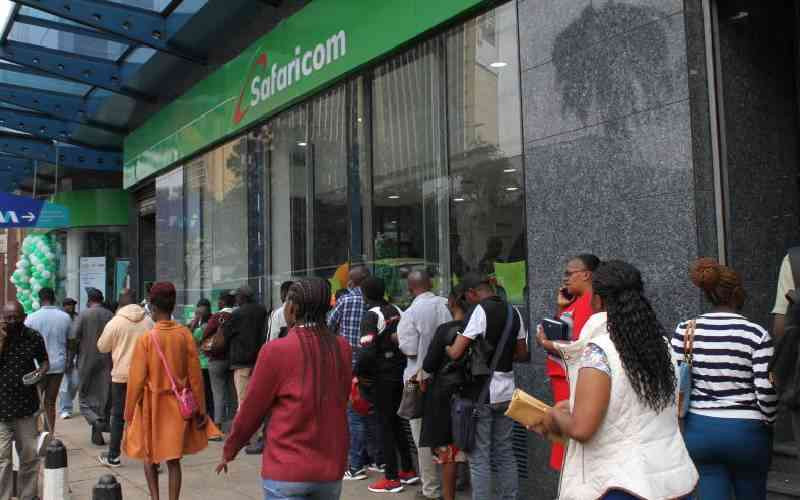
Kenya’s High Court has torn up the Safaricom-Vodacom share sale — and with it, a central plank of William Ruto’s pre-election strategy.
By David Kimani
Kenya’s High Court yesterday declared the government’s sale of a 15 per cent stake in Safaricom to South Africa’s Vodacom Group unconstitutional, illegal, null and void, ordering the shares restored to the State and plunging the Ruto administration into its gravest governance crisis yet — with the August 2027 general election just eleven months away.
The ruling, delivered by a three-judge bench of the Constitutional and Human Rights Division comprising Justices Francis Gikonyo, Roselyne Aburili, and Tabitha Wanyama, dismantled one of the most consequential privatisation transactions in Kenya’s post-independence history. On 30 June, the government had sold 6,009,814,200 Safaricom shares — 15 per cent of the company — to Vodafone Kenya at KSh34 each in a single block trade on the Nairobi Securities Exchange, banking KSh204.3B from the sale and a further KSh40.2B as an advance on future dividends, for a combined KSh244.5B. That money was earmarked to seed the National Infrastructure Fund and the National Sovereign Fund — flagship vehicles for Ruto’s development agenda in the final stretch before voters pass judgment.
Yesterday, the court said the entire process was rotten from the start.
The three-judge bench found that the government had entered into binding agreements with Vodafone Group before completing the required policy and parliamentary approval processes. Records showed that a share purchase agreement, priced at KSh34 per share, and a separate dividend rights purchase arrangement were signed on 3 December 2025. The structure of the deal itself, the court found, was systematically misrepresented to the public, to the Cabinet, and to Parliament.
The court found that although Parliament conducted public hearings in 30 counties, critical documents relating to the transaction — including the share purchase agreement and the agreement concerning future dividend rights — were not made available to the public. That omission was not bureaucratic error. The judges were unsparing: “We accordingly find that the Government of Kenya engaged in unexplained obscurity on the identity of the proposed buyer, made misrepresentation and concealed material information in respect of the partial divestiture throughout the process,” the court ruled.
 The concealment ran deeper than paperwork. The court found that the proposed sale was presented to Parliament and the public as a partial divestiture when, in reality, the transaction involved a much larger corporate restructuring that would give Vodacom effective control of Safaricom. Under the arrangement, Vodafone Kenya’s stake would rise from about 39.9 per cent to 55 per cent, while Vodacom Group would acquire full ownership of Vodafone Kenya. The court said the arrangement therefore amounted to a takeover, rather than simply a sale of a 15 per cent government stake. Parliament had been told it was approving a partial sale of a minority government interest. It had, in effect, been asked to rubber-stamp a foreign takeover of one of Kenya’s most strategically important companies.
The government had mounted a spirited defence. President Ruto and Deputy President Kithure Kindiki argued the proceeds would finance major infrastructure projects and deliver on Kenya Kwanza’s development agenda ahead of the 2027 general election. Kindiki had dismissed critics pointedly, saying: “The opposition is lecturing us as though this is the first time the government and the country have sold Safaricom shares. Safaricom shares were first sold in 2008, and they were sold twice during the administration of President Mwai Kibaki. This is the third sale, and we are not selling all the shares.” Central Bank of Kenya governor Kamau Thugge and the Central Organisation of Trade Unions backed the deal, citing its potential to ease the country’s debt burden.
None of that survived judicial scrutiny. The judges rejected the argument that Parliament’s subsequent approval could cure the constitutional defects, ruling that the petitions challenged the constitutional foundation of the transaction itself. The State had broken the law before Parliament ever voted. Approval granted after the fact could not undo that breach.
The political fallout is immediate and severe — and it arrives at a moment of acute vulnerability for a government already fighting on multiple fronts. Opposition figures including former Deputy President Rigathi Gachagua and Wiper leader Kalonzo Musyoka had strongly criticised the privatisation drive, and the criticism extended beyond the formal opposition to legislators such as Ndindi Nyoro of Kiharu and ODM-aligned members Babu Owino and Caroli Omondi. Critics accused the government of undervaluing the shares and shutting ordinary Kenyans out of a company they effectively owned. Yesterday’s ruling vindicated that argument with the full force of constitutional law.
For Ruto, the timing could scarcely be worse. With the election eleven months away, the Safaricom transaction was never simply a financial instrument. It was a political one. The KSh244.5B was designed to fund roads, electricity infrastructure, and markets — the tangible, visible projects on which Kenya Kwanza planned to run its re-election campaign. The opposition has already vowed to revoke privatisation transactions if it assumes office in 2027, arguing that such decisions are stripping Kenya of its strategic assets. Yesterday’s court ruling did the opposition’s work for it, before a single campaign rally has been held.
The consequences now cascade in several directions simultaneously. Vodacom, which had moved to consolidate Safaricom onto its balance sheet following the June completion, now faces the prospect of unwinding one of the largest privatisation transactions in Kenya’s history. The KSh244.5B the Treasury banked must, in principle, be returned. The National Infrastructure Fund and the National Sovereign Fund, into which those proceeds were channelled, face an uncertain future. Development projects predicated on those funds face delay, cancellation, or emergency refinancing at a moment when Kenya’s debt load is already a political flashpoint.
The court’s judgment also scrutinised Safaricom’s importance beyond its commercial value, noting that the company operates critical telecommunications, mobile money, and digital infrastructure used by millions of Kenyans. That observation matters. Safaricom is not merely the country’s most valuable listed company. It is the backbone of Kenya’s digital economy, the platform through which tens of millions of Kenyans save, pay, borrow, and receive money. The court treated it, correctly, as a strategic national asset — one that cannot be transferred to foreign majority ownership through a process shrouded in opacity.
The ruling also sets a precedent with implications well beyond this single transaction. The decision establishes that the need to raise revenue cannot override constitutional and statutory requirements governing public resources. That principle, now firmly embedded in case law, will constrain every future government contemplating the disposal of public assets. Kenya’s privatisation programme — already controversial — now operates in a fundamentally different legal environment.
What happens next is uncertain, but the direction of travel is clear. The government will almost certainly appeal. Vodacom will resist an unwinding that would require it to disgorge one of Africa’s most profitable telecoms investments. The Treasury will seek time, arguing that reversing a completed transaction of this magnitude cannot happen overnight. The courts will have to manage competing claims of constitutional principle and practical financial reality.
But none of that complexity will be resolved before August 2027. The election will be fought in the shadow of this ruling. Every road not built, every infrastructure promise undelivered, every project stalled for want of funds that the court has now ordered returned will be a campaign argument. The opposition, fragmented and still searching for unity and a candidate, has been handed a narrative gift: a government that sold a national treasure through concealment, misrepresentation, and procedural contempt for the Constitution — and was caught.
For Ruto, the task now is damage limitation in a deeply compressed political window. For Kenya, the task is larger: to determine whether the institutions designed to protect public resources have the strength, speed, and independence to function as the election approaches.
Yesterday, at least, they did.
Similar Posts by The Mt Kenya Times:
- Mt Kenya Times ePAPER November 3, 2026
- Kang’ata: ‘I turned down the Deputy President’s job — it was a trap’
- World Bank’s KSh26B project to restore Kenya’s degraded landscapes and transform 750,000 lives
- Wiper sets final deadline for 2027 aspirants as Kenya’s electoral race begins in earnest
- Kalonzo draws his line in the sand
About the Author