Deputy President Kithure Kindiki
The crown fell. The axes were returned. But the harder question for Kithure Kindiki is not whether Mount Kenya accepted him on Saturday — it is whether he can hold a mountain that is already divided against itself
By David Kimani
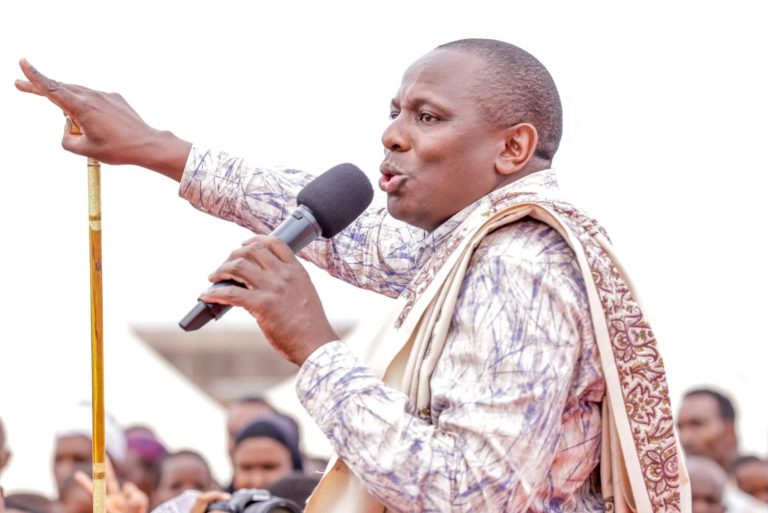
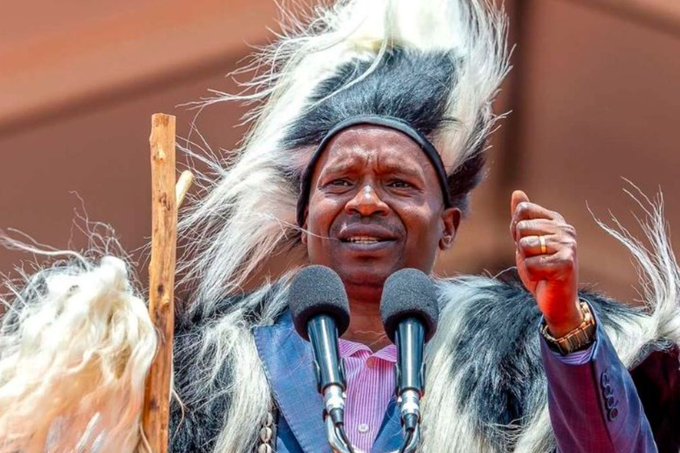
Deputy President Kithure Kindiki was publicly anointed as the political spokesman of the Mount Kenya region at a carefully choreographed ceremony on Saturday, but the symbolism of the occasion cut in more directions than his handlers had anticipated — most uncomfortably when the ceremonial crown slipped and fell during the coronation itself.
In the traditions of the Agikuyu, Ameru and Aembu peoples who inhabit the slopes of the mountain, such moments are rarely dismissed as accident. Elders read them. Communities remember them. Whether one regards the falling crown as cultural omen or simple misfortune, it handed Kindiki’s critics a metaphor they will not surrender willingly, and handed the region’s most formidable political operator — former Deputy President Rigathi Gachagua — a narrative gift he did not have to manufacture.
That is the environment in which Kindiki now operates. Not the clean, manageable terrain of a politician ascending unopposed, but a contested landscape where every symbol is weaponised, every gesture is interrogated and every omission is prosecuted.
The coronation was meant to settle the question of Mount Kenya’s political leadership once and for all. It has, in fact, deepened it.
Since taking office following Gachagua’s impeachment in October last year, Kindiki has moved with visible energy. He has held numerous public meetings and security engagements across the region, projecting the image of a hands-on deputy president attentive to his home turf. The meetings have been consistent, the messaging disciplined. He has spoken about security, development and unity with the fluency of a man who understands what the mountain wants to hear.
But a closer examination of the geography of those engagements reveals a pattern that his political opponents have already begun to exploit. The overwhelming majority of Kindiki’s high-profile appearances have been concentrated in the eastern parts of the mountain — Tharaka Nithi, Embu and Meru, the zones of his own political base and natural constituency. The western flank, encompassing Kiambu, Murang’a, Nyeri and Kirinyaga, has received considerably less of his direct attention, and the communities there have noticed.
This is not a small omission. The western side of Mount Kenya is numerically dominant, politically sophisticated and historically influential in determining who speaks for the region. It is the zone that produced Jomo Kenyatta and Mwai Kibaki. It is the zone where Gachagua built the infrastructure of loyalty that survived his dramatic removal from the deputy presidency. And it is the zone where Kindiki remains, for now, a figure associated with the administration that displaced one of their own.
Winning the west of the mountain requires more than attendance. It requires the kind of sustained, personal political investment that cannot be delivered from Nairobi or through proxies. Communities in Murang’a and Nyeri need to see Kindiki not as a government functionary but as a genuine advocate for their specific concerns — land, water, tea prices, coffee sector reforms and the perennial grievances around resource allocation that have animated Mount Kenya politics for generations. Practical delivery, visible and attributable, is the only currency that moves these communities.
The axes returned on Saturday were intended to signal reconciliation — a ceremonial closing of the wound opened by Gachagua’s removal. But symbolism and political reality are different instruments. Several of the leaders who stood on that stage and surrendered their axes have spent the past year openly calling for the fragmentation of Mount Kenya’s political unity, arguing that the region’s interests are best served by a divided, transactional approach rather than a unified bloc. Their presence at the coronation was a performance of unity. Whether it reflects a genuine realignment is an entirely separate question, and one that the coming months will answer with uncomfortable clarity.
Chief among the complications is the role of Labour Cabinet Secretary Alfred Mutua — known widely as Ruku — alongside other figures who have been vocal about the mountain’s internal divisions. Their association with Kindiki is a double-edged arrangement. It brings him visibility and organisational reach in some areas, but it also ties him to personalities whose political positioning has historically emphasised difference over cohesion. A man attempting to unify the mountain cannot afford to be seen as the candidate of its fractures.
And then there is Gachagua. The former deputy president has not retreated. His Democracy for the Citizens Party is recruiting aggressively across the mountain, holding meetings, signing up members and constructing the architecture of a political vehicle that is explicitly designed to challenge the narrative that Kindiki now represents the region. Gachagua’s personal approval ratings in the western counties remain high. His removal is still spoken of in many households not as a justified constitutional process but as an injustice visited upon the mountain by a government it had trusted.
Gachagua does not need to win every ward. He needs only to ensure that Mount Kenya arrives at the 2027 General Election divided — that the region’s vote is split, its unity fractured and its leverage diminished. A divided mountain cannot negotiate from strength with any presidential candidate. That outcome serves Gachagua’s long-term interests whether or not his own presidential ambitions ultimately materialise, because it demonstrates that the mountain cannot be delivered without him.
Kindiki’s task, therefore, is not simply to be popular. It is to be indispensable — to make the case, through tangible results and sustained engagement, that his proximity to President William Ruto translates into concrete benefits for every county on the mountain’s slopes, east and west alike. Roads, hospitals, water projects, agricultural support and security improvements that carry his fingerprints are worth more to his political project than a hundred rallies.
The coronation gave Kindiki a platform. What he does with it in the twelve months before campaigns formally begin will determine whether Saturday was a genuine turning point or an elaborate ceremony that changed very little. Political coronations in Kenya have a habit of meaning exactly as much as the work that follows them — no more and no less.
The crown fell on Saturday. In the traditions of this mountain, that matters. But traditions also hold that a leader is ultimately judged not by the ceremony of his elevation but by the harvest his people gather under his watch.
The mountain is watching. The harvest is not yet in.
Similar Posts by The Mt Kenya Times:
- Mt Kenya Times ePAPER September 21, 2026
- Gachagua accuses Ruto of using UNGA trip to seal niobium deal in Kwale
- Ichung’wah turns Uhuru’s ‘sponyo’ joke into a policy attack
- Kuria’s rebuke of Kindiki on brews reopens the wound Gachagua left behind
- Nyoro storms Engineer as Njabini chaos signals the mountain is already at war with itself
About the Author