Paper chasing in the shadow of substance: Kenya’s tragicomic obsession with metrics over mastery
 The Mt Kenya Times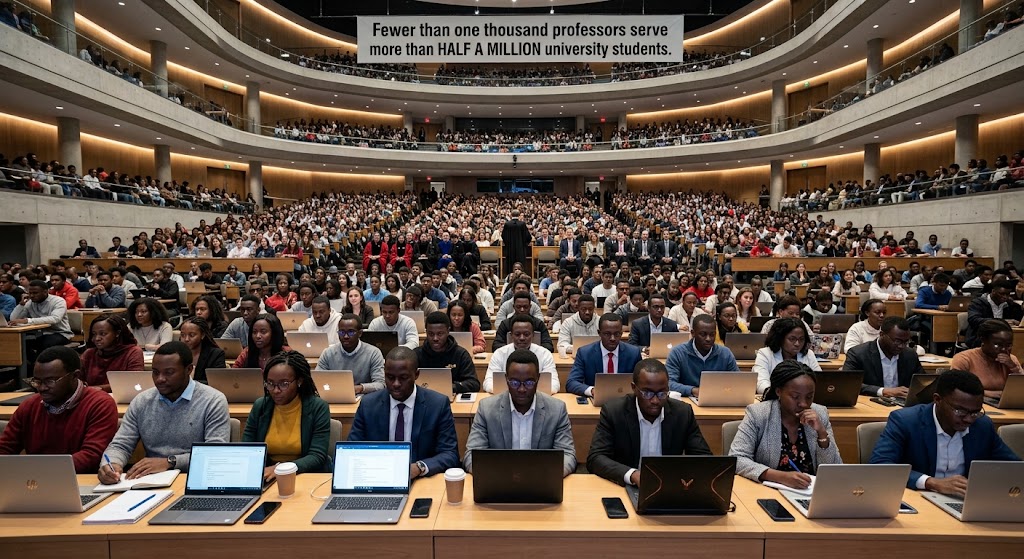
By Jerameel Kevins Owuor Odhiambo
In Kenya today, fewer than one thousand professors serve more than half a million university students. That stark ratio roughly one professor for every five hundred and sixty students stands as a cold, measurable fact. It is not an abstraction. It is the arithmetic of a system that has expanded enrolment while starving the very conditions under which genuine knowledge is forged. From this hard ground the larger crisis grows: research, the supposed engine of national advancement, has been reduced to a numbers game. Publication counts, Google Scholar metrics, citation tallies and the frantic pursuit of grants have become the dominant currency of academic worth. The aim of inquiry the patient, rigorous generation of knowledge that expands the frontiers of understanding has been displaced by the compulsion to publish or perish.
This is not a mild administrative inconvenience. It is a profound betrayal of the university’s historic purpose. Education, at its best, exists to form better thinkers, to cultivate curiosity that outlasts the degree, to create spaces of debate where black-letter law is mastered and then theorised, where questions are prodded until they yield new insight. Instead, Kenyan academia increasingly rewards the appearance of productivity.
A scholar who produces twenty journal articles and three books in a single year while teaching undergraduates, supervising masters and doctoral candidates, and maintaining private practice is not celebrated as a prodigy of intellect. He or she is treated as a suspicious miracle. Time, after all, is finite. Prof. Migai Akech, inaugurated Professor of Law at the University of Nairobi, has publicly noted that a solid, analytically rigorous article of fifty pages normally requires three months of sustained work. That admission, made while he sought elevation to the Court of Appeal, exposes the absurdity of the current metrics regime. If a scholar of established authority needs a full academic term for one thorough interrogation of law, what alchemy allows others to multiply that output many times over while discharging the same teaching and supervisory burdens?
The answer, whispered in corridors and occasionally shouted in private, is often exploitation. Concerns have repeatedly surfaced that some professors lean heavily on postgraduate students paying them poorly or not at all to generate the data, draft the literature reviews, and even write substantial portions of papers that then appear under the senior scholar’s name. This is not mentorship. It is the quiet theft of intellectual labour dressed in the robes of academic hierarchy. Academic dishonesty and plagiarism have risen in tandem. Predatory journals flourish because they offer the quickest route to the required publication points.
The Commission for University Education’s own promotion guidelines award fixed points for articles and books; the system therefore incentivizes volume over depth. History offers a cautionary parallel. Colonial education in Kenya trained clerks and intermediaries, not independent thinkers. The post-independence university was meant to reverse that logic and produce knowledge rooted in African realities. Instead, we have imported the worst features of the Western “publish or perish” culture without the infrastructure, the research time, or the funding that once made such pressure marginally sustainable in richer societies.
The newer distortion is algorithmic. Independent work is increasingly flagged as AI-generated. Detection tools, imperfect and trained on patterns that often mistake formal academic prose for machine output, have produced false positives that reach even decades-old theses. A doctoral dissertation completed in 1990 can register a seven-percent AI score. The result is Kafkaesque: scholars who write carefully in their own voice are placed under suspicion by systems that cannot distinguish human deliberation from statistical predictability. Integrity is not protected; it is undermined by the very instruments meant to safeguard it. Universities that set arbitrary similarity thresholds ten percent acceptable, fifteen percent fatal without transparent validation of the tools they deploy are not defending standards. They are performing the theatre of integrity while the substance drains away.
What, then, should be the aim of research in Kenya? It must be the advancement of knowledge that addresses the country’s concrete dilemmas constitutional design, land, climate, public health, economic justice and that contributes, on equal terms, to global intellectual conversation. Metrics have their place, but only as secondary indicators. Citations can reflect influence; they can also reflect network effects, language bias, and the dominance of Northern journals. High citation counts often reward work that is safe, incremental, or aligned with international funding priorities rather than work that is original in the deeper sense.
Original scholarship does not require the invention of something entirely new under the sun; it requires the rigorous re-examination of existing materials, the exposure of hidden assumptions, the construction of arguments that compel assent through evidence and logic. A thorough paper worthy of a high-impact journal is one that demonstrates mastery of the field, engages competing views with intellectual honesty, and leaves the reader with a clearer, more precise understanding than before. Authority in a discipline such as law is not conferred by the number of entries on a Google Scholar profile. It is earned through sustained, visible contribution teaching that shapes minds, supervision that produces independent researchers, public engagement that tests ideas against reality, and writing that withstands scrutiny over time.
Research grants should never be a precondition for career progression. When funding becomes the gatekeeper of promotion and recognition, inquiry is bent toward the agendas of donors rather than the needs of the society that sustains the university. Awards and titles should follow demonstrated excellence in knowledge generation, not the reverse. Kenya’s universities, the Commission for University Education, the Ministry of Education, and the scholarly community itself must act. Workloads must be reduced so that research time is real rather than residual. Promotion criteria must weight quality of contribution depth of analysis, originality of framing, impact on policy or practice above raw counts. Detection tools for plagiarism and AI must be validated, their error rates published, and human judgment restored as the final arbiter. Supervisory relationships must be audited for exploitation. Students who contribute substantially to research must receive proper authorship credit and fair compensation.
The alternative is continued decline. A nation that measures its scholars by the speed of their paper production rather than the power of their thought will produce clerks of knowledge rather than its architects. Kenya does not lack intellectual capacity. It lacks the institutional courage to protect the conditions under which that capacity can mature. The frontiers of knowledge do not advance through the multiplication of thin publications. They advance when minds are given the time, the freedom, and the integrity to think deeply, to question fiercely, and to write with the authority that only mastery confers. Until the system stops counting shadows and begins to value substance, the academy will remain a house of paper impressive from a distance, empty at the core.
The writer is a social commentator
Similar Posts by The Mt Kenya Times:
- Taufiq Rafat: Voice of Pakistani English Literature
- Nomthandazo Mgcina: A young voice for education, sisterhood and youth empowerment
- Ronaldo, 41, back with Portugal as 1,000-goal milestone beckons
- Stress and depression: When the body speaks what the mouth cannot say
- When political rallies become danger zones
About the Author