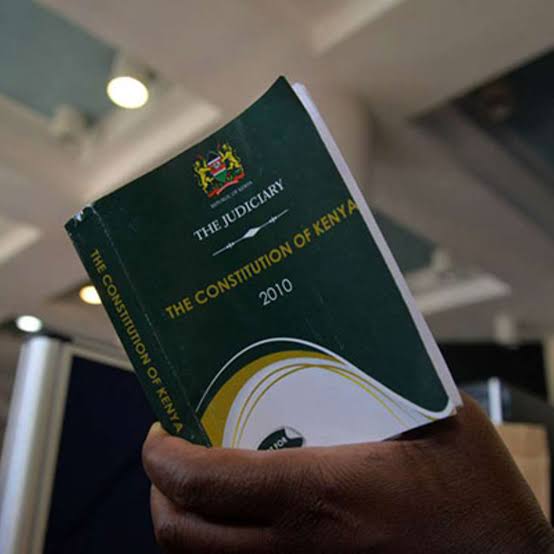
The gavel’s mandate: How Cries of “juristocracy” mask the refusal to submit to Kenya’s transformative constitution
 The Mt Kenya Times
By Jerameel Kevins Owuor Odhiambo
In January 2021 the Supreme Court of Kenya, in Mitu-Bell Welfare Society v Kenya Airports Authority, restored structural interdicts to their rightful place in the constitutional arsenal. The Court held that Article 23(3) of the 2010 Constitution empowers courts to grant “appropriate relief,” and that the word “including” makes the listed remedies non-exhaustive. Supervisory orders that require the State to report, plan, and return under judicial observation are therefore not judicial overreach; they are the Constitution’s own prescription for making rights real. That is the factual starting point. The issue that follows is political and historical: those who cry “juristocracy” when courts exercise this power are not defending separation of powers. They are defending the old order in which the executive could violate socio-economic rights with impunity and then hide behind the formal doctrine of separated functions.
The 2010 Constitution is not a polite rearrangement of colonial furniture. It is a transformative charter. It was forged after decades of one-party dominance, hyper-amendment culture, and an imperial presidency that treated the judiciary as a junior partner. Its Bill of Rights places socio-economic rights housing, health, education, food, water on the same plane as civil and political liberties. Article 21 imposes a positive duty on the State to “take legislative, policy and other measures, including the setting of standards, to achieve the progressive realisation” of these rights. When the State fails, and citizens bring the failure into court under Article 22, Article 23 hands the courts the authority to fashion whatever relief is required to uphold and enforce the Bill of Rights. Article 259 then commands that every provision of the Constitution be interpreted in a manner that promotes its purposes, values and principles; advances the rule of law and the human rights and fundamental freedoms in the Bill of Rights; permits the development of the law; and contributes to good governance. These are not ornamental clauses. They are operative commands.
Structural interdicts flow directly from this textual architecture. A declaration alone often leaves the poor with a paper victory and an unchanged reality. An injunction may stop an eviction today only for the same bulldozers to return tomorrow under a different bureaucratic guise. Compensation may put money in a few hands while the structural conditions that produced the violation remain untouched. A structural interdict does something the traditional remedies cannot: it keeps the court seized of the matter, requires the State to craft a plan, subjects that plan to judicial scrutiny, and monitors implementation. It does not usurp policy-making; it forces the policy-making organs to perform the constitutional duties they have neglected. The Supreme Court was explicit: such orders must be specific, appropriate, clear, effective, and directed at the State agency with the relevant mandate. They are not blank cheques for judicial dictatorship. They are calibrated instruments of constitutional enforcement.
History renders the resistance to these instruments indefensible. Under the independence Constitution the courts largely practiced a formalist restraint that left the executive free to demolish settlements, starve social programmes, and treat socio-economic rights as non-justiciable aspirations. The 2010 Constitution deliberately broke that pattern. It made the rights justiciable. It expanded the remedial toolbox. It instructed judges to develop the law rather than freeze it in colonial amber. When the Court of Appeal in 2016 tried to outlaw structural interdicts by invoking the Civil Procedure Act and the doctrine of functus officio, it was not protecting separation of powers. It was attempting to drag the new constitutional order back into the old dispensation. The Supreme Court correctly rejected that attempt. To insist that courts must still operate within the narrow remedial imagination of the pre-2010 era is to treat the transformative Constitution as optional.
The correlation is unmistakable. Every time courts have used structural interdicts—whether in the original *Mitu-Bell* housing litigation, in the early COVID-19 contingency planning orders, or in subsequent education and eviction cases—the resistance has come from the same quarters: an executive that prefers to announce policies without being held to timelines, and a political class that treats judicial supervision as an affront rather than a constitutional dialogue. Public data only sharpen the point. Kenya’s judiciary continues to receive less than one per cent of the national budget while carrying massive case backlogs. Yet the same institution is expected, when rights are violated, to deliver effective remedies. Starving the courts of resources and then accusing them of overreach when they fashion the only tools capable of making rights meaningful is a cynical manoeuvre. It is the politics of convenience dressed up as constitutional principle.
Those who invoke separation of powers as a shield against structural interdicts misunderstand both the doctrine and the Constitution. Separation of powers is not a doctrine of mutual paralysis. It is a doctrine of mutual accountability under a supreme law. When a matter is live before a court, the Constitution itself assigns the judicial arm the duty to grant appropriate relief. That duty does not evaporate because the relief has budgetary or policy consequences. If the State’s failure to realise the right to housing or health is the result of unreasonable neglect, the court that merely declares the violation and walks away has failed in its constitutional mandate. Article 259 does not permit such failure. It demands interpretation that advances human rights and contributes to good governance. Structural interdicts are one of the few mechanisms that can convert those lofty commands into lived reality for the residents of Mitumba Village and countless other communities still waiting for the progressive realisation the Constitution promised them.
Original insight reveals the deeper stakes. The cry of “juristocracy” is often less a principled defence of democratic accountability than a demand that the judiciary remain a spectator while the political branches perform their familiar dance of tactical concession without structural change. Kenya’s recent political history is littered with withdrawn bills, reshuffled cabinets, and elite pacts that leave the underlying machinery of exclusion intact. Into that vacuum of genuine political responsibility, the transformative Constitution places the courts not as substitute executives, but as the final institutional voice capable of insisting that rights are not merely aspirational. To disarm the courts of structural interdicts is to return the most vulnerable citizens to the mercy of that vacuum.
The call to action is therefore categorical and directed at every institutional actor. The judiciary must continue to exercise the full remedial authority conferred by Articles 23 and 259, crafting structural interdicts that are precise, time-bound, and respectful of institutional competence, yet unflinching in their demand for compliance. The executive must abandon the posture of injured sovereignty and treat supervisory orders as the constitutional dialogue they are designed to be. Parliament must stop outsourcing hard distributive choices to the courts and then complaining when the courts fill the gap. Civil society and the academy must refuse the false dichotomy that pits judicial creativity against democratic legitimacy; under a transformative Constitution the two are allies, not antagonists. Citizens must recognise that the 2010 Charter is not a museum piece. It is a living instrument that demands continuous enforcement.
Kenya is no longer in the constitutional dispensation of the past. The imperial presidency has been constitutionally dethroned. The courts have been constitutionally armed. Structural interdicts are not the gavel’s usurpation of the crown. They are the gavel’s fulfilment of the people’s mandate. Those who still speak as if the old formalisms survive have simply refused to read the supreme law that now governs them. The Constitution is clear. The only remaining question is whether the political branches will finally submit to it.
The writer is a social commentator
Similar Posts by The Mt Kenya Times:
- Botswanan writer lands in Nairobi: Dr. Otukile visits the country that gave her first break
- Kakuzi birdwatching tour ends in triumph as Japanese royalty sights rare migratory birds
- KSh6.4 million up for grabs as MKU searches for its most impactful alumni
- South Sudan: A test of leadership
- Manchester United secure land for new 100,000-seat stadium
About the Author