Safari Rally confirmed for 2027 WRC calendar as Kenya eyes motorsport revival
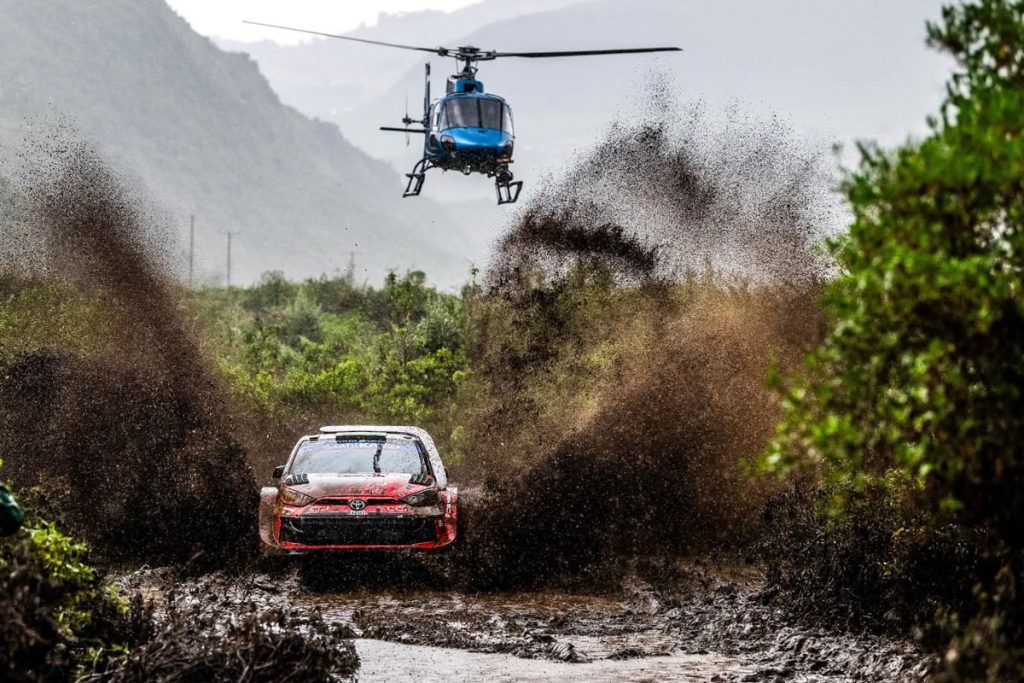
Action at 2026 WRC Safari Rally. Photo/WRC X
With the iconic event secured for March, attention shifts to building a national motorsport pyramid that outlasts any single race
By Martin Weche
Kenya’s Safari Rally will return to the 2027 World Rally Championship calendar, scheduled for 18 to 21 March, after months of intensive behind-the-scenes negotiations led by WRC Safari Rally Project Chief Executive Officer Carl Tundo in partnership with the government and Motorsport Kenya Federation.
The confirmation ends a period of considerable uncertainty around one of rallying’s most storied events. Tundo, a five-time Safari Rally winner and vice president of Motorsport Kenya Federation, stepped into the chief executive role shortly before the 2026 edition at a moment when the project faced serious financial and organisational strain. His immediate brief was unambiguous: stabilise the event, deliver the 2026 race, and secure Kenya’s place on the WRC map beyond it. Yesterday’s calendar announcement marks the completion of that first phase — and the beginning of a considerably more demanding second one.
“We are extremely excited to have the Safari Rally back on the 2027 WRC calendar,” Tundo said. “The Safari is one of the most iconic rallies in the world, and having Kenya confirmed once again is a tremendous achievement for the country. There has been a huge amount of work behind the scenes. The team has worked extremely hard, and we are grateful for the support we have received from government and all the stakeholders involved.”
Tundo acknowledged the role played by President William Ruto, under whose instructions he took charge of the project, as well as Tourism and Wildlife Cabinet Secretary Salim Mvurya and Principal Secretary Elijah Mwangi, in providing the political and institutional backing that made the calendar retention possible.
For Altaf Ganatra, president of Motorsport Kenya Federation, the WRC confirmation matters — but it represents only one component of a broader and more ambitious vision for Kenyan motorsport. Speaking yesterday, Ganatra was clear that the Safari Rally should function as the pinnacle of a national sporting pyramid, not as a stand-alone spectacle disconnected from the grassroots.
“The Safari Rally is much more than a sporting event,” Ganatra said. “It is a global showcase for Kenya, our people, our talent and our tourism. But the government has demonstrated that its interest in motorsport goes beyond the Safari Rally. There is now an opportunity to revive and develop the entire sport, from grassroots competition to the international stage.”
That development programme spans a wide range of disciplines, including Tarmac Racing, Rallycross, Rally, Autocross, Rally Raid, Karting, Cross Car, Drifting, E-Sports, Sim Racing, Classic and Historic Motorsport, and four-wheel-drive off-road competition. The ambition, Ganatra said, is to construct a genuine development pathway — one through which a young Kenyan can enter motorsport at the lowest level and, with talent and opportunity, progress to international competition.
“We want a young Kenyan to be able to enter the sport at grassroots level, develop through Autocross, Rallycross, Tarmac, Rally or Rally Raid and ultimately have the opportunity to compete internationally,” he said. “This is not just about drivers. It is about mechanics, engineers, officials, marshals, teams and businesses.”
The vision is well-articulated. The challenge, as everyone involved privately acknowledges, is execution. Securing a calendar slot is a diplomatic and financial achievement; delivering a world-class event is an operational one, and the two require different skills. That operational responsibility now rests squarely with Tundo and his project team. The government and the federation have provided the framework. The 2027 Safari Rally itself must be built from the ground up, on a tighter timeline and with a global audience watching.
Tundo is under no illusions about the scale of what lies ahead. “The Safari is back, Kenya is on the calendar, and we are proud,” he said. “But this is only one part of the journey. Now we have to put on a great show in 2027 and continue building a motorsport system that can serve Kenya for generations.”
Kenya’s relationship with the WRC has always carried a weight beyond sport. The Safari Rally, first held in 1953 and a fixture on the world championship calendar for decades before its long absence, is woven into the country’s identity in ways that few international sporting events achieve anywhere. Its return in 2021 after a 19-year hiatus was celebrated as a moment of national pride. Retaining it, and building something durable around it, would mean considerably more.
For Ganatra, the measure of success will not be the 2027 race alone. “The Safari Rally is the pinnacle,” he said, “but underneath it we need a strong national sport — strong clubs, properly organised championships, trained officials, better safety standards and opportunities across every discipline.”
The calendar is confirmed. The harder work begins now.
Similar Posts by The Mt Kenya Times:
- Mt Kenya Times ePAPER October 9, 2026
- Ruto claims farming revolution as election season dawns
- China grants Kenya $2M for drought and Ebola response
- High Court upholds KSh2.5M IEBC fine against Gikaria
- Kenya’s opposition fractures with 11 months to the ballot
About the Author