School feeding in Kenya: Can every child access a meal and an education?
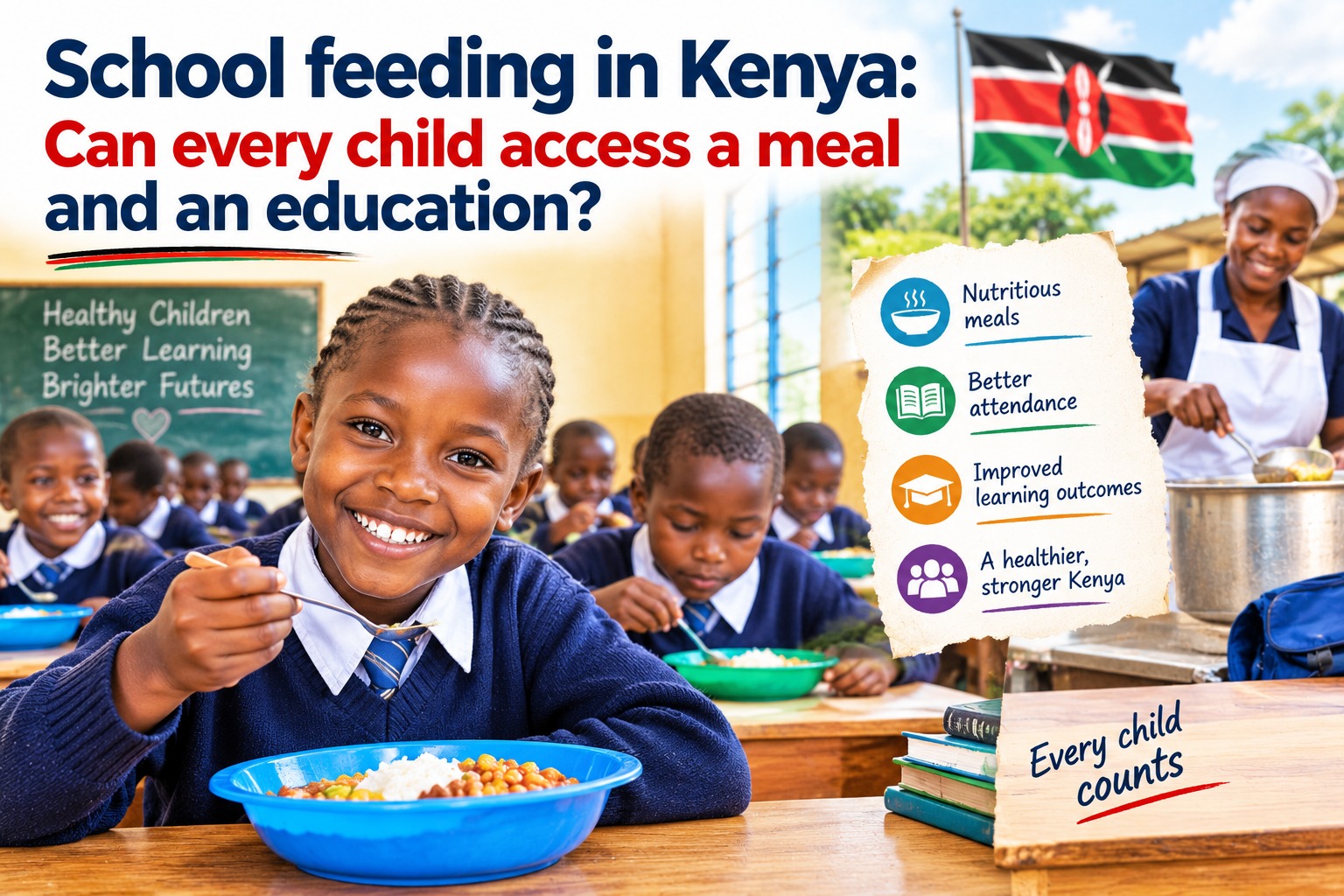
Thousands of Kenyan children sit in classrooms every day too hungry to learn — and the country cannot afford to keep pretending that is acceptable
By Collins Kibet
A child who arrives at school without breakfast is already behind before the lesson begins. Hunger does not pause for arithmetic or reading comprehension. It gnaws at concentration, dulls memory, suppresses participation and makes the simplest instruction feel unreachable. Yet across Kenya, thousands of learners face exactly this reality every single school day — and the country’s educational ambitions are quietly paying the price.
School feeding programmes are frequently discussed as welfare initiatives, a kindness extended to the poor. That framing understates their importance considerably. They are investments in human capital, in national productivity and in the basic fairness that meaningful education requires. Physical presence in a classroom is not the same as learning. A hungry child may occupy a desk, but their mind is elsewhere.
The problem is most acute in drought-prone regions, informal settlements and households living under sustained economic pressure. Many parents cannot reliably provide breakfast before school. Some cannot provide dinner either. When children from these households attend class, their attention is divided between whatever is being taught and the very immediate discomfort of an empty stomach. The consequences accumulate over time — poor performance, disengagement, absenteeism and, eventually, dropout. Hunger is not the only driver of educational inequality in Kenya, but it reliably deepens every other inequality that already exists.
A well-designed and consistently funded school feeding programme addresses several of these pressures simultaneously. It incentivises attendance, particularly among children whose families weigh the cost of sending them to school against the cost of keeping them home to work or help with younger siblings. It reduces the financial burden on vulnerable households, freeing parents to manage other pressing needs. And when meals meet genuine nutritional standards, it supports the physical and cognitive development that learning depends upon. These are not marginal benefits. For a child living in poverty, a reliable school meal can be the difference between staying in school and leaving it.
Kenya’s development trajectory depends on the knowledge, skills and ambitions of its young population. The country cannot credibly aspire to produce the teachers, engineers, doctors, entrepreneurs and public servants it needs if a significant portion of those future professionals cannot concentrate in primary school because they are hungry. The connection between nutrition and educational outcome is not speculative — it is well-documented and the evidence is unambiguous. Treating school feeding as a charitable add-on rather than a core component of educational policy is a choice Kenya can no longer justify.
Funding remains the most persistent obstacle. Purchasing food, transporting supplies, preparing meals and maintaining safe kitchen facilities require substantial and consistent resources. Where funding is delayed or inadequate, meals become irregular, and irregular meals are almost as damaging to attendance as no meals at all. National and county governments, development partners and private stakeholders must work together to establish financing arrangements that are sustainable rather than seasonal. Budgets must be transparent, monitored rigorously and protected from diversion. Resources allocated to feeding programmes must reach the schools that need them, not disappear into procurement chains that benefit everyone except the children.
Dependence on emergency donations or temporary partnerships is not a strategy. Purchasing food from local farmers and cooperatives offers a more durable model — one that keeps money circulating within communities, creates markets for agricultural produce and builds relationships between schools and their surroundings. Local procurement, however, requires careful management. Good intentions do not substitute for clear supply chains, fair pricing, food safety standards and professional oversight. Sustainable programmes are built on systems, not goodwill.
Equity must also shape how resources are allocated. Not every school faces the same pressures, and policy that treats all schools identically produces outcomes that are identical in name only. Schools serving communities affected by recurrent drought, chronic food insecurity or extreme poverty need more support, not the same support distributed more thinly. Recognising that reality is not a departure from fairness — it is what fairness actually requires.
Community involvement strengthens whatever structures exist. Parents, school management committees, teachers and local leaders can monitor food quality, flag irregularities and help identify the most vulnerable learners. Their participation should complement, not replace, the government’s fundamental responsibility to ensure that public education functions. Oversight must be genuine — not performative audits that satisfy reporting requirements while meals remain inadequate or unsafe.
The measure of success for any school feeding programme should not stop at the number of meals served. It must extend to attendance rates, learner retention, classroom participation and, ultimately, educational outcomes. Those figures tell the real story of whether the investment is working and whether the most vulnerable children are being reached.
Kenya has made real progress in expanding access to education. Enrolment figures have risen, new classrooms have been built and the policy conversation has matured considerably. But enrolment without retention is incomplete progress, and retention without adequate nutrition is a fiction. A child who is hungry, exhausted and anxious about the next meal cannot compete on equal terms with a child whose basic needs are reliably met. Pretending otherwise does not close the gap — it widens it.
The question facing Kenya is no longer whether school meals are beneficial. The evidence settled that long ago. The question is whether the country is prepared to fund them adequately, manage them professionally and sustain them for long enough to make a genuine difference. A nation that feeds its learners invests in their potential. A nation that protects that potential builds the only foundation its future actually rests on.
Similar Posts by The Mt Kenya Times:
- Mt Kenya Times ePAPER October 15, 2026
- One year on: ‘Dad is gone’ — Ida Odinga recalls the moment Kenya lost Raila
- Matiang’i and Nyoro pledge free senior secondary education from 2028
- Kenya’s election countdown: DCP and Gachagua fire the opening shot in 2027 battle
- When students become the community’s hope
About the Author