Beyond university degrees: Why Kenyan youth must embrace practical skills
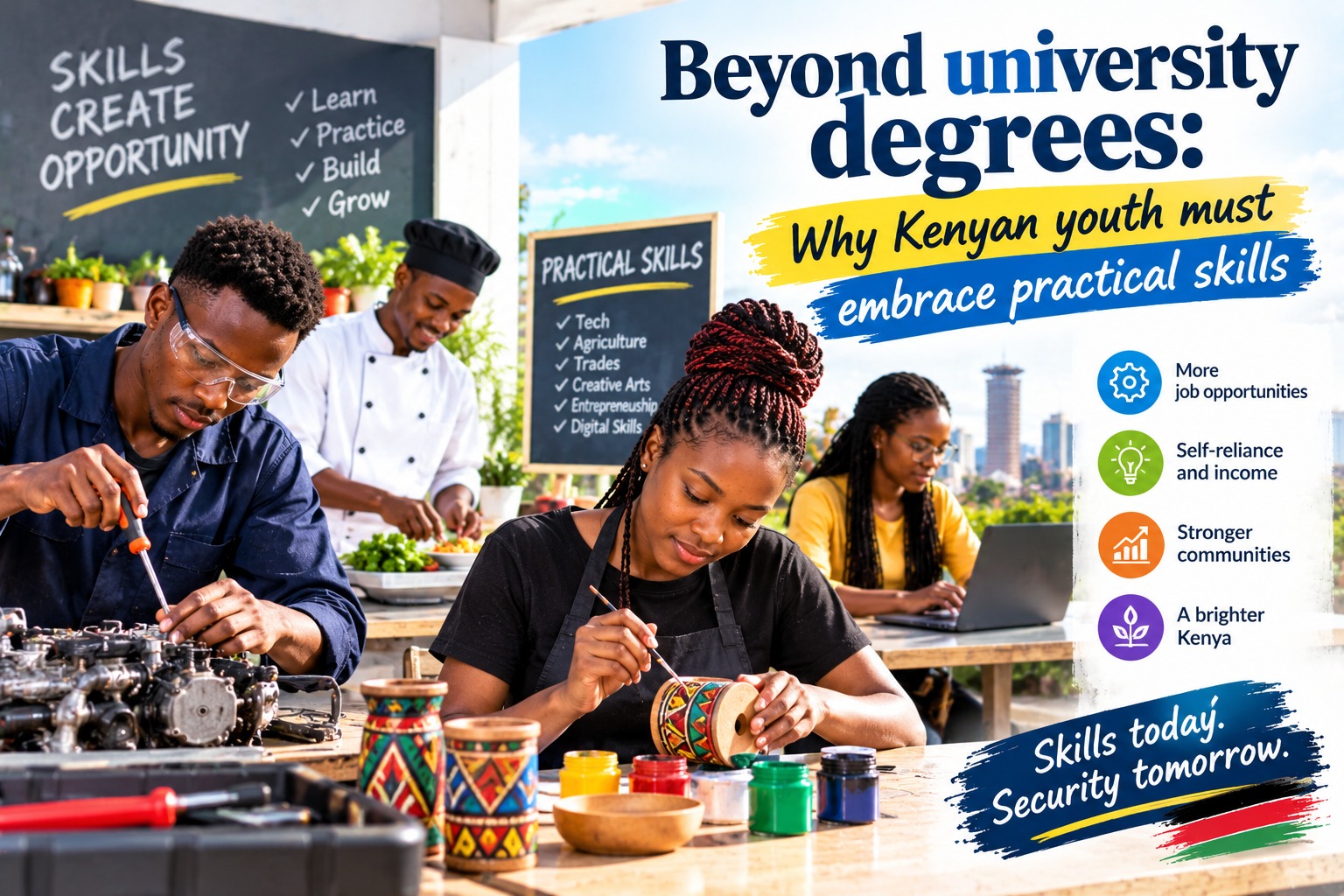
A certificate opens doors, but it is skill, creativity and adaptability that determine what happens once you walk through them
By Victorine Nekesa
Every year, thousands of Kenyan families pour their savings into school fees, uniforms and examination preparation, driven by a deeply held conviction that education is the surest path to a better life. That conviction is not wrong. But it is incomplete — and the gap between a university degree and a sustainable livelihood is widening in ways that Kenya can no longer afford to ignore.
The question is no longer whether young people should pursue education. They should. The question is what kind of education, and whether academic qualifications alone are sufficient preparation for a world that increasingly rewards what you can do over what you have studied.
Kenya’s employment landscape has shifted dramatically. Graduate unemployment is not a new phenomenon, but its scale is now impossible to dismiss. Universities continue producing thousands of graduates annually into a job market that cannot absorb them at the pace required. Meanwhile, genuine gaps exist in the economy — in construction, technology, creative production, digital services and skilled trades — that go unfilled because the training pipeline has not kept pace with demand.
On 15 October 2026, the government renewed its call for young people to embrace Technical and Vocational Education and Training, framing practical skills as central to self-reliance and economic growth. The initiative seeks to connect youth with accessible training and certification pathways. It is a step in the right direction, but the cultural shift it requires runs deeper than any government programme alone can achieve.
For too long, vocational training has carried an undeserved stigma in Kenya — treated as the consolation prize for those who did not make it to university. That perception is both inaccurate and costly. A trained electrician, a skilled graphic designer, a competent mechanic or a professional hairdresser with business acumen can build a livelihood that rivals and often exceeds what a degree alone delivers. Professionalism, discipline and continuous learning are what separate a struggling technician from a thriving one — not the institution where they trained.
The creative and digital industries deserve particular attention. Young people who can write compelling content, design visual media, edit video, photograph events or manage social media platforms are sitting on genuine income-generating potential. With reliable internet access and the right tools, these skills can reach clients well beyond the immediate community. A freelance designer in Nakuru can serve a client in Nairobi, Mombasa or abroad. Geography is no longer the constraint it once was.
Practical skills and academic education are not in competition. They work best together. A communication student who supplements their journalism training with photography, video production and digital content creation is not diluting their degree — they are multiplying its value. Universities and colleges must recognise this and respond accordingly, strengthening practical training, expanding internship partnerships and creating structured opportunities for students to build real portfolios before graduation. A transcript tells an employer what a graduate studied. A portfolio shows what they can actually deliver.
The private sector and community organisations also carry responsibility here. Vocational training must be affordable, geographically accessible and aligned with what employers genuinely need. Young people who have acquired skills informally — through apprenticeships, self-teaching or community learning — deserve clear pathways to formal certification. Their competence should not be invisible simply because it was gained outside a classroom.
Individual attitude matters equally. Acquiring a skill is the beginning, not the destination. Financial literacy, customer service, communication and basic business planning are the difference between a talented individual and a sustainable enterprise. Young Kenyans who combine a marketable skill with the ability to manage money, retain clients and plan for growth are not just employable — they are capable of employing others.
None of this removes the need for broader structural change. Training alone cannot solve youth unemployment. Kenya needs a business environment that supports emerging entrepreneurs, expands access to affordable financing and removes bureaucratic barriers that prevent small enterprises from scaling. Individual effort and structural support must move together.
The goal was never simply to produce graduates. It was always to prepare young people who can identify problems, build solutions and contribute meaningfully to national development. A degree remains a valuable foundation. But practical ability, creative thinking and the willingness to adapt are what determine whether that foundation becomes something lasting.
For Kenya’s young generation, the future belongs not to those who waited for opportunity, but to those who built it.
Similar Posts by The Mt Kenya Times:
- Oburu marks birthday and brother’s death from Nairobi Hospital bed
- Natembeya and Orengo demand answers over security withdrawal
- Linda Mwananchi Movement: The brand that could reshape Ruto’s path to 2027
- ODM and Linda Mwananchi clash at Raila’s Bondo memorial
- Kenya’s opposition fractures at Raila’s memorial
About the Author