D-Day in Ol Kalou: Ruto and Gachagua face their sharpest test yet
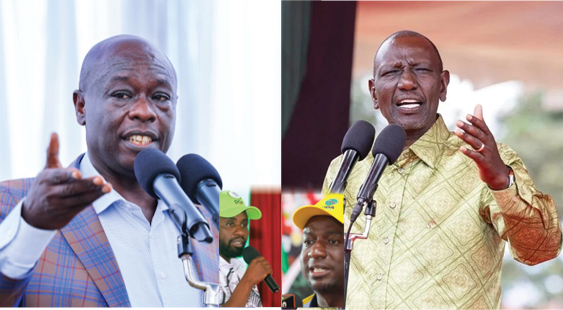
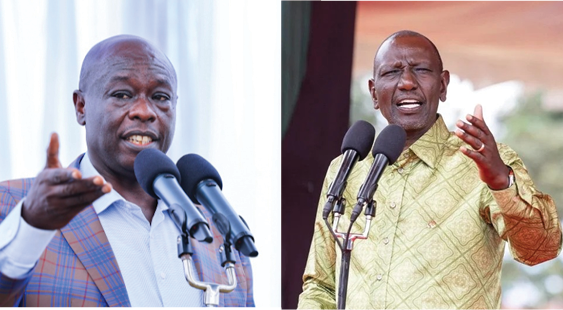
President William Ruto and his former Deputy, Rigathi Gachagua and their candidates for Ol Kalou
More than 1,000 police officers, water cannons and a constituency’s worth of political capital converge on Nyandarua as voters decide a by-election both camps have turned into a referendum on 2027
By MKT Reporter
Voters in Ol Kalou Constituency go to the polls today, July 16, in a parliamentary by-election that has evolved from a routine contest to replace a deceased MP into the most closely watched political showdown of the year between President William Ruto’s United Democratic Alliance and the Democracy for the Citizens Party led by his former deputy, Rigathi Gachagua.
The seat fell vacant after the death of David Kiaraho, who had represented Ol Kalou for three terms on a Jubilee Party ticket, on March 29. What should have been a straightforward mini-poll has instead become, in the words of political observers and the candidates themselves, an early referendum on where the Mount Kenya vote will land in 2027.
Nine candidates were cleared by the Independent Electoral and Boundaries Commission, but the race has narrowed to a two-horse contest. The ruling party has fielded Samuel Muchina Nyagah, who secured the UDA ticket after garnering 3,221 votes against runner-up George Wambugu Kanuri in party nominations. The DCP has backed Sammy Kamau Ngotho, who won his party’s nomination with 12,957 votes and has campaigned on a platform of direct bursary disbursement to schools, promising residents relief from what he calls bureaucratic delays. Jubilee Party’s Wilson Kigwa is also in the running, seeking to retain the seat the party held under Kiaraho.
The scale of the political investment in a single constituency has been unusual even by Kenyan by-election standards. Nyandarua Senator John Methu, DCP’s acting secretary-general, has led campaign messaging framing the vote as a referendum on the cost of living and the direction of governance under the current administration. On the government side, the campaign has drawn in a succession of Cabinet Secretaries, among them Rebecca Miano, Davis Chirchir, William Kabogo and Alice Wahome, alongside governors Susan Kihika, Anne Waiguru and Cecily Mbarire, and former Cabinet Secretary Moses Kuria, who has been the most vocal government-aligned figure in the race.
Kuria has framed the by-election in explicitly national terms. “We are not just any other party, we are the ruling party,” he told supporters at UDA headquarters after Muchina’s nomination, arguing the party would be judged on its development record rather than rhetoric. When Gachagua alleged that the government had funnelled over KSh1 billion into bribes and roughly KSh10 billion into projects in the constituency, Kuria did not deny the spending but disputed the framing, insisting the true value of national government investment in Ol Kalou and wider Nyandarua County exceeded KSh10 billion in legitimate development, not inducement.
Gachagua, for his part, has accused the state of deploying its full machinery against his candidate. In a July 9 statement, he claimed the administration had spent heavily on both cash handouts and infrastructure projects timed to influence the vote, and alleged a plan to have the IEBC postpone or cancel the poll should internal government assessments point to defeat for Muchina. IEBC chairperson Erastus Ethekon had earlier warned the commission could be forced to postpone the by-election if documented breaches of the electoral code, including voter bribery and illegal night campaigning, continued unchecked.
Security preparations have matched the scale of the political stakes. Inspector General of Police Douglas Kanja announced the deployment of more than 1,000 officers, backed by four platoons each of the General Service Unit and the Anti-Stock Theft Unit, four water cannons and Directorate of Criminal Investigations personnel tasked with probing electoral offences. “We have over 1,000 police officers deployed to ensure that the by-election is adequately covered,” Kanja said, confirming that all 114 polling stations would each have a minimum of two officers and a standby response team of no fewer than fourteen. He also issued a direct warning to young people against allowing themselves to be mobilised to disrupt voting.
Gachagua has questioned that same deployment. In a four-page letter to Kanja dated July 15, he described the security presence as unprecedented, put the figure at 2,000 officers rather than 1,000, and demanded that all personnel be uniformed, display service numbers and use marked vehicles, alleging that command of the police service had shifted toward government-aligned politicians. The National Police Service had not responded to the letter’s contents by the time of publication.
The IEBC has confirmed logistics are complete for the constituency’s 73,480 registered voters, who will cast ballots at 144 polling stations across the five wards of Rurii, Kanjuiri Ridge, Karau, Kaimbaga and Mirangine, using either a national identity card or a valid passport.
What the result means will extend far beyond Ol Kalou. A UDA win would allow the government to claim its development-first campaign, anchored by big-ticket promises such as the long-delayed Ol Kalou Stadium and the proposed revival of the Nairobi–Nyahururu railway line, still resonates in a region that gave Ruto 87 percent of its vote in 2022. A decisive DCP victory would hand Gachagua tangible proof that his break with the president has not cost him Mount Kenya’s loyalty, strengthening his hand heading into 2027 whether he leads the opposition ticket himself or brokers it. A narrow result on either side would settle little and likely intensify the contest for the region ahead of the general election.
For the people of Ol Kalou, caught between record police deployment, a flood of government project launches and dueling allegations of vote-buying, today’s ballot is a chance to have the final word on a campaign that, for fifty days, has rarely been about them at all.
Similar Posts by The Mt Kenya Times:
- AI Curse or boon: The Future of Intelligence: Artificial or Emotional?
- Dr. Ekrah Ndung’u wins TVET advocacy award after 12 years
- Mt Kenya Times ePAPER October 17-18, 2026
- Ruto bets billions on Kerio Valley — with one eye on 2027
- Ruto’s health ministry kills Murang’a’s digital hospitals
About the Author