The Mt Kenya Times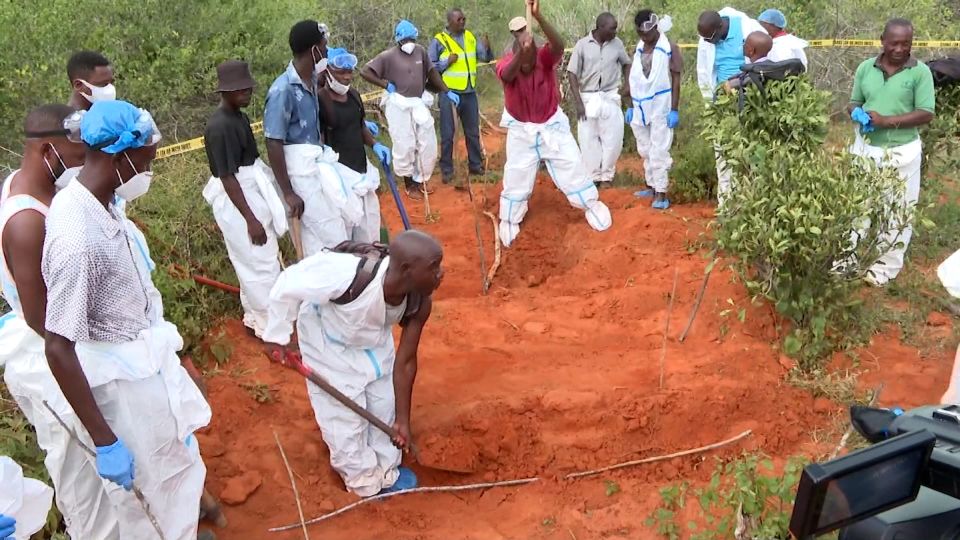
Shakahola
By: Jerameel Kevins Owuor Odhiambo
The year of the Lord is 2023 and the setting is in Kilifi County, a husband walks into a police station because his wife and daughter have not returned from a forest. What the officers find when they follow him is not a missing-persons case. It is a nation’s reckoning with itself, dug up one shallow grave at a time. By the time the exhumations slowed, more than four hundred bodies had been pulled from the red soil of Shakahola, and autopsies would show that most of them had starved, some strangled, some suffocated, some beaten all in pursuit of a heaven their pastor promised was only reachable through hunger. That is not metaphor. That is inquest.
We must resist the temptation to file Shakahola under the folder marked “cult,” seal it, and walk away relieved that madness has an address far from our own pews. To do that is to misdiagnose the disease by staring only at its most advanced tumor. What killed those four hundred people did not arrive as a foreign thing. It walked in wearing the same vestments it wears on any ordinary day of worship, carrying the same book, singing the same hymns. The forest was not an aberration. It was an amplification of something that already lives, quietly and respectably, in a thousand congregations across this country.
So let us name the thing properly, because a wound you cannot name is a wound you cannot dress. Fundamentalism is not simply “taking religion seriously,” and it is not synonymous with devotion, discipline, or even literalism on its own. It is a particular architecture of the mind, built on three load-bearing walls. The first is certainty without appeal: a conviction so total that no fact, however documented, is permitted to modify it only to be reinterpreted, explained away, or declared a test sent to try the faithful. The second is a single, unquestionable source of authority, be it a text or a man claiming direct line to God, whose word requires no corroboration and tolerates no cross-examination. The third is the collapse of the world into two camps only the saved and the damned, the obedient and the cursed so that anyone counselling caution, whether a doctor, a journalist, or a frightened relative, is not a second opinion but an enemy of the faith. Strip away the theology and what remains is a closed epistemological system: a way of knowing that has sealed its own exits.
That is why a mother who withholds antimalarials from a feverish child in favour of fasting and prayer is not practising an extreme version of faith. She is executing the same operating system that built the graves at Shakahola, just running a gentler subroutine of it not yet asked to walk the doctrine’s last, lethal mile. Evidence-based medicine survives on falsifiability: a claim is only as good as our willingness to test it against the world and discard it when it fails. Fundamentalist reasoning inverts this completely. The conclusion is fixed in advance, sacred, non-negotiable, and any inconvenient fact a rising temperature, a starving child, a positive HIV test is not data to be reckoned with but a trial of obedience to be endured. Once a mind has been trained to treat contradiction as temptation rather than information, it has lost the one tool that lets a person distinguish a good idea from a fatal one. That is not spiritual devotion. That is the deliberate disarming of a population’s critical faculty, congregation by congregation, sermon by sermon.
Kenya has watched this arithmetic play out before Shakahola and since. Investigators and human rights bodies who examined the case concluded that the tragedy was not simply the work of one deranged preacher but a failure the state had been warned about and declined to stop, with security officers in the area faulted for negligence long before the graves were found. That finding matters, because it tells us fundamentalism does not kill alone. It kills with the complicity of institutions too polite, too electorally cautious, or too theologically deferential to intervene while a “man of God” is still merely eccentric rather than yet a murderer. The four thousand-odd registered churches operating in this country at the time were not evidence of a spiritually rich nation. They were evidence of a regulatory vacuum wide enough to bury four hundred people in, and no one thought it strange enough to close.
And it is never only the dead we should count. Under the same architecture of certainty, girls have been married off before their bodies were ready for it, women have been told a husband’s violence is a cross to bear rather than a crime to report, children born with correctable conditions have been presented to congregations as demons to be exorcised rather than patients to be treated, and queer Kenyans have been catalogued as abominations rather than citizens. Each of these is fundamentalism doing precisely what its architecture is built to do: convert a human rights violation into a religious observance, so the perpetrator feels obedient rather than guilty, and the victim is taught to feel deserving rather than wronged. The erosion is slow enough that no single sermon looks like a crime scene. But add up enough sermons, enough closed epistemologies, enough unquestionable men, and you get Shakahola. You get a father calmly denying his starving children food and calling it faith.
None of this indicts belief itself, and it would be intellectually dishonest and strategically self-defeating to pretend otherwise. Kenya’s churches have buried the state’s failures more often than they have caused them: feeding programmes, hospices, schools in counties the government forgot, moral courage during years when courage of any other kind was scarce. The problem this essay names is not faith. It is faith stripped of its humility, faith that has stopped asking questions of itself, faith weaponised by men who discovered that “God told me” is a sentence no magistrate wants to be first to challenge. There is a difference between a congregation that prays over a sick child on the way to hospital and one that prays instead of going. The first walls of fundamentalism certainty, singular authority, closed camps are absent from the first congregation and load-bearing in the second.
The task in front of us, then, is not to choose between the sanctuary and the clinic. It is to insist, without apology, that no pulpit in this republic sits above the Constitution, and that a doctrine which cannot survive contact with a blood test or a court of law has no business shaping the lives of children who never consented to it. Regulate the unregistered churches. Prosecute the men who dress predation in prophecy. Teach reasoning, not merely recitation, in the Sunday school and the public school alike. Protect the believer’s right to worship exactly as fiercely as we protect the child’s right not to be starved for it.
Shakahola’s graves have mostly been closed now. The question this country has not yet closed is whether it will keep manufacturing the architecture that filled them.
The writer is a social commentator
Similar Posts by The Mt Kenya Times:
- Mt Kenya Times ePAPER October 21, 2026
- Kenya confirms ninth Ebola case as outbreak remains contained within single cluster
- Musk pledges SpaceX share for every American child in 2027
- Abiy calls for deeper Kenya-Ethiopia trade partnership at Eldoret ceremony
- Kenya’s oil moment: Promise, responsibility and the long road from Turkana to market
About the Author