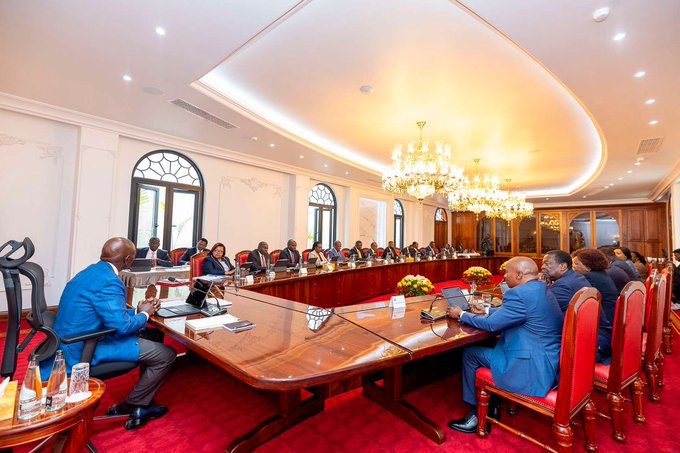
Kenya’s $1 Billion Digital Dream Hits a Wall: Microsoft Data Centre Stalls Over Power Crisis

By The Diaspora Times Team
NAIROBI, KENYA — It was billed as the deal that would transform Kenya into Africa’s premier technology powerhouse. Announced with considerable ceremony during President William Ruto’s state visit to Washington in May 2024, the $1 billion partnership between Microsoft, Abu Dhabi-based artificial intelligence firm G42, and the Kenyan government promised to deliver a world-class, geothermal-powered data centre at Olkaria — the anchor of a new East Africa cloud region that would bring AI-era infrastructure squarely to the continent. Two years on, that dream is gathering dust. The electricity grid that was supposed to power it simply cannot keep up.
Kenya is still trying to revive the Microsoft-G42 data centre plan, but power and approval constraints keep it stalled. The proposed facility would draw roughly a third of the country’s installed capacity, while Treasury clearance and guarantee terms remain unresolved. The delay leaves East Africa without a flagship Microsoft-G42 cloud build as rival infrastructure projects and regional demand continue moving forward.
The numbers that have brought this flagship project to a standstill are, in hindsight, stark. The proposed data centre would require about one gigawatt of power supply. Considering that Kenya currently has a total installed power capacity of approximately three gigawatts, the facility would consume a disproportionate share of the country’s entire energy supply. It was President Ruto himself who made the contradiction plain — and public — while addressing Kenyans living in Doha, Qatar, in November 2025. “When I returned to the country, we were told one data centre requires 1,000 MW and yet we have 2,300 MW. For us to do the data centre, we have to shut down half the country,” he said, in remarks that sent shockwaves through Kenya’s technology and investment communities.
The original vision was ambitious: a data centre campus in Olkaria, south-west Kenya, powered entirely by geothermal energy, with an initial capacity of 100 megawatts that could eventually rise to one gigawatt. The facility was intended to host Microsoft Azure services through a new East Africa cloud region, positioning Kenya as a regional hub for cloud computing and artificial intelligence.
What changed between the fanfare of the Washington signing and the cold reality of implementation was not the ambition — it was the arithmetic. Negotiations between the consortium and Kenya’s energy ministry broke down, according to people familiar with the talks, over a demand that the government underwrite the entire one-gigawatt load through a mix of state-owned geothermal plants and long-term power purchase agreements with independent producers. Officials balked at the financial exposure, which could have run into hundreds of millions of dollars annually, and questioned whether Kenya’s grid could reliably deliver that much capacity to the remote site near Olkaria.
Microsoft and G42 countered that the guarantee was necessary to secure financing from international lenders. Banks and export credit agencies demanded a sovereign-backed assurance that the power would be both available and paid for over a twenty-year horizon. Without that, the consortium argued, the project’s economics would be too uncertain. It is the kind of impasse that exposes the gap between headline diplomacy and the hard engineering reality of building infrastructure at scale.
Kenya’s Special Technology Envoy Philip Thigo has pushed back against suggestions that the project has been abandoned outright. “His point has not been that the project was suspended, but Kenya must confront the scale of energy required to support next-generation digital infrastructure,” Thigo said in a statement. He maintained that the government remains committed to scaling electricity generation to at least 10,000 megawatts by 2030 — a target that would make facilities like the Microsoft-G42 campus feasible. It is an admirable goal. It is also a long way from where Kenya stands today.
John Tanui, principal secretary at Kenya’s Ministry of Information, told Bloomberg that the project has not been withdrawn and that discussions are continuing, adding that the “scale of the data center they [Microsoft] wanted to do still requires some structuring.” Measured words, perhaps, for a project that once promised to reshape the continent’s digital architecture.
The Olkaria region remains, in principle, one of Africa’s most promising locations for energy-intensive digital infrastructure. The Olkaria geothermal field, located in Hell’s Gate National Park north-west of Nairobi, has the steam reserves to support significant generation expansion. But reserves in the ground and watts on the grid are two very different things, and the investment and development timelines required to bridge that gap are measured in years — not months.
Meanwhile, Kenya’s broader data centre sector has not stood still. Smaller, modular, carrier-neutral facilities have quietly been delivering. iX Africa’s NBOX1 facility came online in early 2025 with 4.5 megawatts of IT power, with a much larger 18 megawatt phase planned. Oracle then selected iXAfrica to host its Nairobi cloud region, bringing AI-ready rack density to East Africa. The pattern is clear: four-to-twenty megawatt carrier-neutral facilities are being absorbed by the grid without drama. Hyperscale sites that demand a third of the national supply are not. The Olkaria EcoCloud project — a separate 60-megawatt campus on geothermal power — continues on a more modest and grid-compatible trajectory.
The lesson being absorbed, somewhat painfully, across Kenya’s technology policy circles is one that other emerging economies have learned before: digital ambition must be grounded in energy reality. The delay leaves East Africa without a flagship Microsoft-G42 cloud build, as rival infrastructure projects and regional demand keep moving. South Africa, Egypt, and Nigeria are all pressing forward with their own data centre expansions. Every month of uncertainty in Nairobi is a month in which those competitors consolidate their advantage.
The broader stakes extend well beyond corporate investment. The government’s eCitizen platform — which processes millions of digital public service transactions — was expected to form part of the initial demand base alongside private-sector customers across East Africa. A functional East Africa Azure cloud region would have reduced latency for businesses and governments across the region, lowered costs for cloud-dependent services, and provided the AI-processing backbone for the next generation of public services. That vision has not disappeared — but it has been deferred.
President Ruto has acknowledged that Kenya requires at least 10,000 megawatts of electricity generation capacity to industrialise and support future technologies such as AI data centres, estimating that the country would need more than one trillion Kenyan shillings in investment to expand generation through projects such as the High Grand Falls Dam. It is the right diagnosis. Whether the political will and financial engineering exist to act on it — and to act fast enough — is the question on which Kenya’s digital future now turns.
Kenya marketed itself to the world as Africa’s Silicon Savannah. To earn that title in the age of artificial intelligence, it will need to do something far more fundamental than signing agreements in Washington — it will need to keep the lights on.
Similar Posts by The Mt Kenya Times:
- Mt Kenya Times ePAPER October 12, 2026
- Gachagua’s party storms Kikuyu from afar as 2027 countdown begins
- Counties caught: The KSh100B payroll scandal Kenya can no longer hide
- CS Ogamba: tree planting could generate carbon credit millions to fund education
- Farouk Kibet calls for unity and development as leaders rally behind Ruto’s 2027 re-election bid
About the Author