

By Elizabeth Angira
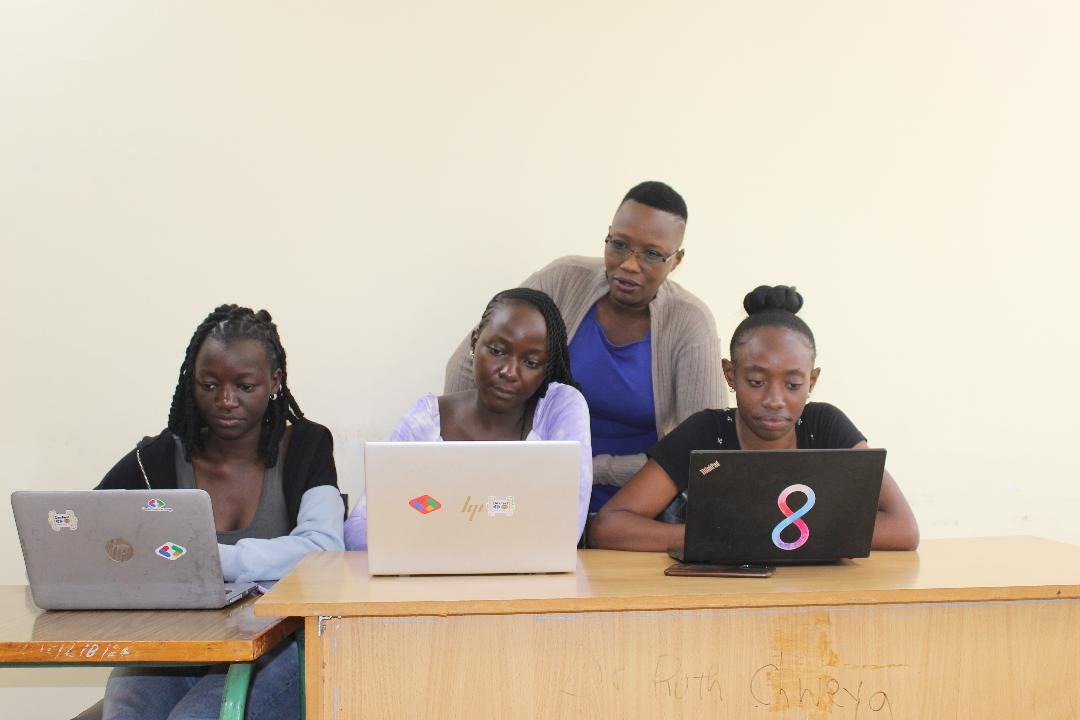
In a computer lab in Kisii, it’s not unusual to find a young woman staring down lines of code in a room where she is one of a handful. For many, getting there has meant pushing past expectations about what women should study and who belongs in technology.
When Purity Adhiambo, a 20-year-old software engineer, enrolled in the Computer Science programme at Kisii University, she knew little about the field. A friend had nudged her to join, saying the course had strong job prospects. In a class of 47 students, only five were women, a gap that was intimidating but also motivating.
“It was not easy, but I wanted to be counted among strong women who beat the odds and competed equally with men. There is a perception that women prefer ‘soft’ courses,” she says.
“I wanted to stand out and prove that women can also excel in male-dominated fields.”
Her persistence paid off. In 2023, Purity won a Mozilla Award for her mental health chatbot. During her fourth year, she developed an AI-powered pregnancy support app that allows women to track their health and receive automated responses to their questions. It is integrated with Google Maps, enabling users to locate the nearest hospital.
“The app can guide a pregnant mother if she is far from home and needs urgent medical attention,” she explains.
“I feel so happy that I was able to come up with something that can help people,” she says.
“That award encouraged me. It showed me that women can do even better if they are supported and motivated.”
But what kind of “AI” is being built in places like Kisii? In most cases, including Purity’s chatbot and her pregnancy support app, the technology relies on pre-built systems rather than developing new AI models. These apps are useful, but they place developers in the role of using and adapting AI, rather than building the core systems behind it.
The difference matters because while women like Purity are creating solutions, they are mostly working at the level where AI is applied, not where it is designed, trained, and controlled.
Gender Gap in Technology Roles
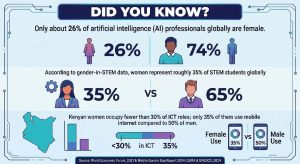 According to the 2024 GSMA Mobile Gender Gap Report, women occupy fewer than 30 per cent of ICT roles in Kenya, with representation in AI and machine learning even lower. In Kisii and across the country, young women are increasingly entering digital spaces, but often under constrained conditions.
Limited access to devices, unreliable internet and gaps in advanced training continue to shape how far they can go. Cultural expectations also influence who enters which fields.
Purity believes that one of the biggest barriers holding women back is the fear of stepping into male-dominated spaces.
“The community does not really discriminate against women. It is the lack of support and fear that makes women think they are not suited for these courses,” she explains.
Still, she remains optimistic: “Everything is digital now. It is upon women to show up and fight for their space.”
However, showing up does not guarantee equal participation. In Kenya’s emerging digital economy, many AI-related roles are concentrated in data labelling, transcription, and content moderation. These roles are essential to training global AI systems, yet they are typically low-paid, outsourced and invisible. As such, youth enter AI not as innovators, but as digital labour supporting systems built elsewhere.

Initiatives such as the Ajiry Digital Programme are expanding access to digital skills but also shaping where young people land in the tech economy. Supported by the Mastercard Foundation and partners, the programme trains youth for online work.
Since 2023, about 16,000 women have enrolled, making up roughly 70 per cent of participants. But the focus on quick, marketable skills often channels them into entry-level digital tasks, raising questions about whether these programmes are opening pathways into higher-value AI roles or reinforcing their place at the margins.
“We make sure the skills we teach are marketable. Once trained, we encourage them to look for online jobs instead of going back to the villages,” says County Manager Ishmael Nyakoni.
Structural Limits
At training institutions in Kisii, more women are enrolling in technology courses. In 2025, Kisii National Polytechnic trained 32 learners in AI, 11 of whom were women.
“Technology has sparked interest, and more women are eager to learn new digital skills,” says Moses Omwenga, Head of the Department of Computing and Informatics.

Through mentorship and exposure, more women are beginning to build confidence and enter these spaces, but structural barriers remain, and access does not always translate into advancement.
“When opportunities arise, men are often prioritised. Women are questioned about who will take care of the children or whether their husbands will allow them to participate,” says Peris Ongori, an ICT lecturer at the polytechnic.
“Technology has traditionally been male-dominated. Although enrolment has improved, we have not yet achieved the two-thirds gender balance,” adds Teresa Kwamboka Abuya, a computer science lecturer at Kisii University.
Most training remains introductory to intermediate, raising questions about whether women are being prepared to build AI systems or primarily to use them.
Innovation at the Edges of the System
Student-led innovations are emerging, but they also show where women sit within the AI ecosystem.
Lydia Muchemi, a third-year software engineering student, developed HeadSpace, a mental health platform, connecting users to therapists.
“Most young people turn to chatbots because they are accessible, but they are not sustainable or reliable,” she says.
Carlos Cindy built Nutri Pro, a nutrition app for people living with chronic conditions, while Emmanuela Omondi developed a smart waste sorting system using sensors and data tracking.
“Sometimes there are assumptions about who belongs in technical spaces,” says Omondi.
Some projects are progressing toward patenting, but without sustained funding, advanced training and industry access, the leap from local innovation to scalable AI systems remains uncertain.
AI, Bias, and Risk
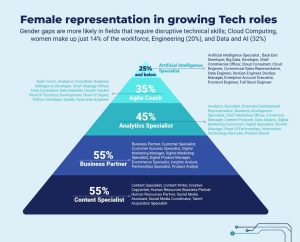 As AI becomes embedded in everyday life, questions of bias and representation grow more urgent. If women are underrepresented in designing AI systems, their perspectives risk being excluded.
Tools like chatbots and recommendation systems depend on the data they are trained on. Without diverse datasets and inclusive design, AI can reinforce existing inequalities, including gender bias in healthcare and access to services.
There are also concerns around data ownership and privacy, particularly where sensitive information is involved.
The developments in Kisii signal progress, but their long-term impact remains uncertain. Are these initiatives building a generation of women who will shape AI systems, or a workforce that supports them from the margins?
For Omondi and others, the work is both personal and collective.
“Innovation is not limited by gender,” Omondi says. “What matters is identifying a real problem and building a solution.”
But the real question is whether women will have the resources and influence to shape AI or remain confined to its periphery.
In Kisii, that answer is still being written.
This article was produced as part of the Gender+AI Reporting Fellowship, with support from the Africa Women’s Journalism Project (AWJP) in partnership with DW Akademie. The journalist used AI tools as research aids to review and summarise relevant policy and research documents and extract key statistics. All interviews, analysis, editorial decisions and final wording were done by the reporter, in line with Mt Kenya Times’ editorial standards.
 Elizabeth Angira is a trailblazing climate journalist whose work bridges science, policy, and human impact. As Senior Climate Reporter at The Mount Kenya Times, she leads in-depth coverage on climate resilience, energy innovation, and sustainability across East Africa and beyond. Her storytelling has earned international acclaim, including a third-place win for “The Best Energy Story in Foreign Media” by the Global Energy Association in Moscow.
Elizabeth’s portfolio reflects her commitment to excellence and advocacy:
*************************************************
🏆 Awards & Honors
Elizabeth Angira is a trailblazing climate journalist whose work bridges science, policy, and human impact. As Senior Climate Reporter at The Mount Kenya Times, she leads in-depth coverage on climate resilience, energy innovation, and sustainability across East Africa and beyond. Her storytelling has earned international acclaim, including a third-place win for “The Best Energy Story in Foreign Media” by the Global Energy Association in Moscow.
Elizabeth’s portfolio reflects her commitment to excellence and advocacy:
*************************************************
🏆 Awards & Honors
 Simiyu S. Stanford
  Jerameel Kevins Owuor Odhiambo