When Rights exist on paper but barriers remain: Kenya must end the second-class treatment of Persons with Disabilities
 The Mt Kenya Times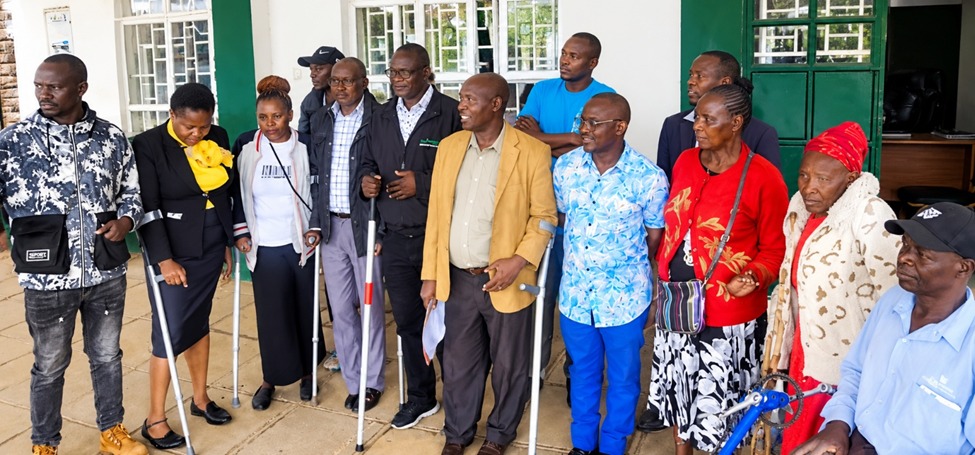
Persons with Disabilities
By Mr. Fredrick Kipchumba Chelimo – PWD
Email; jiamini.network@gmail.com
There is a painful contradiction at the heart of Kenya’s disability agenda: the Constitution recognises equality, legislation provides affirmative action, public procurement reserves opportunities for disadvantaged groups, yet millions of persons with disabilities continue to encounter barriers that make those rights difficult to exercise. The problem is no longer simply the absence of laws. It is the distance between what Kenya promises and what PWDs experience: rights have been recognised, but the conditions necessary to enjoy those rights have not been sufficiently dismantled.
Globally, disability is not a marginal phenomenon. The World Health Organization estimates that approximately 16% of the world’s population—1.3 billion people—live with significant disability. Earlier WHO/World Bank estimates put the figure at about 15%. This is a substantial proportion of humanity. Yet in Kenya, disability policy too often remains framed around welfare, charity and small interventions rather than economic citizenship, equal participation and removal of structural barriers.
The debate around a 5% disability quota illustrates the contradiction. Five per cent is sometimes presented as an affirmative benchmark, but it should not become a ceiling on rights or a substitute for substantive equality. The Constitution’s Article 54 requires progressive implementation of at least 5% representation of persons with disabilities in elective and appointive bodies. The current legal framework also contains affirmative-action obligations. The crucial question is whether such provisions are being treated as minimum guarantees or convenient ceilings.
The procurement situation is even more revealing. Kenya’s procurement law requires at least 30% of procurement budgetary allocations to be reserved for enterprises owned by women, youth, persons with disabilities and other disadvantaged groups. The e-GP system itself incorporates the 30% reservation mechanism. Yet that 30% is a collective pool, not a 30% PWD entitlement. At a glance, PWDs still remain disadvantaged with more AGPO allocated to Youth and Women. Procurement barriers with its attendant technologies and skills required to competently bid in an environment with a hostile environment for disabled persons.
And the actual utilisation exposes an uncomfortable gap. A recent official evaluation reported that, from a total procurement budget of KSh993.5 billion, only KSh77.2 billion was awarded to special groups under AGPO—approximately 26% of the amount that should have represented the 30% reservation. Of the KSh77.2 billion, PWD enterprises received KSh9.4 billion, or 12%, compared with 48% for women and 33% for youth. The same evaluation found that none of the 395 assessed institutions complied fully with the 30% allocation. This is not merely an accounting problem. It is an equality problem.
A PWD entrepreneur cannot be said to be competing on equal footing merely because a tender portal technically allows them to submit a bid. What happens when the information is inaccessible? When financing is unavailable? When premises are inaccessible? When transport is prohibitive? When assistive technology is unaffordable? When tender requirements unintentionally exclude small PWD enterprises? When payments are delayed and the business lacks the working capital to survive? Equality without barrier removal can become equality in name only.
Government frequently invokes international best practice when defending administrative reforms, fiscal policies and institutional changes. There is nothing wrong with learning from the world. But the same principle must apply to disability inclusion. If international standards recognise disability as a human-rights and development issue, Kenya should be equally ambitious in adapting those standards to its own governance and economic systems.
At county level, the contrast can become particularly painful. In Nakuru, PWDs recently protested delays surrounding the county’s KSh27.5 million Persons with Disabilities Fund for 2025/26. The county subsequently announced that the fund would be operationalised and that a monitoring framework would be established.
The practical answer is not another declaration. Government should establish a measurable national disability inclusion compact with annual targets for employment, procurement, accessibility, enterprise financing, political representation, education, health and assistive technology with clear gaps indicated. Every ministry and county should publish a PWD inclusion scorecard showing allocations, beneficiaries, contracts awarded, payments made and barriers removed. AGPO should publish PWD-specific procurement data rather than burying disability within a collective 30% category. Procurement systems should measure not merely tenders reserved but contracts actually awarded and paid.
We are appreciative to those who have placed their reputations, careers and even political ambitions on the line to speak for PWDs. We must recognise them without reservation. In Uasin Gishu, Hon. Regina Chumba and Hon. Kering have publicly championed disability rights, accessibility, employment and economic participation, including advocacy for sign-language interpretation and opportunities for PWDs. Their efforts—and those of many other disability advocates whose names may not appear in national headlines—should not be taken for granted. We appreciate you. We adore you. We admire you. We are taking note.
Counties should also ring-fence disability funds, publish disbursement schedules and subject them to participatory monitoring by representative PWD organisations. Accessibility must become a mandatory budget line at project-design stage, not an afterthought. But government action alone will not transform this landscape. PWDs must unite.
Not in anger against society, but in organised pursuit of constitutional citizenship. Disability organisations, CBOs, entrepreneurs, professionals, caregivers, women, youth and older PWDs must stop operating as isolated islands. There is strength in unity, credibility in evidence and power in collective civic action. Those who have been pushed to the margins must use whatever strength remaining—not to seek pity, but to demand dignity, opportunity, accountability and equal citizenship.
Kenya has written enough promises. The next chapter must be about removing the barriers that make those promises inaccessible. PWDs deserve better. Kenya can do better. And together, they must insist that it does
Similar Posts by The Mt Kenya Times:
- Uhuru’s 2022 election claim: What really happened?
- When the rains come, Kenya must be ready
- Maybe Gen Z did not stop consuming news. Maybe news stopped looking like news
- Nairobi Standard Chartered Marathon sponsorship rises 17% to unlock KSh273m for vulnerable groups
- When everyone can speak, who will get heard?
About the Author