TVS and Car & General open Nyeri motorcycle training hub in KSh4M skills push
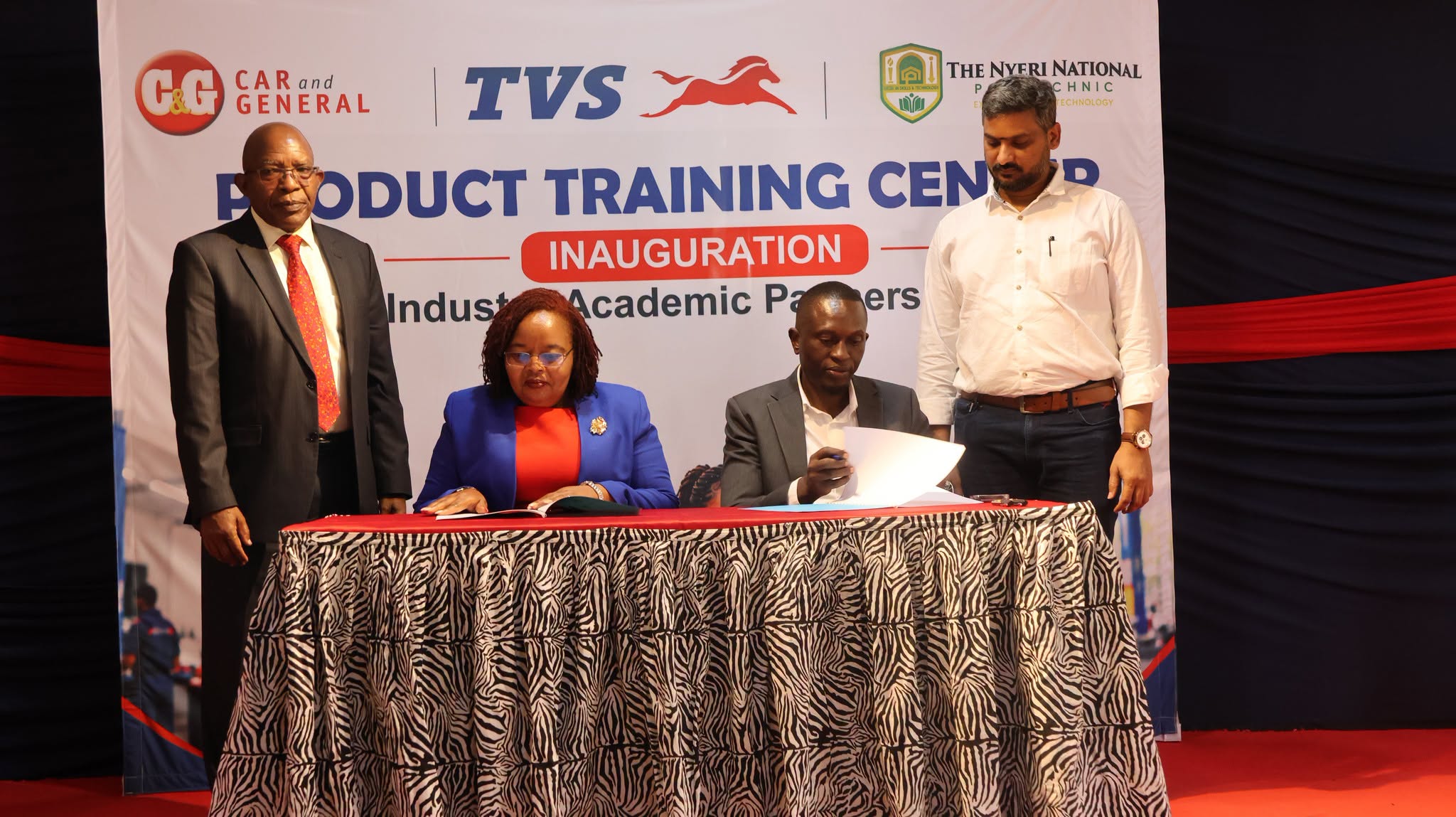
A new 225-square-metre facility at Nyeri National Polytechnic aims to professionalise Kenya’s boda boda economy and build a certified technical workforce for a sector that supports 2.5 million livelihoods.
By Jane Njeri
Kenya’s motorcycle industry took a significant step towards professionalisation Friday when Car & General (Trading) Limited, TVS Motor Company and Nyeri National Polytechnic jointly inaugurated a dedicated TVS Motorcycles Training Centre at the polytechnic’s campus in Nyeri — a facility valued at over USD 30,000 and designed to close a skills gap that has long constrained one of the country’s most economically vital sectors.
The 225-square-metre centre was opened by George Rubiri, General Manager of Car & General; Pradeep Chaurasiya, Business Head for Africa at TVS Motor Company’s International Business division; and Rachel Kimani, Chief Principal of Nyeri National Polytechnic. The inauguration marks the most concrete expression yet of a partnership between private industry and public technical education that its architects say is built for the long term.
The facility is equipped to handle the full breadth of modern motorcycle training. A 30-seater classroom with a digital projector sits alongside TVS motorcycle training engines, specialised workshop tools, two operational TVS motorcycles, an air compressor, a tyre-changing machine, a wheel alignment machine and two motorcycle service ramps. Students completing programmes here are expected to leave certified and work-ready — capable of entering employment as qualified technicians, establishing their own repair workshops or building spare-parts enterprises.
The timing is deliberate. Kenya’s two-wheeler economy has grown into one of the country’s most consequential industries, generating an estimated KSh660B annually and supporting more than 2.5 million Kenyans either directly or indirectly. The sector spans boda boda transport, last-mile delivery and logistics, spare-parts retail, repair and maintenance, vehicle financing, insurance and an expanding electric mobility segment. Beyond urban mobility, motorcycles have become infrastructure in their own right — connecting rural communities to markets, schools, health facilities and financial services in areas where roads and public transport remain inadequate.
Against that backdrop, the shortage of formally trained motorcycle technicians is not simply a skills problem. It is an economic constraint. Rubiri, who was speaking at the launch, made the point directly. “The motorcycle industry has evolved into one of Kenya’s most important economic sectors, creating employment, enabling entrepreneurship and supporting millions of livelihoods,” he said. “As the industry grows, the need for professionally trained technicians becomes even more critical. This Training Centre is our contribution toward building the technical capabilities required to support a safer, more productive and increasingly locally manufactured mobility industry.”
Rubiri noted that Car & General, which this year marks 90 years since its founding, has maintained its distribution partnership with TVS Motor Company for more than 25 years, supplying Kenyan customers with motorcycles, genuine spare parts and after-sales support while assembling TVS machines locally in Nakuru.
Chaurasiya echoed the industry case for investment in technical education. “TVS Motor Company believes that skills development is fundamental to strengthening the mobility sector,” he said. “This Training Centre will provide learners with access to modern motorcycle technologies and industry-relevant knowledge while supporting the development of a skilled workforce that can meet the changing needs of the market.”
TVS Motor Company, one of India’s largest manufacturers of two and three-wheelers, has built its Kenyan presence over decades through the Car & General partnership and now sees technical training as the logical extension of that commercial commitment.
For Kimani and her institution, the centre represents something that vocational education in Kenya has long argued for but rarely secured in this form: direct industry investment in the learning environment. “Technical and vocational education must remain closely connected to industry if we are to produce graduates who are ready for employment and entrepreneurship,” she said. “This partnership reflects our shared commitment to quality skills development and national economic growth.”
Nyeri National Polytechnic, established in 1977, is among Kenya’s leading public TVET institutions, offering programmes across engineering, computing, agriculture, automotive and electrical engineering disciplines. The new centre adds a sector-specific layer to that portfolio at a moment when demand for certified motorcycle technicians is rising faster than the system has been producing them.
The three partners described Friday’s launch not as an endpoint but as the opening of a broader collaboration — one aimed at strengthening technical education, supporting local manufacturing and improving the competitiveness of Kenya’s mobility economy from the ground up.
Similar Posts by The Mt Kenya Times:
- Critical Review of Pride and Prejudice: Journey from Misunderstanding to Love and Respect
- Attracting a tourist to heritage sites or bringing them back? Amir Timur’s legacy from a tourism geography perspective
- Nyahururu cannot afford to remain in the dark
- University students want class, not another countdown to crisis
- Staying steady in a first-world rush
About the Author