UNIVERSITY OF CHENAB, GUJRAT
A PROJECT OF VICTORIAN NOVEL
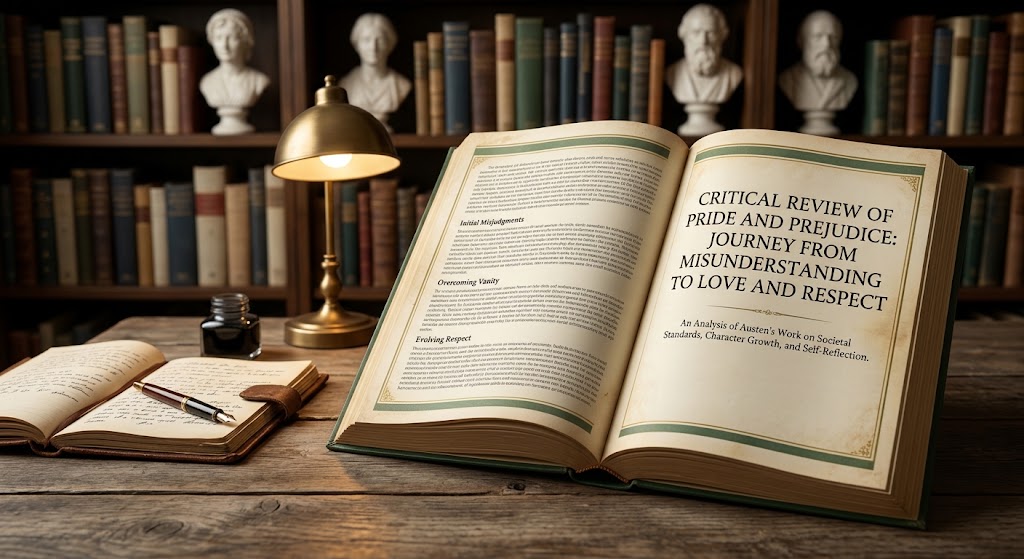
CRITICAL REVIEW OF PRIDE AND PREJUDICE
Journey from Misunderstanding to Love and Respect
Submitted to
Muhammad Adnan Gujjar
Submitted and Reviewed by
Maham
Programme
BS English – 4th Semester
Critical Review of Pride and Prejudice
Title: Journey from Misunderstanding to Love and Respect
Pride and Prejudice is a timeless novel written by Jane Austen. It was composed during the Regency period in Britain, a time when society was strongly divided by social class and women had considerably less power and independence than men. Austen began writing the novel in 1796, and it was published in 1813. Marriage plays a central role in the story, which is why the novel is often discussed in terms of the marriage market. Through the lives of her characters, Austen presents the customs, relationships, and social values of her time. She explores important themes such as pride, prejudice, love, marriage, and the class system.
The story mainly focuses on the changing relationship between Elizabeth Bennet and Mr. Darcy. It also revolves around the Bennet family, which consists of Mr. and Mrs. Bennet and their five daughters: Jane, Elizabeth, Mary, Catherine (Kitty), and Lydia. Mrs. Bennet is particularly concerned about her daughters’ futures and hopes that they will marry wealthy and socially respectable men.
The novel opens with the famous statement: “It is a truth universally acknowledged, that a single man in possession of a good fortune, must be in want of a wife.” This sentence introduces the importance of marriage and wealth in the society depicted in the novel. Austen uses it ironically to draw attention to the social expectations surrounding marriage.
Jane Austen introduces the Bennet family through a conversation between Mr. and Mrs. Bennet. Mrs. Bennet is excited to learn that a wealthy young man, Mr. Bingley, has rented Netherfield Park. She immediately begins thinking about the possibility of one of her daughters marrying him. Mr. Bennet responds calmly and teasingly, showing that he does not share his wife’s excitement. This opening conversation reveals their contrasting personalities and establishes marriage as a major concern in their society.
At a gathering and dance in Meryton, Elizabeth first encounters Mr. Darcy. Darcy appears proud and distant from the other guests. When he refuses to dance with Elizabeth, she overhears his dismissive remark that she is not attractive enough to tempt him. His comment hurts her feelings and creates a negative first impression. Elizabeth’s early judgement of Darcy becomes the beginning of the misunderstandings that shape their relationship.
As the novel progresses, Darcy begins to recognise the faults in his proud behaviour and gradually becomes more considerate and humble. Elizabeth, too, reconsiders her opinion of him after learning more about his character and actions. Both characters develop through self-reflection and a better understanding of one another. When Lydia elopes with Wickham, Darcy quietly intervenes to help resolve the crisis and protect the Bennet family’s reputation. His actions reveal his generosity and genuine concern for Elizabeth.
Major Themes
- Love and Marriage
Love and marriage are central themes in the novel. Austen presents different kinds of relationships and marriages. Jane Bennet and Mr. Bingley represent sincere affection and mutual attraction. Charlotte Lucas and Mr. Collins enter a practical marriage based largely on financial security rather than romantic love. Lydia and Wickham’s relationship reflects immaturity and irresponsibility. In contrast, Elizabeth and Darcy develop a relationship based on respect, understanding, and personal growth. Their marriage represents the ideal relationship in the novel. Austen suggests that marriage should involve affection, compatibility, and mutual respect rather than being based solely on wealth or social advantage.
- Pride and Prejudice
The title reflects the personal weaknesses that initially prevent Elizabeth and Darcy from understanding one another. Darcy’s pride is evident in his early behaviour, while Elizabeth forms a prejudice against him based on his first impression and incomplete information. Both characters must recognise and overcome these faults. Austen shows that pride and prejudice can damage relationships, while self-awareness and open-mindedness can help people develop mutual respect.
- Social Class and Status
The novel also highlights the influence of social class on relationships and marriage. Darcy initially considers the Bennet family’s social connections and behaviour inferior to his own upper-class position. Austen criticises a society that judges people according to wealth, family background, and status. Through Elizabeth and Darcy’s relationship, she suggests that personal character, integrity, and kindness are more important than social rank.
Jane Austen’s Writing Style
Jane Austen’s writing style is clear, engaging, and rich in irony. She carefully observes human behaviour and uses realistic dialogue to reveal the personalities and motivations of her characters. Her irony allows her to criticise social conventions, class prejudice, and the pressure placed on women to marry advantageously. Through humour, conversation, and detailed characterisation, Austen presents society in a natural and convincing way.
Personal Response and Lessons Learnt
In my opinion, Pride and Prejudice is an interesting and meaningful novel. It teaches readers that first impressions can be misleading and that people should not be judged without understanding their character. The novel also shows that a successful marriage should be based on love, maturity, trust, and mutual respect rather than wealth or social position. Elizabeth and Darcy’s journey demonstrates the importance of recognising one’s mistakes and learning from them.
Conclusion
Pride and Prejudice remains one of Jane Austen’s most admired novels because of its memorable characters, balanced plot, humour, and universal themes. It combines romance with a thoughtful criticism of social class, marriage customs, and human weaknesses. The novel does more than entertain its readers: it encourages them to question prejudice, value personal character, and build relationships on understanding and respect. Through Elizabeth and Darcy’s journey, Austen suggests that true happiness becomes possible when people overcome their misunderstandings and learn to appreciate one another.
Similar Posts by The Mt Kenya Times:
- Catholic bishops warn Parliament against electoral bills that could undermine 2027 vote
- Crystal Asige takes on KRA over disability tax rules she says undermine hard-won rights
- Linda Mwananchi tops Nairobi as TIFA poll reshapes Kenya’s 2027 political map
- Oburu Oginga returns to Senate after two months of illness
- Sifuna’s Linda Mwananchi Movement holds closed NDC as 2027 platform takes shape