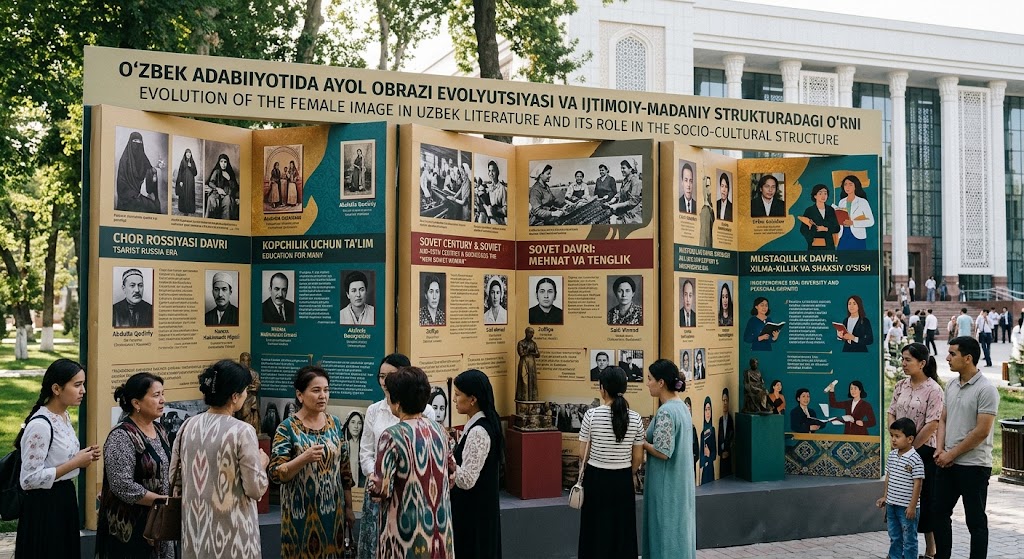
The evolution of the female image in Uzbek literature and its role in the socio-cultural structure
By: Shukurova Laylo Fakhriddin kizi
First-year student
Faculty of English Philology and Translation Studies
Samarkand State Institute of Foreign Languages
Abstract
This comprehensive scholarly article systematically examines the socio-cultural status of women and the centuries-long evolution of female characters in the history of Uzbek literature through comparative-historical and gender-based approaches. The study provides an in-depth analysis of mythological elements in folklore, the philosophy of classical literature, the literary environments of nineteenth-century Kokand and Khiva, social tragedies in the enlightenment prose of the Jadid period, socialist realism in Soviet literature, and the psychological and existential transformations in contemporary Uzbek prose after independence. The article theoretically substantiates the patterns underlying the development of female characters from traditional symbolic archetypes into complex individuals with rich inner conflicts, as well as their transition from passive objects to active subjects.
Keywords: Uzbek literature, female image, evolution, gender interpretation, Jadidism, socialist realism, Zulfiya, O‘tkir Hoshimov, Zulfiya Qurolboy qizi, psychologism, national mentality, archetype of loyalty.
Introduction
Literature is one of the greatest mirrors reflecting the social thought, cultural level, historical experiences, and spiritual values of every nation. Within this spiritual mirror, women’s lives and their roles in the family, state, and socio-cultural structure have always been among the central and aesthetically significant themes, alongside different social groups and systems of social relations. In Uzbek literary studies, examining gender issues, women’s rights, and the evolution of characters in literary works is important not only for identifying aesthetic principles but also for understanding profound socio-anthropological and historical-philosophical processes.
Throughout the centuries, changing socio-political systems, religious paradigms, the consequences of colonialism, and different layers of national mentality have directly and significantly influenced the artistic representation and typological characteristics of female characters in literature. The evolution of female representations has covered an extensive historical distance, beginning with mythological goddesses and heroic girls in folklore and extending to the complex, urbanized women of the modern era. By examining this evolutionary process, it is possible to understand how the spiritual and intellectual development of the Uzbek people has transformed over time.
The relevance and purpose of this study are to identify the artistic and aesthetic nature of female characters characteristic of different historical and social periods of Uzbek literary thought, examine their psychological representations in epics, poetry, and prose, and analyze the dynamic changes in their inner worlds. Through this analysis, the study aims to develop a comprehensive scholarly understanding of the evolution of female characters in Uzbek literature.
Main Body
Mythological and Folkloric Roots: Symbols of Resilience and Sovereignty in Heroic Epics
The oldest and most fundamental layers of the concept of woman in Uzbek literary thought can be traced back to oral folklore, particularly mythological narratives, fairy tales, and heroic epics. In ancient myths, influenced by the legacy of matriarchal societies and subsequent totemistic beliefs, women were initially portrayed as life-giving figures, sacred protectors of clans and tribes, and beings possessing supernatural power.
The character of Barchinoy in Alpomish, one of the most prominent masterpieces of Uzbek heroic epic poetry, vividly embodies ancient ethnic ideals and perceptions of women’s social freedom. An analysis of the epic reveals that Barchin is not merely a symbol of physical beauty or a woman confined to domestic responsibilities. Rather, she is an independent individual capable of competing with the most powerful heroic men in physical strength, military ability, and intellectual capacity.
Barchin’s setting of four challenges for the heroes at Oydin Lake is not simply a fairy-tale detail. It represents a firm demand for a woman’s right to determine her own destiny, establish her social position, and exercise her freedom. By setting these conditions, she becomes an active participant in social relations. The underlying philosophy that the hero who fulfills her conditions will win and receive her hand in marriage reflects the idea of female independence.
In lyrical and romantic epics such as Oygul va Baxtiyor and Kuntug‘mish, female protagonists are also portrayed not as helpless figures who merely weep in the face of difficulties, but as courageous and determined individuals who stand alongside men and participate in strategic decisions concerning the destinies of states and tribes. Therefore, in the folkloric period, Uzbek women can be seen as possessing a high degree of moral and physical strength in literary representation.
The Representation of Women in Classical Literature: From the Philosophy of Divine Love to the Poetics of Real Historical Figures
During the Eastern Renaissance and the development of classical Uzbek literature, particularly in Chagatai-language poetry, the image of women acquired new spiritual dimensions through Sufi symbolism and philosophical-aesthetic interpretations. The great poet and thinker Alisher Navoi elevated the female individual to the level of human perfection in his immortal epic collection Khamsa.
The character of Shirin in Farhod va Shirin challenges the traditional image of the passive beloved in Eastern literature. In Navoi’s interpretation, Shirin is an educated woman with considerable intellectual and philosophical abilities who possesses extensive knowledge of Greek and Eastern philosophy. Most importantly, she is an independent political leader capable of governing Armenia wisely in economic, cultural, and judicial matters, placing the welfare of her people above her personal happiness.
Meanwhile, the character of Layli in Layli va Majnun represents the dramatic, tragic, and existential rebellion of a woman’s heart trapped within the strict moral and social conventions of feudal society and the constraints of tribal traditions. Layli is not merely a beautiful body viewed through the eyes of a man; through her love, she becomes a spiritual figure who attains divine knowledge. Despite the strict prohibitions imposed by society, she preserves her spiritual freedom and the sovereignty of her inner world.
When examining Zahiriddin Muhammad Babur’s Baburnama, literature moves away from philosophical symbolism toward the depiction of realistic characters. Babur describes his grandmother, Eson Davlat Begim, and his mother, Qutlug‘ Nigorxonim, emphasizing their intelligence and strong political will during periods of palace intrigue, military campaigns, and severe geopolitical crises. Eson Davlat Begim’s military and tactical strategies in preserving the throne and punishing conspirators when Babur was still a young child serve as historical and documentary evidence of women’s fundamental role in the governance of feudal states.
By the nineteenth century, the emergence of poets such as Nodirabegim, Jahon Otin Uvaysiy, and Mahzuna in the literary environments of Kokand and Khiva initiated a significant transformation in the position of women as literary subjects in Uzbek literature. Women were no longer merely lyrical objects portrayed through the eyes of male writers. Instead, they began to express their own pain, sorrow, and spiritual resistance to social injustice and male dominance through ghazals and mukhammas poems. Nodira’s ghazals, in particular, demonstrate the independent and dignified position of the female heart within the social hierarchy.
Jadid Literature and the Tragedies of National Awakening: The Fate of Women Under Ignorance and Feudal Oppression
At the beginning of the twentieth century, the Jadid enlightenment movement in Turkestan raised the issue of women’s liberation, their freedom from oppressive forms of religious fanaticism, access to education, and transformation into equal members of society. These issues were presented not merely as social concerns but as essential conditions for the survival and development of the nation. In the works of leading Jadid writers such as Abdulla Qodiriy, Abdulhamid Cho‘lpon, and Abdurauf Fitrat, female characters moved beyond the domestic and familial sphere to become central figures in social, political, and national liberation discourse.
An analysis of Abdulla Qodiriy’s novel O‘tkan kunlar
The tragic destinies of Kumushbibi and Zaynab in this early Uzbek novel represent the culmination of social and moral conflicts between traditionalism, religious superstition, and feudal backwardness. Through Kumush, Qodiriy created not only an ideal of physical and moral beauty but also an image of Eastern intellectual independence shaped by the enlightened family environment of Margilan. Kumush possesses emotional independence and remains steadfast in her love for Otabek.
However, the crisis caused by Otabek’s second marriage in Tashkent, arranged by his parents against his wishes, draws both Kumush and Zaynab into a devastating psychological and physical tragedy. Zaynab, whose identity is gradually undermined by feudal stereotypes and the pressure of clan traditions, becomes another victim of this social system.
Zaynab’s inner jealousy and psychological breakdown are consequences of the violence inflicted on female psychology by the feudal family system. Through the tragic destinies of these two women, Qodiriy reveals the legal and moral decline of an entire society and the corruption of its family institutions.
An analysis of Abdulhamid Cho‘lpon’s novel Kecha va kunduz
Cho‘lpon exposes the lack of women’s rights under a cruel social order through the character of Zebi. She is an innocent young woman deprived of social, legal, and personal rights. As a result of her father’s religious fanaticism and ignorance, she is forced into marriage as the fourth wife of Akbarali Mingboshi, a man several years older than her. Her tragedy lies in her innocent perception of the world through singing and pure emotions.
Cho‘lpon connects Zebi’s personal tragedy with the broader political crisis of society. At the end of the novel, Zebi becomes the victim of a crime she did not commit and is unjustly sentenced by a court of Tsarist Russia to exile in Siberia. Through Zebi’s character, Cho‘lpon conveys a powerful message: a nation that keeps its women uneducated and enslaved can never fully liberate itself from the chains of colonialism.
Soviet-Era Literature: Socialist Realism, Postwar Resilience, and the Formation of the Archetype of the “Devoted Uzbek Mother”
Soviet-era literature, following the principles of socialist realism, idealized women on the surface as leading workers and active participants in public life. Nevertheless, Uzbek writers managed to preserve the profound national, lyrical, and dramatic essence of Uzbek womanhood within these ideological frameworks.
The creative phenomenon of Zulfiya Isroilova and the representation of women in her poetry
In Zulfiya’s poetry, the female image emerges through both luminous lyricism and profound social-philosophical reflection. Women in her works are not merely beautiful, emotionless beloved figures; they are individuals with deeply suffering hearts and strong characters who endure separation and the hardships of fate.
In poems such as Matonat, Shu qiz edi, and Xotira, written during the Second World War, women were elevated to symbols of national defense, loyalty, and freedom. In the poetic works written after the untimely death of her husband, Hamid Olimjon, Zulfiya created a lasting spiritual monument to Uzbek women’s fidelity and enduring devotion. She expanded the representation of Uzbek women beyond the family sphere, presenting them as creative, intellectual, and globally significant individuals in Uzbek poetry.
The concept of motherhood and womanhood in the works of O‘tkir Hoshimov
In O‘tkir Hoshimov’s prose, the female image receives one of its most lyrical and emotionally profound interpretations. His novella Dunyoning ishlari is an outstanding literary tribute to motherhood in Uzbek literature. The Mother portrayed in this work represents the national archetype of a woman capable of carrying the concerns of the entire world in her heart and willing to make any sacrifice for her children.
The characters of Qora amma, Robiya, and Qurbon xola in his novel Ikki eshik orasi also reveal the resilience and tragedy of Uzbek women who carried the burden of difficult physical labor, traditionally expected of men, during the war and the difficult postwar years.
The Period of Independence: Psychological Realism, Modernist Trends, and the Transformation of Contemporary Perspectives
Following independence in 1991, Uzbek literary thought experienced a fundamental aesthetic transformation. The false ideological idealization characteristic of Soviet literature and the exclusive emphasis on women’s oppression and victimhood typical of the Jadid period gradually gave way to more complex representations. At the center of literature emerged the independent female individual, with her own inner conflicts, mistakes, and personal needs, demanding recognition of her distinct identity within society and the family.
The works of Zulfiya Qurolboy qizi and the analysis of female psychology
Zulfiya Qurolboy qizi is one of the contemporary Uzbek prose writers who boldly explores the hidden dimensions of female psychology. In her novel Oyimtilla and several short stories, the individual psychology of women is revealed through internal monologues and stream-of-consciousness techniques.
The character of Nilufar differs significantly from the traditional image of the obedient Uzbek woman. She is a dynamic character who constantly changes under the influence of childhood psychological trauma and the harsh social environment of the modern market economy. Nilufar strives for professional advancement, confronts the male-dominated world, and assumes responsibility for her own destiny.
New trends in contemporary prose
In contemporary short stories by Xurshid Do‘stmuhammad, Isajon Sulton, Erkin A’zam, and Javlon Jovliyev, female characters are portrayed amid the conflicts of the modern era, including economic migration, Westernization, and tensions between national values and changing social expectations. Women in contemporary literature are no longer represented merely as housewives confined to the family. Instead, they emerge as entrepreneurs, social activists, politicians, and individuals striving for personal happiness and freedom.
Conclusion
The artistic and aesthetic nature of female characters and their socio-cultural significance in Uzbek literary studies have undergone fundamental and systematic changes alongside the historical, ideological, political, and cultural development of society. The evolutionary process that began with the free and sovereign heroic girls of folk epics was spiritualized in medieval classical poetry and elevated to the level of a spiritual renaissance.
The social tragedies of the Jadid period in the early twentieth century were followed by Soviet-era representations of resilient, devoted, and lyrically elevated mothers. The creative freedom that emerged during the independence period introduced a new type of female character into national literature: a modern woman who has undergone profound psychological transformation and is conscious of her individual rights.
In conclusion, the representation of women in Uzbek literature has evolved from a passive and disenfranchised object of artistic portrayal into an active social subject capable of determining her own destiny and identity.
Similar Posts by The Mt Kenya Times:
- Modern methods of supporting socially vulnerable families
- Heavy menstrual bleeding and iron deficiency anemia in women of reproductive age
- Climate Change Threatens Food Security In Adamawa As 94.8% Of Farmers Report Crop Yield Changes – Dr Tari
- When a Name Becomes More Than a Game:
- Mt Kenya Times ePAPER October 31 – November 1, 2026
About the Author