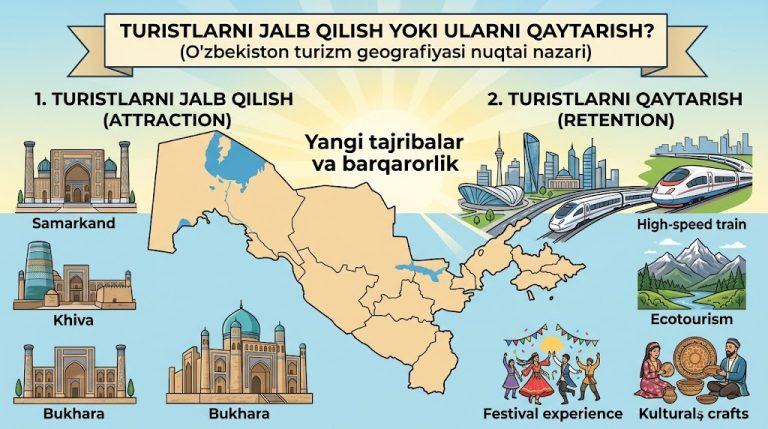
Attracting a tourist to heritage sites or bringing them back? Amir Timur’s legacy from a tourism geography perspective

By: Isoqjonova Naimabonu
| Geography suggests that the answer depends on where the tourist comes from. Attracting a visitor means overcoming space, in the form of distance, cost, and unfamiliarity, while bringing a visitor back means keeping a place worth returning to. For nearby markets, return visits are the easier task. For distant markets, the first visit is often the only one a destination can realistically expect. |
The Tourism System: Where Attraction and Return Take Place
Travel as a Spatial System. Tourism geographers describe travel as a system rather than a single event. Leiper (1979) divided it into a generating region where tourists live, a transit route, and a destination region. Attraction is a task of the first two parts: a destination must be known and reachable from the place the tourist leaves. Return depends mostly on the third: what the tourist found on arrival. Push and pull factors work together in this system (Dann, 1977). Push factors, such as the wish to escape routine, arise in the generating region. Pull factors are the qualities of the destination—in Uzbekistan, the imposing Timurid architecture, historical monuments, and grand urban ensembles of Samarkand, Buxoro, and Shahrisabz. Lew (1987) showed that attractions are not just sites but a combination of the place itself, how it is presented, and how it is perceived by the visitor. Because perception is shaped before travel, attraction is largely a battle for image across space.
Why Attraction is Harder with Distance: The Timurid Heritage Context
Distance Decay and Visitor Typologies. The best-documented spatial pattern in tourism is distance decay: the number of visitors falls as the distance from the origin rises. McKercher and Lew (2003) found that most travel flows are concentrated near their origin, and that the effect varies with the cost, time, and accessibility of travel. For distant international markets (such as Western Europe, the Americas, or East Asia), every additional kilometre increases the cost of attracting a tourist to Timurid heritage sites, making remote markets the most expensive to win. The tourist’s own character matters as well. Plog (1974) proposed that travellers range from psychocentric, who prefer the familiar, to allocentric, who seek the unfamiliar. Early heritage visitors to Central Asia were predominantly allocentric explorers. Cohen (1972) likewise described tourists as balancing novelty against familiarity. Distant, unfamiliar places showcasing medieval Silk Road history must therefore persuade visitors who accept greater uncertainty.
Why Returning to Historical Destinations is a Different Geographical Problem
Repeat Decision Dynamics. A return visit is not a repeat of the first decision. Gitelson and Crompton (1984) found that many travellers return to a place they know because it lowers risk and carries emotional meaning. Later studies link satisfaction to loyalty (Yoon and Uysal, 2005; Chi and Qu, 2008), while Oppermann (2000) showed that loyalty differs strongly between tourist groups. Space again plays a role. A short regional trip costs less and fits more easily into a calendar, so people living in neighbouring regional markets can visit sites like Gur-e Amir or Shah-i Zinda repeatedly. A long-haul international traveller faces high travel costs each time, and the motive of discovering new world wonders often pushes them toward a new country altogether. Repeat visitors also use space differently. Lau and McKercher (2004) compared first-time and repeat visitors and found that first-timers explored more widely across iconic sites, while repeaters concentrated on a narrower set of familiar places or deeper cultural experiences. For planners in Uzbekistan, loyal visitors support specialized niche cultural sites, whereas new visitors spread benefits across major tourist hubs.
The Destination Life Cycle of Central Asian Heritage Tourism
Evolutionary Cycle. Butler (1980) described a destination’s evolution in stages: exploration, involvement, development, consolidation, stagnation, and then decline or rejuvenation. The balance between new and returning visitors shifts along this curve. Early on, heritage tourism focused on Amir Timur’s architectural centers depended on adventurous newcomers. As infrastructure expands, a larger portion of demand may come from loyal repeaters. Rejuvenation of Silk Road heritage destinations requires both new cultural experiences/events for returning visitors and improved global access for first-time ones.
What This Means for Timurid Heritage Tourism Planning
- Match the marketing strategy to the geographic market zone. Focus on visitor retention and event-based travel in near and regional markets, and on brand awareness and accessibility in distant long-haul markets.
- Direct transport links, high-speed rail networks (such as the Afrosiyob), and visa simplification reduce the friction that distance imposes on first-time visits.
- Introduce dynamic cultural festivals, specialized Timurid history routes, and temporary exhibitions to give returning visitors a strong motive to return.
- First-time visitors need comprehensive visitor information that leads them smoothly through major landmarks, while repeaters need depth, local immersion, and thematic cultural routes.
- Track the share of first-time vs. repeat visitors by country of origin, not merely total arrival numbers, to guide sustainable destination policy.
Conclusion
From the standpoint of tourism geography, attracting visitors to Amir Timur’s grand heritage and bringing them back are two stages of one spatial process. The first is limited by distance, global perception, and access; the second is governed by on-site experience, depth, and continual product renewal. Nearby regional tourists are easier to bring back, while distant long-haul tourists are harder to attract initially and harder to retain for repeat visits. A durable tourism strategy for Uzbekistan’s historical centers therefore applies distinct approaches to each market zone, treating a highly satisfying initial visit as the indispensable foundation of both.
Isoqjonova Naimabonu is a 2nd-year undergraduate student in the Department of History within the Faculty of Social Sciences at Namangan State University.
Similar Posts by The Mt Kenya Times:
- Critical Review of Pride and Prejudice: Journey from Misunderstanding to Love and Respect
- TVS and Car & General open Nyeri motorcycle training hub in KSh4M skills push
- Nyahururu cannot afford to remain in the dark
- University students want class, not another countdown to crisis
- Staying steady in a first-world rush
About the Author