‘No’ to predators: Kalonzo draws battle lines for Kenya’s 2027 election
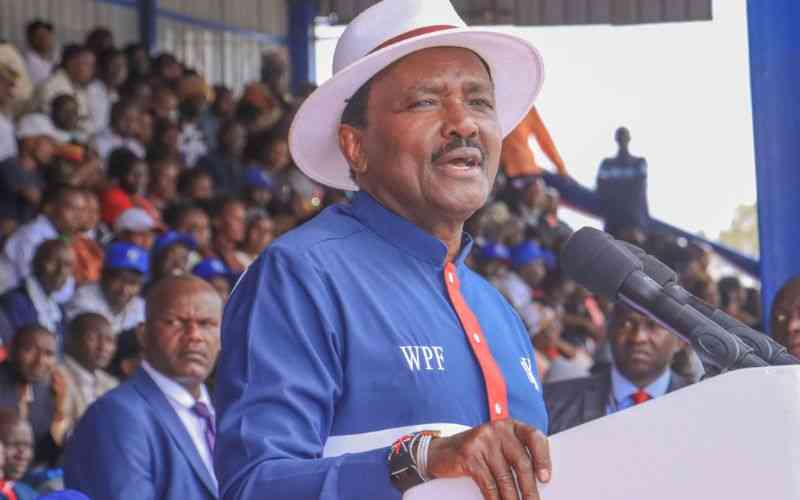
Wiper Patriotic Front leader Kalonzo Musyoka
Kalonzo Musyoka publicly rejects Kenya Kwanza overtures, signalling an opposition still crowded with ambition but dangerously short of consensus
By James Mwangi
Wiper Patriotic Front leader Kalonzo Musyoka yesterday drew the sharpest line yet between himself and President William Ruto’s Kenya Kwanza administration, rejecting approaches to join the ruling coalition and vowing to contest the August 2027 presidential election on the opposition ticket — a declaration that lays bare both the resolve and the fragility of Kenya’s divided opposition with less than a year to polling day.
Speaking during a church service in Machakos, Musyoka dismissed the overtures with characteristic directness, framing his refusal in moral as much as political terms. “No, thank you. I cannot join hands with predators. You have done so much damage to millions of Kenyans. Many Kenyans are suffering under this administration — what am I joining you to do? Thank you, but no,” he said, drawing applause from the congregation. He went further, invoking the ballot as the only arena in which he would engage Ruto. “Ruto himself has said I’m his biggest challenger in a democratic election. How then does he expect me to join hands with him? No, thank you. We meet at the ballot.”
The remarks were a direct response to overtures that had gathered pace in recent days, led by figures close to Ruto, including presidential aide Farouk Kibet, who urged Musyoka to abandon the opposition and work with the government — a push that forms part of a broader Kenya Kwanza strategy to consolidate support in Ukambani, a region traditionally aligned with Musyoka. The lure was given an opening, in part, by the friction Musyoka encountered within the opposition itself: he had faced visible hostility from supporters of Nairobi Senator Edwin Sifuna during the rebranding of Sifuna’s Linda Mwananchi Movement, an episode that Ruto allies exploited to suggest the veteran politician was being marginalised in his own camp.
Musyoka, who has served as vice-president under two presidents and contested the presidency on multiple occasions, has consistently declined such overtures. He has ruled out any pre-election talks with Ruto, insisting he will only engage the President after the conclusion of the 2027 General Election, and maintained that the opposition remains focused on unseating the Kenya Kwanza administration. Yesterday’s remarks were, in tone and substance, his most emphatic statement yet.
Yet for all the conviction in his voice, Musyoka’s declaration arrives in the context of an opposition whose presidential field is crowded, competitive, and still unresolved. Kenya’s fractured opposition finds itself trapped in a paradox of its own making: rich in ambition, yet dangerously poor in consensus, with a crowded field of presidential hopefuls, each with compelling credentials and debilitating liabilities, testing whether the coalition can subordinate personal ambition to the singular goal of unseating Ruto.
A poll conducted with just a year to the 2027 election shows Musyoka as the leading choice among voters opposed to Ruto, but with Sifuna at 13 per cent, former Interior Cabinet Secretary Fred Matiang’i at 11 per cent, and Gachagua trailing, the opposition vote remains split across several potential candidates. More troubling still, Ruto, whose support has fallen from 36 per cent to 31 per cent, continues to lead the individual presidential field — meaning the opposition collectively commands a larger pool of support, but only if it can consolidate.
That consolidation remains the defining challenge. Rigathi Gachagua, the former deputy president impeached in late 2024 and now leading the Democracy for the Citizens Party, has claimed the support of nearly 12 million Kenyans and positioned himself as a strong negotiator over who should lead the opposition into 2027, at various points naming Musyoka, Matiang’i, Martha Karua of the People’s Liberation Party, and himself as serious contenders for the ticket. Matiang’i, the former Interior Cabinet Secretary who has since declared a presidential bid and secured endorsement as Jubilee Party’s flagbearer, is argued by his defenders to offer the credibility of a technocrat in a field dominated by career politicians. Sifuna, meanwhile, having been pushed out of the Orange Democratic Movement, is plotting a presidential campaign anchored in western Kenya, with allies indicating he will formalise his bid. Kiharu MP Ndindi Nyoro, after nearly a year of consultations with Gachagua, Musyoka, Karua, and Matiang’i, has joined the People’s Party of Kenya, presenting the formation as a platform that could accommodate a wider opposition movement without immediately committing to a specific presidential candidate.
The arithmetic of the challenge facing whoever emerges as opposition flag bearer is unforgiving. As the incumbent, Ruto enters the 2027 race with advantages none of his rivals possess: the power of office, a nationwide political network, and the ability to campaign on the record of his first term. The opposition’s best — indeed, its only — realistic path to victory runs through unity, and that unity has so far eluded it. An online public vote organised by the WANTAM movement to identify a unified opposition ticket saw Sifuna and Matiang’i take an early lead in the presidential category, with Musyoka trailing behind and Gachagua registering a modest showing, underscoring the fragmented nature of the anti-Ruto coalition.
Musyoka’s political longevity is itself both his greatest asset and his most persistent liability. Viewed by allies as a steady hand capable of holding together a fragile opposition alliance, a quality that could prove decisive if negotiations eventually narrow the race to a single candidate, he nonetheless enters each election cycle carrying the weight of repeated near-misses and the perception, fair or otherwise, that the presidency has always been one coalition short. His declaration yesterday — defiant, clear-eyed, and calibrated to his Ukambani base — is designed to dispel any notion that age or circumstance has diminished his appetite for the fight.
As recently as July, Musyoka joined Matiang’i, Gachagua, and other opposition figures at a church service in Machakos County to dismiss claims of internal divisions as propaganda, insisting their coalition remained focused on a united front against Ruto. Whether that unity holds as August 2027 approaches — with egos, regional calculations, and polling numbers all pulling in different directions — is the question that will ultimately determine whether Kenya wakes up to a new president or a second Ruto term.
For now, Musyoka has given his answer on one matter at least: he will not be joining the other side. Kenya’s political season is only beginning, and the ballot box, as he says, remains the only predator he intends to face.
Similar Posts by The Mt Kenya Times:
- Omari tells Matiang’i: Come back to Ruto or the Gusii community pays the price
- Waiguru tells Mt Kenya voters: Judge the person, not the party
- Gathecha defends Ruto’s development record, cites projects in Tharaka-Nithi
- Kenya’s universities reopen: The long road to academic recovery after the lecturers’ strike
- Gachagua counts down: 280 days to Kenya’s political reckoning
About the Author