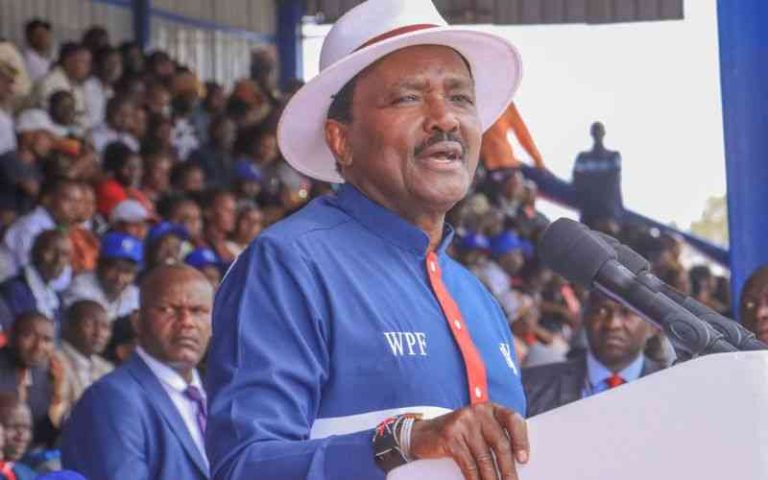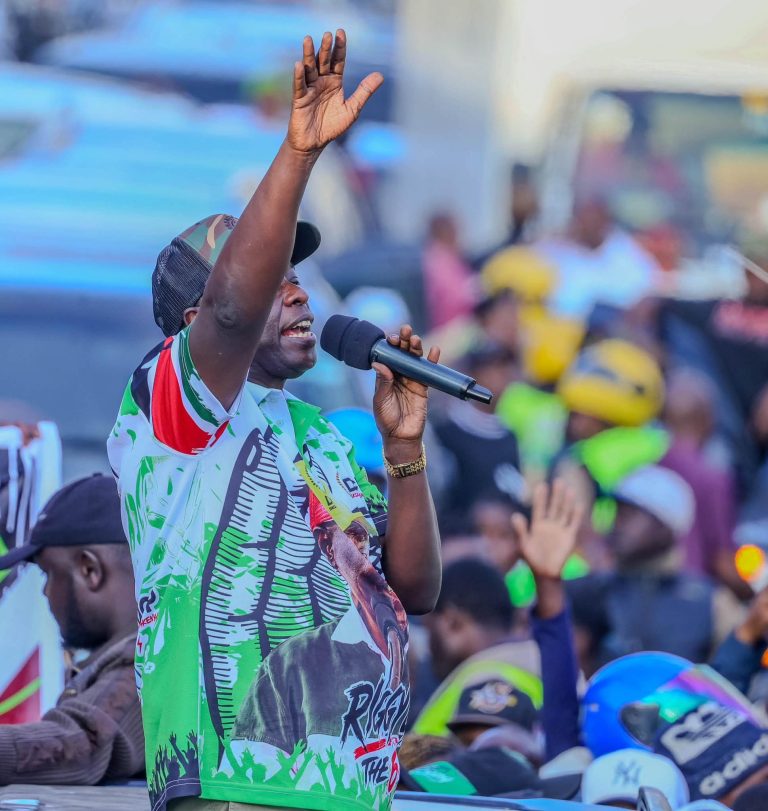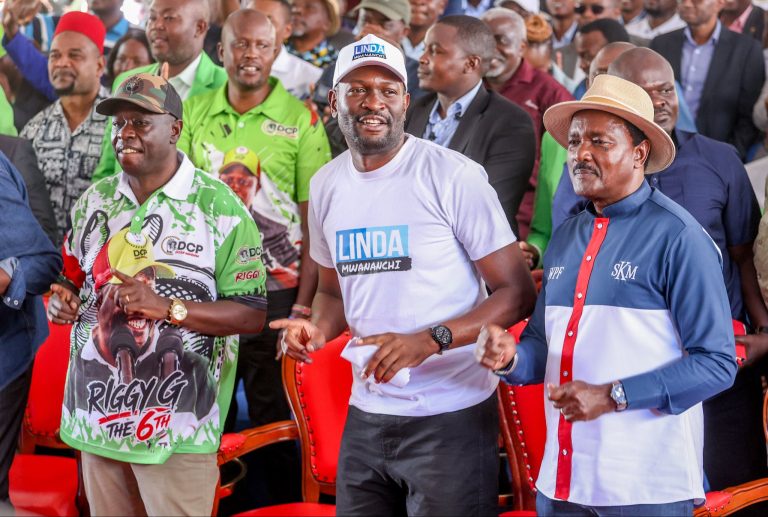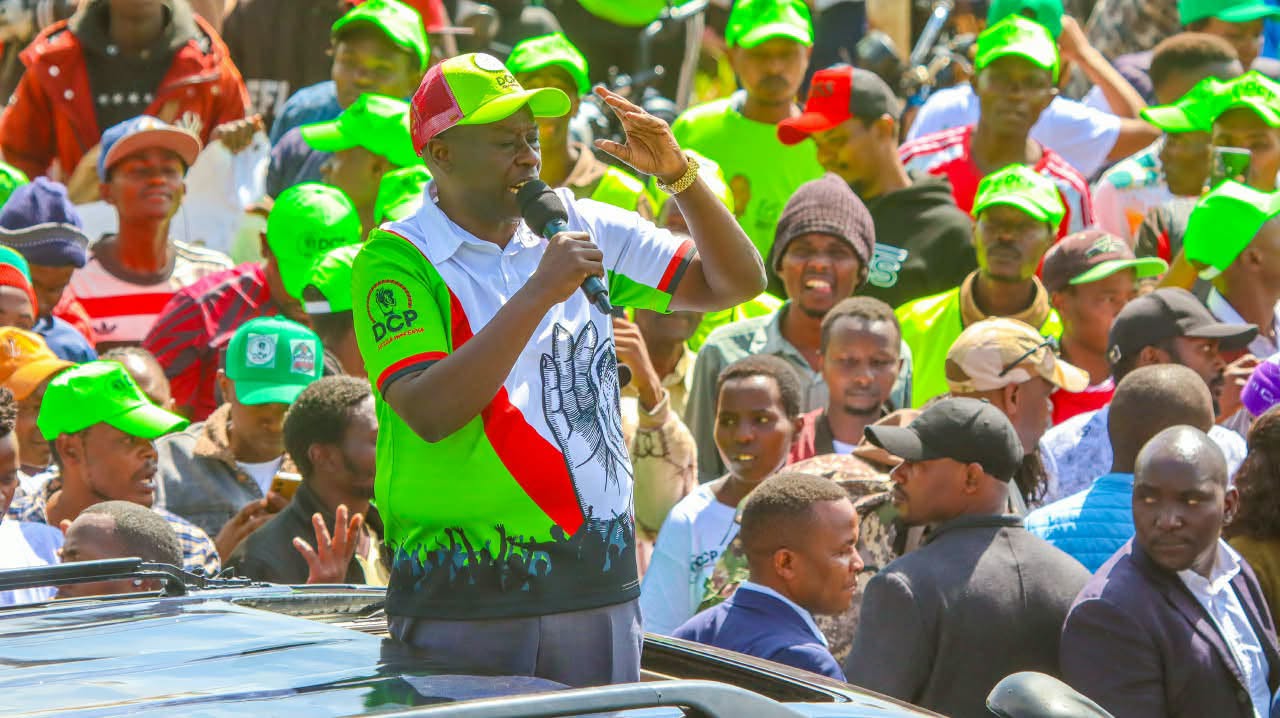
Former Deputy President Rigathi Gachagua
The former deputy president’s vote-count arithmetic on Inooro TV reframes the 2027 presidential race — but the numbers raise as many questions as they answer
By David Kimani
Former Deputy President Rigathi Gachagua yesterday declared that a combined opposition vote of more than seventeen million would defeat President William Ruto in the August 2027 General Election, publicly assigning vote tallies to his allies — ten million from the Mt Kenya bloc he leads, four million from Nairobi Senator Edwin Sifuna, and three million from Wiper Patriotic Front leader Kalonzo Musyoka — and presenting the arithmetic as proof that a united anti-Ruto front would prevail at the ballot.
Gachagua made the declarations during a live appearance on Inooro TV’s Kiririmbi show, a platform he has used repeatedly to speak directly to his Agikuyu, Aembu, and Ameru base on matters of political strategy. The setting was deliberate. By choosing a vernacular television interview rather than a rally podium, he was not merely rallying a crowd — he was laying out a negotiating position, in plain figures, for the consumption of his coalition partners, his rivals, and, crucially, the millions of Mt Kenya voters who will decide whether his ambitions survive contact with the ballot box.
“Our optimal target is about eight million votes, with a turnout of at least seven million. This includes the Agikuyu, Aembu and Ameru communities wherever they are in the world,” Gachagua said during the interview, adding that he expected the region to deliver the decisive margin that would end Ruto’s presidency. The ten million figure he has repeatedly projected is built on a foundation of the 3.5 million votes Mt Kenya cast for Ruto in 2022 — votes that represented nearly half of the President’s total tally of 7.1 million — with the remainder to come from increased voter registration and higher turnout across the region.
The claims are bold, and they arrive at a moment when Kenya’s presidential mathematics are being redrawn almost weekly. In an earlier Inooro TV interview, Gachagua had made the framework even more explicit: “My plan is to go with a headstart of seven million votes, which I have already mobilised. With all that, I am targeting a minimum of ten million votes. I will present my ten million votes and request my counterparts to endorse and add me their votes.” Yesterday’s interview on the same station followed the same logic, with Sifuna and Musyoka now assigned specific numerical contributions — four million and three million respectively — that together with the Mt Kenya bloc would comfortably exceed the 50 per cent plus one threshold required for a first-round victory.
Whether those numbers reflect reality, political aspiration, or a calculated negotiating gambit is the question that will define the coming months. Speaking during a tour of Western Kenya in June, Gachagua had already been publicly assembling his arithmetic: “Back home, I have consolidated seven million votes. In Nairobi, we have consolidated three million votes. We want the Mulembe nation to consolidate five million votes, and then join them with Kalonzo’s three and a half million votes,” he said — a statement that signals his vote-counting exercise has been ongoing for some time, and that Western Kenya is now as central to his electoral strategy as the Mt Kenya heartland.
The challenge for Gachagua is that his conditions for coalition have been explicit, at times almost transactional. He has told Musyoka directly: “We’ve done the math. For you to win the presidency, you must secure fifty plus one. The people of Ukambani must increase their votes to between 3.5 and 4 million. Once you get to that number, look for me.” He has also urged Ukambani leaders to focus on voter registration, saying: “We, in our region, want to have ten million votes. You must get to four million, and if you want us to form the government together, you must ensure that young people register as voters.” By publicly crediting Musyoka with three million in yesterday’s broadcast, Gachagua appears to signal some movement in that negotiation, even if the figure still falls below the threshold he originally set.
Sifuna’s assigned four million is perhaps the most politically significant number in the equation. Gachagua has elsewhere stated that the opposition must put aside personal ambitions and agree on a single candidate based on electoral arithmetic rather than seniority, political history, or individual expectations, and has even said he would be willing to serve as Sifuna’s running mate if the political numbers pointed to the Nairobi senator as the strongest opponent of Ruto. By treating Sifuna as a four-million-vote bloc rather than a junior figure, Gachagua effectively elevates him to a co-equal in coalition negotiations — a move that simultaneously flatters Sifuna, complicates Musyoka’s claim to the top of the ticket, and gives Gachagua maximum flexibility over who he ultimately throws his weight behind.
The opposition is also targeting Gen Z voters, expected to number eight million by 2027, with Musyoka calling for 100,000 young volunteers to guard the vote: “This time, they won’t steal the vote. We need 100,000 incorruptible youths to guard the vote at polling centres.” The IEBC has announced plans to register 5.6 million new voters before the election, and whichever side converts that registration into turnout will gain a decisive advantage.
The electoral terrain against which all of this is being mapped remains demanding. Ruto denied the President more than 3.5 million votes in 2022 when those votes came from Mt Kenya — meaning that Gachagua switching sides does not merely subtract from Ruto’s column, it potentially adds to the opposition’s, a double swing that fundamentally alters the calculus. Polling bears this out: a recent survey shows that while Ruto remains ahead in the individual presidential field, Musyoka, Sifuna, Matiang’i, and Gachagua together command a combined share of the electorate that exceeds his total — the question being whether that combined support can be directed behind a single candidate before polling day.
That question is one Gachagua has not yet answered, and yesterday’s broadcast, for all its numerical confidence, did not resolve it. He has maintained that the opposition must be guided by arithmetic, not sentiment: “If we do our arithmetic and find that Nairobi Senator Edwin Sifuna will send President William Ruto home early, so be it,” a line that tells both allies and rivals everything about how he approaches the final negotiation — pragmatically, with votes as the currency and victory as the only principle.
The numbers Gachagua has put on the board are large, his ambition unmistakable, and the political season ahead brutal in its demands. Whether ten million, four million, and three million can be made to sit at the same table — and vote the same way — is the central drama of Kenya’s road to August 2027. The arithmetic is seductive; the politics, considerably less so.
Similar Posts by The Mt Kenya Times:
- Food security in Kenya: How farming, climate and policy shape the nation’s future
- ‘No’ to predators: Kalonzo draws battle lines for Kenya’s 2027 election
- Critical Review of Pride and Prejudice: Journey from Misunderstanding to Love and Respect
- Attracting a tourist to heritage sites or bringing them back? Amir Timur’s legacy from a tourism geography perspective
- TVS and Car & General open Nyeri motorcycle training hub in KSh4M skills push
About the Author