Accept education sector reforms and become change managers, MKU pro-chancellor tips school heads
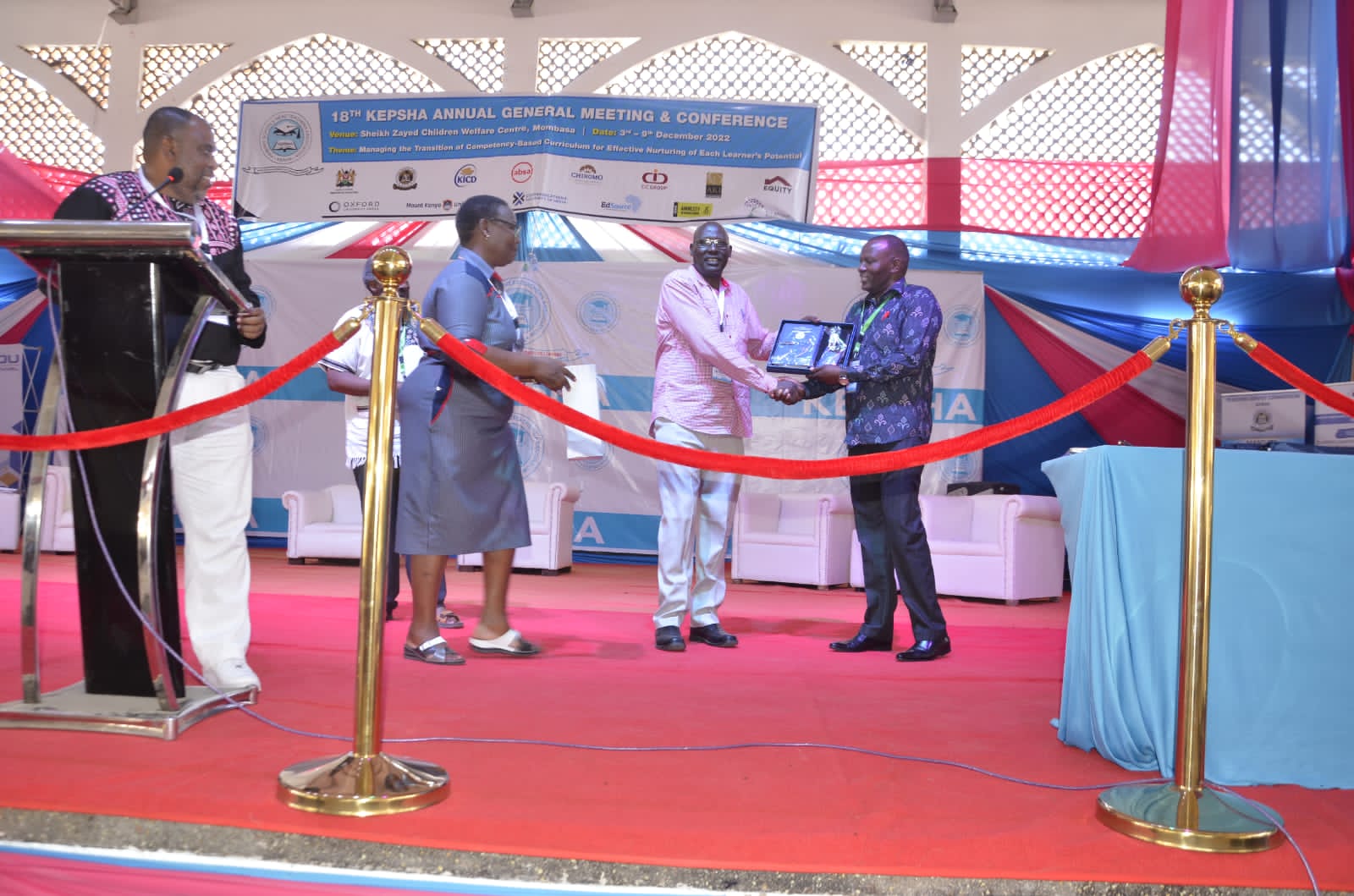
Mr Philip mitei, National Secretary, KEPSHA awarding a token of appreciation to pro-Chancellor, Mount Kenya university, Dr Vincent Gaitho

By James Wakahiu
Worth Noting:
- “While the Kamunge Report (1988) featured mostly on education quality, relevance, and financing, the Koech Report (1999) and advocated for Total Integrated Quality Education and Training (TIQET) to replace the 8-4-4 system. Kamunge recommended the expansion of compulsory basic education from 8 years to 12 years, that no examination be held between primary and secondary, a reduction of subjects at secondary to ease curriculum as well as introduction of a pre-university level to allow student to mature before going to university,” he said.
- Dr Gaitho reminded the head teachers that other countries also periodically review their national education curriculums. “In 2011, “student-centric, values-driven” was introduced by the Ministry of Education as the theme for educational reform and innovation in Singapore. It purposed that all children were ensured the opportunity to develop holistically and maximize their potential.
Primary school head teachers have been advised to embrace new changes brought about the introduction of the Competency-Based Curriculum (CBC) and to agree to spearhead reforms in the education sector from the front and by example.
Mount Kenya University (MKU) Pro-Chancellor, Dr Vincent Gaitho says educational reforms have been made from time to time since independence in Kenya through commissions which are operationalized in the context of the country’s educational perspective.
This comes after President William Ruto last week directed that the Grade 6 Kenya Primary School Education Assessment (KPSEA) examination shall not be used to determine the placement of pupils to Junior Secondary School (JSS). The policy was recommended by the Presidential Working Party on Education Reforms, instituted by Ruto on September 30, 2022 to evaluate the country’s new CBC education system and make recommendations submitted its preliminary report to the head of state.
According to Ruto, KPSEA will instead be used to scrutinize learning progress and provide feedback to education sector players on areas of the Competency-Based Curriculum (CBC) that require intervention. The President further directed that the junior secondary schools – Grade 7, Grade 8 and Grade 9 – be domiciled in the existing primary schools. “The Ministry of Education will provide the necessary guidelines on how this will be done,” a statement issued by State House Spokesperson Hussein Mohamed said.
Speaking at the 18th Kenya Primary Schools Headteachers Association (KEPSHA) annual general meeting and conference at Sheik Zayed Children’s Centre in Mombasa, Dr Gaitho recalled the recommendations of the various commissions on education reforms issued since independence as part of a dynamic education system. “The Ominde Report (1964) was first stablished for colonial education reforms and served to mobilize human resources to achieve national development and unity,” he said. Dr Gaitho, is also the chairman, Education Sector Board of the Kenya Private Sector Alliance (KEPS as well as Secretary General, National Association of Private Universities in Kenya (NAPUK) said that in 1976, the Gachathi Report helped to redefine vocational policies, cultural aspirations, socio-economic, and national unity while the Mackay Report (1981) terminated A-Level education, established 8-4-4 education system, the Commission for Higher Education and Moi University.
“While the Kamunge Report (1988) featured mostly on education quality, relevance, and financing, the Koech Report (1999) and advocated for Total Integrated Quality Education and Training (TIQET) to replace the 8-4-4 system. Kamunge recommended the expansion of compulsory basic education from 8 years to 12 years, that no examination be held between primary and secondary, a reduction of subjects at secondary to ease curriculum as well as introduction of a pre-university level to allow student to mature before going to university,” he said.
Dr Gaitho reminded the head teachers that other countries also periodically review their national education curriculums. “In 2011, “student-centric, values-driven” was introduced by the Ministry of Education as the theme for educational reform and innovation in Singapore. It purposed that all children were ensured the opportunity to develop holistically and maximize their potential. How? Through a new Framework for 21st Century Competencies and Student Outcomes and by instilling in students core values and competencies deemed crucial in the 21st century,” he said.
Dr Gaitho was speaking on the topic, “Reforming the Kenyan Education System to meet local and national needs for inclusive and transformative Education’. The conference, which opened on Monday December 5 with thousands of delegates in attendance, was held under the theme; ‘Managing the Transition of Competency Based Curriculum for Effective Nurturing of Each Learners Potential’.
He took the tutors through the various political party manifestos on education sector spearheaded by ruling parties since the late President Mwai Kibaki took over the government in 2003. However, although the Free Primary Education (FPE) was successfully introduced in in 2003, education outcomes remain highly inequitable.
“Considerable progress has been made towards universal secondary education, but the current tiered system places the better-resourced national schools out of the poor’s reach. The cost of joining a boarding secondary school is expensive for ordinary working Kenyans. Bursaries available are far from adequate,” Dr Gaitho said,
He said distress calls for and heroic acts of determination by bright children, who are unable to take up their places in such high schools, has become the norm. “The girl in Tharaka Nithi County made news by walking 50km to the school she had been admitted to be a good example. In Embu, a boy sought to pay his school fees with a cockerel,” said the lecturer.
Going forward under CBC, Grade 6 Kenya Primary School Education Assessment (KPSEA) examination shall not be used to determine the placement of pupils to Junior Secondary School (JSS) but to scrutinize learning progress and provide feedback to education sector players on areas of the CBC that require intervention. Grade 7, Grade 8 and Grade 9 – be domiciled in the existing primary schools and an extra classroom and a laboratory be built across all primary schools to be used by the Junior Secondary School learners.
“There is need to bring teachers up to speed with the necessary skills that will allow them to begin delivering CBC lessons based on the system’s principles. We need to develop modalities of fast-tracking retooling teachers to ensure the country has sufficient numbers who are compliant with CBC. Priority should be given to those teachers who will be handling Grade 7 learners.” He said.
Quoting from the late South African reggae musician Lucky Dube’s song, War and Crime, the Pro-Chancellor called on all stakeholders to come together and tackle the challenges in education sector. “We do what we do not because we are cowards. Create a legacy and write your own story in a soul and you will be happy and contented,” he told the tutors.
During the conference, primary school heads called on the government to review capitation on primary schools, saying the amount currently in place falls below the requirements to effectively run a school. They now want the capitation reviewed and increased from Sh1, 400 to about Sh7, 500 per child per year. Kenya Primary School Heads Association national chairman Johnson Nzioka said the last review on capitation was done in 2010. “The current capitation per learner in secondary school is Sh22, 244. In a case scenario of running an ideal primary school of 400 pupils, the cost comes to about Sh3 million per annum,” Nzioka said.
Opening the forum, the new Basic Education Principal Secretary Belio Kipsang dropped a bombshell when he announced that the government will from January do away with boarding primary schools for pupils learning in Grades 1 to 9. The net effect of the radical policy means that pupils transiting to Junior Secondary Schools will join day schools in their home areas. The government will from January 2023 do away with boarding primary schools for pupils learning in grades 1 to 9.
The PS was speaking when he officially opened the 18th Kenya Primary Schools Head Association (KEPSHA) annual meeting in Mombasa where primary school heads from all 47 counties have congregated for the five day conference.
Similar Posts by The Mt Kenya Times:
- Mt Kenya Times ePAPER August 28, 2026
- Kenya is losing fifteen mothers a day — and the numbers are getting worse
- Consolata International University opens new academic year with call to humanise artificial intelligence
- Written in gold, wielded in iron: Katiba@16 and the realities of power
- Mang’eni challenges universities to put entrepreneurship at the heart of learning
About the Author