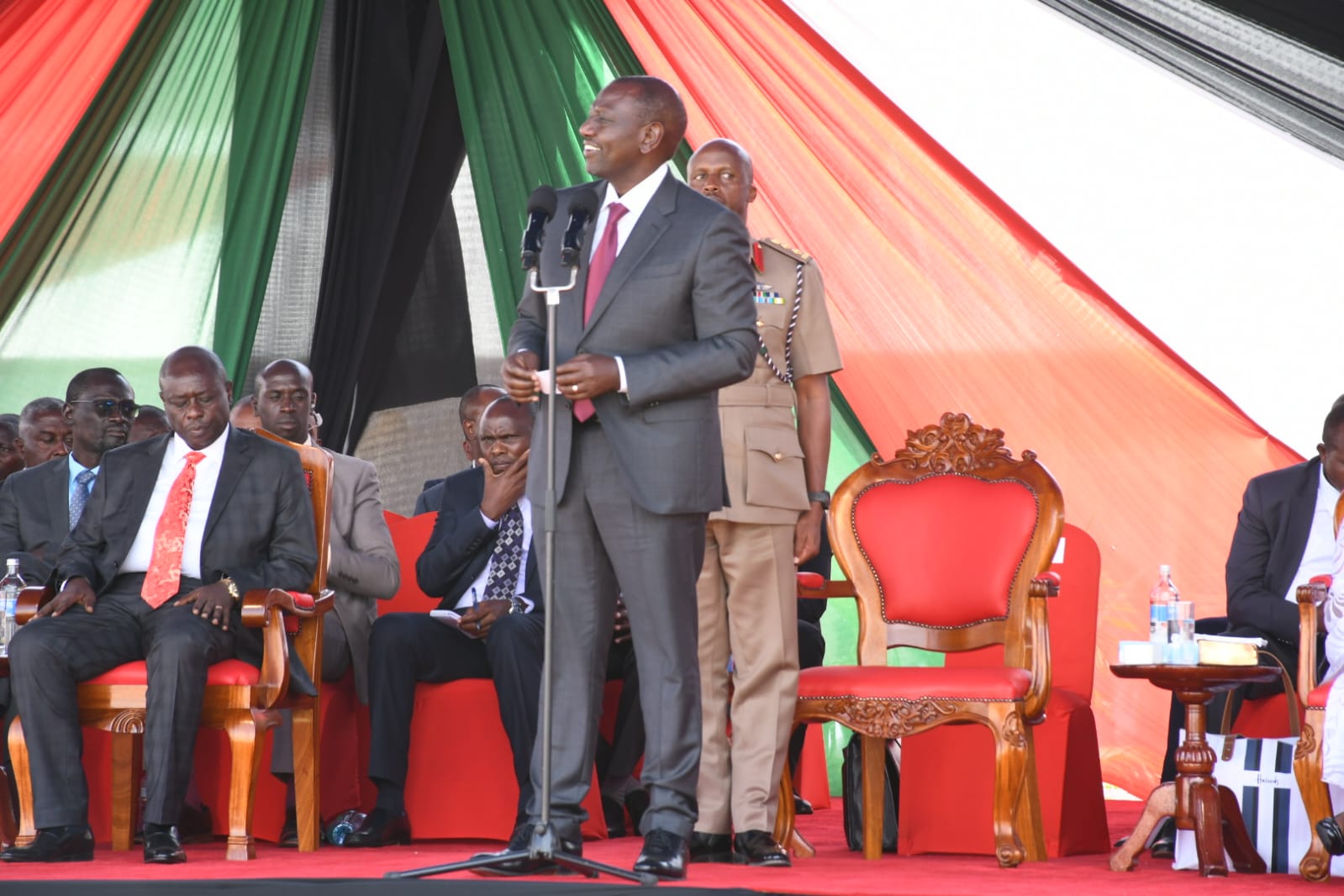
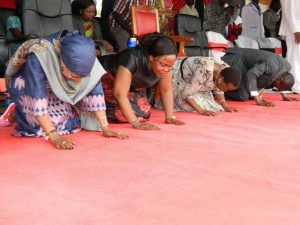
President William Ruto during prayer meeting at Nyayo stadium

By Jerameel Kevins Owuor Odhiambo
Worth Noting:
- It has been noted that the power of prayer in times of crisis cannot be underestimated. One person noted, ‘when we remain quiet and unconcerned, thinking it is the responsibility of the government and politicians, then we are delaying our own breakthrough and economic liberation.
- When Christians keep quiet, the destruction of the land will befall all of us. Someone needs to stand in the gap, intercede and call on the Lord for restoration. A shut mouth is a shut destiny.
- Throughout the Bible, the early prophets and the apostles responded to crises by praying and seeking the face of the Lord for directions. They did not leave the problems to the Kings to solve.
Professor Nouriel Roubini who is an economics scholar based in New York University penned an article titled: ‘Loans and Prayers won’t Solve Economic Crisis.’ In the paper he stated that countries known collectively as the PIIGS-Portugal, Ireland, Italy, Greece and Spain are burdened with increasingly unsustainable levels of public and private debt. As per then Portugal, Ireland and Greece borrowing costs soared to record highs, even after their loss of market access led to bailouts financed by the European Union and the International Monetary Fund.
He proceeds to note: ‘The official approach, Plan A, has been to pretend that these economies suffer a liquidity crunch, not a solvency problem, and that the provision of bailout loans together with fiscal austerity and structural reforms can restore debt sustainability and market access. This extend and pretend or lend and pray approach is bound to fail, because, unfortunately, most of the options that indebted countries have used in the past to extricate themselves from excessive debt are not feasible.’
Welcome to Kenya. What is the state of the nation as of now? The government is experiencing a cash crunch as Kenya continues to live way above her means. The current fiscal deficit is estimated at approximately Sh 862 billion, or 7.5 per cent of the GDP. Although the government plans to slush the 3.3 billion budget by Sh 300 billion as per proposals by the current regime. The rise of the dollar against the Kenyan shilling has increased the cost of foreign debt servicing by over 20%. The majority of Kenyan foreign debt is dominated in the greenback, hence affecting the cost of debt. Likewise, the devaluation of the shilling against the dollar further widens the trade deficit, pushing the inflation rate and cost of living even higher.
The consumer price index is increasing despite the increase in the interest rate by the Central Bank of Kenya to curtail further inflationary increases. Furthermore, the World Bank and the International Monetary Fund have lowered the global GDP projections from 4.1 % in 2022 to 3.2% in 2023. This is partly due to the impact of climate change on the global economy and geopolitical escalations that have affected global supply chains and the productivity of key global food baskets.
The cash crunch is the public sector is likely to affect the welfare of employees in key government entities and agencies and private organizations that provide goods and services to the government. Fiscal consolidation is part of the government’s conduits to address the huge wage bill and meet the austerity recommendations by the International Monetary Fund. The allocation of funds to the counties, semi-autonomous agencies, consolidated funds and state departments as of now is experiencing delays. One economist noted that: ‘the cash crunch, coupled with an expected decline in tax remittance from the anticipated economic downturn, will affect public cash flow and the Kenyan government’s ability to meet her financial obligations. As such, salary delays may be experienced, particularly for government employees.’
The global investment market is more volatile as nations face high inflation rates and economic recession. Financial sector regulators, including the US Fed and the Central bank of Kenya, have introduced monetary policies to help steer through the potential economic risks, including increasing the interest rates. The fiscal policies adopted by the Central Bank of Kenya, including raising the interest rates by 175 basis points seemingly haven’t so far managed to deflate the rising CPI. The impact of other global externalities beyond the control of the Kenyan government, including the rising dollar price and high fuel cost among other geopolitical factors have rendered the Central Bank Monetary measures toothless.
Kenyan shilling since the year has been slumping against the US dollar as it closes yet another key confidence. The weakening trend in the Kenyan shilling is set to continue into 2023, with the United States of America tipped for additional rate hikes.
Kenya’s foreign exchange reserves has dropped to a near ten-year low, further breaching the critical level of four months import cover in the wake of huge foreign debt repayments. Reserves currently stand at Sh 869 billion, equivalent to 3.88 months import cover, which is the lowest since April 4, 2013 according to the latest Central Bank of Kenya data. Kenya’s reserves have been depleting partly because of repayments to bilateral and commercial lenders and the CBK’s intervention to try and slow down the shilling’s depreciation against the US dollar.
The reserves have remained below the four month’s import cover since 26th January dropping by over Sh 66 billion. This has emerged in a period when the country was expected to repay foreign debts estimated at 63 billion, according to the World Bank tracker of public debt. The reserves are used by countries to meet their international financial obligations such as paying foreign debts, influencing monetary policy and supporting the importation of critical goods. The size of the official reserves usually projects an air of confidence and calms investors’ fears in the event they want to move their money out of a country. Kenya has over the years relied on external financing to replenish its reserves but now faces the prospect of having to make debt repayments without sufficient inflows. The government is betting on debt inflows to shore up the reserves with concessional funding from the World Bank and the International Monetary Fund expected to boost the forex cover.
Perfect, you now get the scenario in Kenya. It is expected that much needs to done in order to boost the economy. If that isn’t done soonest definitely the economic turmoil that this country will experience will be damn dire. What has the President of the Republic of Kenya done? He has been calling upon members of the clergy to pray that Kenya raises its revenue collection and offset its debt burden. One wonders if prayers by any way plays the bigger role in debt payment and revenue collection. Dr Ruto sometime back said, ‘Countries like ours raise between 20%-25% of their GDP in terms of revenue but for us, we are 14%. I want you to pray for our nation so that we can move our revenue from 14% to 25% because that is where countries like ours are. I have agreed with our taxmen that as a country we must move our revenue collection to between Ksh 4 and Ksh 5 trillion and I am trusting God for it.’
It has been noted that the power of prayer in times of crisis cannot be underestimated. One person noted, ‘when we remain quiet and unconcerned, thinking it is the responsibility of the government and politicians, then we are delaying our own breakthrough and economic liberation. When Christians keep quiet, the destruction of the land will befall all of us. Someone needs to stand in the gap, intercede and call on the Lord for restoration. A shut mouth is a shut destiny. Throughout the Bible, the early prophets and the apostles responded to crises by praying and seeking the face of the Lord for directions. They did not leave the problems to the Kings to solve. It was a corporate affair. When the voice of Christians is heard in times of crisis, the voice of God too will be heard to bring deliverance to people. Economic crises and troubles in life reveal; 3 types of people: those who sit down unconcerned, the critics who think nothing will work and criticize people and those who pray and take action. The latter are those who have unwavering faith and are ready to hold on to promises of God. When all hope is lost, we need the people of faith to put their faith to work and call on God.’
Despite the sentiments above, calling for prayers day and day out yet little actions is done with those in power is small is a perfect testament of mockery. It reminds of the quotation God helps those who help themselves. This quotation is all about self-initiative and agency. Many have attributed its origin to Benjamin Franklin but the roots of this idea goes all the way back to ancient Greece. Though it has ancient origins, the actual English version of this quote we use today was first penned by Algernon Sydney. With the state of the nation currently, there is work that needs to be done with the government so as to ensure the economy is back on its feet. Prayers alone won’t aid.
Nigerian Vice President, Professor Yemi Osinbajo, at one time urged government officials to be diligent and hardworking declaring that Nigeria’s economy will not grow by fasting and prayer but by the collective effort of all citizens. This message should reach to the man at the helm of government together with his wife and Deputy President as well as his wife. Prayers occupy a vital place in life that is not in doubt. Over prioritizing the same at the expense of doing the real work is a kin to expecting goodies without working for the same. Let this message sink to this government. What the top government leaders are doing is pure over religiosity.
Odhiambo Jerameel Kevins Owuor is a law student at University of Nairobi. He is an ardent commentator on social, contemporary, legal and political issues. He can be reached at kevinsjerameel@gmail.com
Similar Posts by The Mt Kenya Times:
- Mt Kenya Times ePAPER October 24-25, 2026
- Muturi calls on IEBC to keep election technology tender clean and on schedule
- Ruto meets UAE minister in push to deepen trade ties
- Gideon Moi breaks silence on Ruto fallout, cites broken promises
- The doctor who refused to abandon a sick Uganda
About the Author